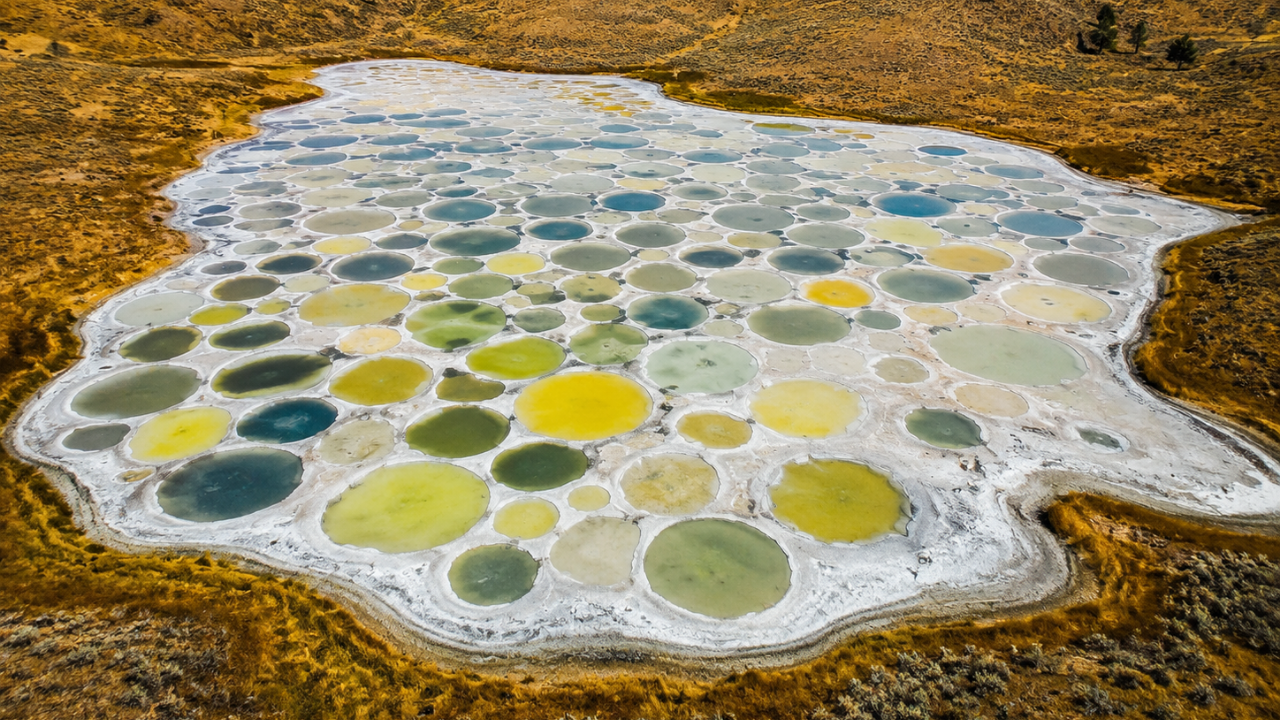
Spotted Lake is one of Canada’s most extraordinary natural wonders, tucked away in a quiet corner of British Columbia’s desert region. From a distance, it looks like an ordinary body of water. But as summer heat sets in, something extraordinary begins to happen: the water starts to vanish, and in its place, hundreds of circular, brightly colored pools appear across the lakebed, transforming the landscape into what looks like a giant, natural polka-dot canvas.
A Lake That Disappears to Reveal Its True Colors
Unlike most lakes, Spotted Lake doesn’t stay full year-round. During the wetter winter and spring months, it looks like a fairly typical, unremarkable body of water. But once the dry Okanagan summer arrives, intense heat causes much of the surface water to evaporate, leaving behind a dense concentration of dissolved minerals that had been suspended throughout the lake.
As the water level keeps dropping, these mineral-rich deposits begin to separate into distinct circular pools, each one surrounded by naturally hardened mineral crusts that form solid pathways between them. What was once a single sheet of water gradually breaks apart into a mosaic of individual “spots,” some small enough to step over, others large enough to walk around for several minutes.
The Chemistry Behind the Colors
So why do the pools turn different shades instead of all evaporating into the same dull residue? The answer lies in the lake’s unusually rich mineral composition. Spotted Lake contains high concentrations of magnesium sulfate, calcium, and sodium sulphates, along with trace amounts of several other elements, including silver and titanium.
As each individual pool evaporates at its own pace, the specific mineral makeup within it determines the color that appears. Some pools take on a pale yellow tone, others shift toward green or blue, and a few develop a milky white crust depending on how concentrated the minerals become. Because evaporation doesn’t happen uniformly across the lake, no two pools change at exactly the same rate, which is why the entire lakebed ends up looking like a living, shifting piece of natural art rather than a single uniform pattern.
Temperature, remaining moisture, and even microscopic organisms living within the brine can further influence the exact shade of each spot, meaning the lake rarely looks identical from one week to the next during peak summer.
A Sacred Site Long Before Science Explained It
While researchers only recently began studying the chemical processes in detail, the Syilx Okanagan Nation has known and respected this lake for generations. Long before it appeared in travel articles or science journals, Kliluk was regarded as a sacred healing site, with each individual pool believed to hold its own distinct therapeutic properties tied to its mineral content.
The lake’s history took a very different turn during the early twentieth century, when its mineral-rich salts were harvested for industrial use. During World War I, workers reportedly skimmed large quantities of magnesium sulfate from the lakebed each day, which was shipped off and used in the manufacturing of ammunition. Some accounts suggest the lake displayed an even wider range of colors before this period of heavy extraction altered its natural mineral balance.
Ownership of the land changed hands several times over the following decades until 2001, when the Okanagan Nation successfully reacquired the site, ensuring it would be protected and preserved as the sacred landmark it had always been to their people.
Why You Can Look, But Can’t Get Too Close
Today, Spotted Lake sits within a protected area along Highway 3, northwest of Osoyoos in the Similkameen Valley. Visitors are welcome to view the phenomenon from a designated roadside lookout, but access beyond the fence line is strictly prohibited.
This isn’t simply about tourism control. The lake’s delicate mineral crusts and shallow brine pools are surprisingly fragile, and foot traffic can permanently damage the patterns that take an entire season to form. Because the site remains culturally sacred, respecting these boundaries is considered essential, both for scientific preservation and out of reverence for its significance to the Okanagan people.
Travelers hoping to catch the lake at its most dramatic should plan a visit during the peak of summer, typically from July through late August, when evaporation is at its strongest and the color contrast between pools is most vivid. Arrive too early in the season, and the lake may still look like an ordinary body of water, with the spotted transformation only beginning to take shape.
A Reminder of How Unusual Nature Can Be
What makes Spotted Lake so compelling isn’t just its striking appearance, but what it represents scientifically. It’s a rare, real-world example of how evaporation, mineral chemistry, and environmental conditions can combine to produce a visual effect that looks almost engineered, yet is entirely the product of natural processes playing out over thousands of years.
Similar hypersaline formations exist in other parts of the world, but few match the vividness and consistency of Kliluk’s pattern. For scientists, it remains a valuable site for studying mineral crystallization and brine chemistry. For visitors, it’s simply one of the most surprising things Canada’s landscape has to offer, proof that some of the planet’s most remarkable sights are hiding in plain sight, waiting for the right season to reveal themselves.