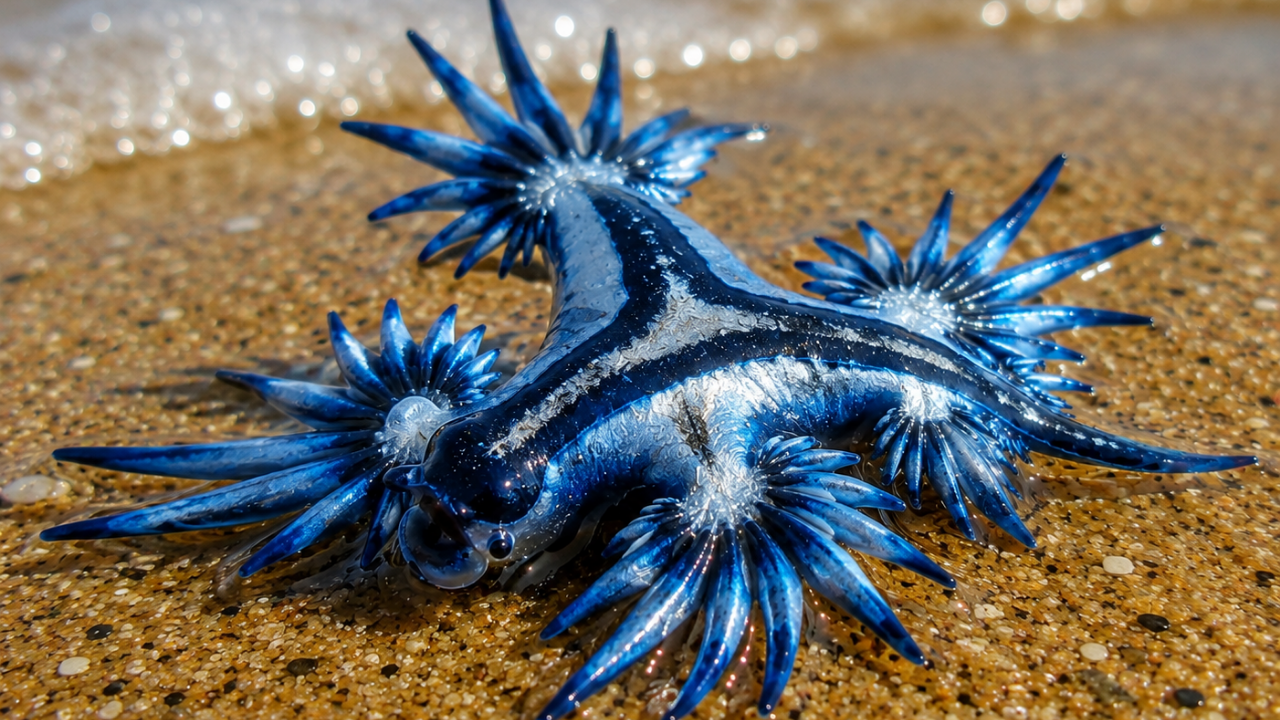
Something strange and strikingly beautiful has been washing ashore along parts of Australia’s coastline – and marine experts are urging beachgoers to look, but never touch. The blue dragon sea slug, scientifically known as Glaucus atlanticus, is one of the ocean’s most visually mesmerizing creatures, yet it carries a sting powerful enough to rival some of the sea’s most feared predators. Despite measuring barely three centimetres in length, this tiny drifter has been making headlines across coastal communities, and for good reason.
What Exactly Is the Blue Dragon Sea Slug?
The blue dragon sea slug belongs to a group of marine molluscs called nudibranchs, though it behaves nothing like the slow-moving, bottom-dwelling slugs most people picture. Instead of crawling along rocks or coral, this creature spends its entire life floating upside-down on the ocean’s surface. A small gas-filled sac in its stomach keeps it buoyant, allowing wind and ocean currents to carry it wherever they please.
Its appearance is what truly sets it apart. The body is patterned in deep blue and silvery-white stripes, with several finger-like appendages branching outward like wings. This design isn’t just for show – it’s a survival tool. When viewed from above, the blue side blends into the deep ocean water, hiding it from hungry seabirds. When seen from below, the pale underside merges with the sunlit surface, disguising it from fish lurking beneath. This clever two-way camouflage is known as countershading, and few creatures use it as effectively as this one does.
Why This Creature Is More Dangerous Than It Looks
Here’s where the story takes a darker turn. The blue dragon sea slug doesn’t produce its own venom. Instead, it hunts and feeds on the Portuguese man o’ war, one of the ocean’s most venomous floating organisms, along with other stinging siphonophores. Rather than being harmed by its prey’s defences, the sea slug absorbs the stinging cells, known as nematocysts, and stores them within specialised structures in its own body.
The result is unsettling: when threatened, the blue dragon can release a sting that is often more potent than that of the very jellyfish it consumed. For humans, accidental contact can cause intense burning pain, swelling, and in some cases, symptoms severe enough to require medical attention. What makes this even riskier is that the danger doesn’t end when the creature dies. Even a lifeless blue dragon lying on the sand can still deliver a painful sting if touched with bare skin, since the stinging cells remain active long after the animal itself has died.
Why Is It Appearing on Beaches Now?
Blue dragon sightings aren’t entirely new to Australia, but recent reports from coastal regions in New South Wales and Queensland have drawn fresh attention. Experts point to a combination of factors: seasonal wind patterns, shifting ocean currents, and rising sea temperatures that appear to be expanding the creature’s typical range. What was once considered a rare encounter is becoming increasingly common along Australia’s eastern coastline, and similar sightings have also been recorded further afield, including waters off South Africa and even the Gulf Coast of the United States.
Because these slugs drift entirely at the mercy of the wind and tides, they often arrive in clusters rather than alone. Marine biologists refer to these groups as “blue fleets,” and their sudden appearance on shorelines is usually a sign that local wind and current conditions have pushed surface-dwelling organisms toward the coast.
What to Do If You Spot One
If you come across a blue dragon sea slug while walking along the beach, the golden rule is simple: admire, don’t touch. Its colours may look almost artificial, like something painted by hand, but that beauty is precisely what makes it easy to mistake for a harmless ornament rather than a living, venomous animal.
Marine safety officials recommend the following precautions:
- Never pick up a blue dragon sea slug, even if it appears dead or motionless
- Keep children and pets away from any unusual blue or silver creatures on the sand
- If accidentally stung, rinse the area with seawater (not fresh water) and seek medical advice if symptoms worsen
- Report unusual sightings to local marine conservation groups, as this data helps researchers track changing ocean patterns
A Tiny Creature With a Big Ecological Story
Beyond the warnings and the striking photographs shared online, the blue dragon sea slug plays a genuinely important role in ocean ecosystems. By feeding on the Portuguese man o’ war and similar organisms, it helps keep populations of these stinging drifters in check. Its very existence is a reminder of how interconnected and delicately balanced marine food webs really are, and how creatures barely the size of a human finger can carry an outsized influence on their environment.
Its name draws from Greek mythology, echoing Glaucus, a sea deity said to guide sailors and creatures of the deep. It’s a fitting origin story for an animal that seems to belong more to legend than to biology, floating silently across open water, unseen until the tide decides otherwise.
Final Thoughts
The blue dragon sea slug is a striking example of nature’s ability to combine beauty and danger in the same small package. As sightings continue to be reported along Australian shores, the message from marine experts remains consistent: observe from a safe distance, resist the urge to touch, and appreciate one of the ocean’s most extraordinary yet overlooked creatures for what it truly is – a tiny predator disguised as a work of art.