
Some historical events are strange enough that if you read them in a novel, you’d assume the author was exaggerating for effect. This is one of those stories – except every detail is documented, verified, and backed by physical evidence that still exists in a museum today.
The Kentucky meat shower explained through modern science tells the story of a single spring morning when the sky, without warning, began raining flesh – and the explanation behind it turned out to be almost as strange as the event itself.
When the Sky Started Snowing Meat
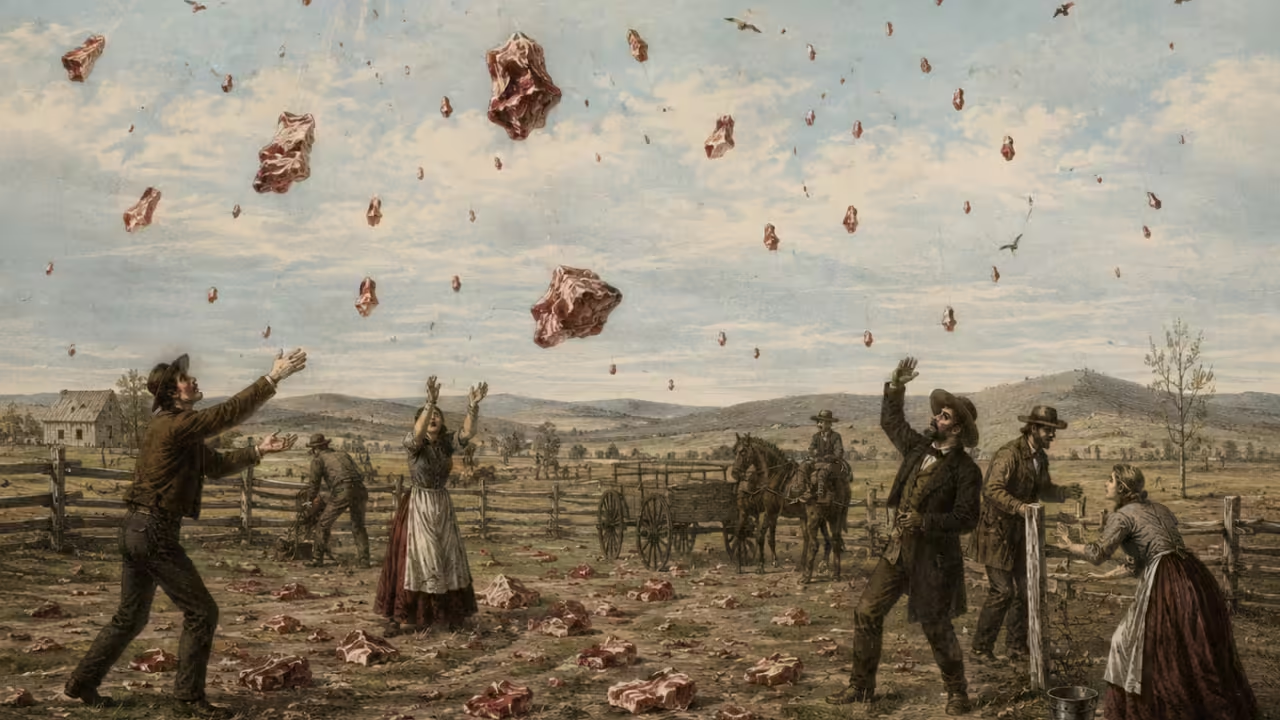
Picture a quiet farm in the hills of Bath County, Kentucky, in the spring of 1876. No storm clouds. No wind warning. Just a normal, clear day, with a farmer’s wife going about her outdoor chores in the yard. Then, without any warning at all, small flat pieces of something began drifting down from the sky around her – landing gently, almost the way snowflakes settle, except these weren’t cold or white. They were red, wet, and unmistakably organic.
Within a few short minutes, an area covering roughly the size of a football field was littered with these strange fragments — some barely the size of a coin, one reportedly stretching nearly four inches across. As quickly as it started, it stopped. No more falling. No explanation. Just a field full of unidentified flesh and a family standing in stunned confusion.
The Neighbors Come Running
Word travels fast in small farming communities, and this was no exception. Within hours, neighbors had gathered at the property to see the strange debris for themselves. Some pieces had landed directly on fence rails. Others were scattered loosely through the grass.
A couple of local men, apparently more curious than cautious, decided to actually sample small pieces of the mysterious material. Their verdict? It reportedly tasted something like mutton, or possibly venison – hardly the reassurance anyone was hoping for, but at least it didn’t taste rotten or foreign.
When Panic Meets Imagination
It’s worth remembering the context here: this was rural America in the 1870s, decades before radio, television, or any scientific consensus on unusual weather phenomena. Naturally, imaginations ran wild. The woman who witnessed the event firsthand later admitted to a fleeting, horrifying thought – that the material might somehow be connected to family members who were away from home that day. Others in the region speculated about signs, omens, or something more otherworldly entirely.
Meanwhile, scientists and journalists further from the scene offered their own theories, some more credible than others. One chemist speculated the material was actually a type of gelatinous algae that forms after heavy rain, somehow scattered by unusual wind patterns. Another publication floated the idea that the debris had come from space – fragments from some cosmic source drifting down through the atmosphere. Neither explanation held up particularly well once actual samples were examined.
Laboratories Get Involved
To settle the growing debate, several samples of the fallen material were carefully preserved in alcohol and shipped off to different research institutions for formal testing.
What came back wasn’t a single, clean answer – it was confusion. Different labs identified different tissue types entirely. Some samples appeared to be lung tissue. Others looked more like muscle. Still others resembled cartilage. One particularly unsettling report even speculated that a fragment might have come from human lung tissue, while a separate analysis suggested horse tissue instead.
Rather than solving the mystery, the lab results only deepened it – because whatever had fallen from that Kentucky sky clearly wasn’t from a single source. It was a mixture.
A Kentucky Doctor Cracks the Case
The explanation that eventually gained the most traction didn’t come from a big-city laboratory – it came from a local physician who approached the mystery with a mix of medical knowledge and basic outdoor observation. His theory: vultures.
Specifically, a flock of vultures flying at high altitude directly above the farm, likely startled by something below, and reacting the way vultures often do when frightened – by vomiting up their stomach contents in a defensive, weight-shedding escape response.
This isn’t some obscure or invented behavior. Vultures across multiple species are known to regurgitate when threatened, partly as a defense mechanism (their stomach acid is famously corrosive) and partly to make a faster getaway by lightening their body weight mid-flight. And critically, the behavior tends to spread through a group – when one bird vomits in alarm, others nearby often follow almost instinctively.
If a large enough flock had been circling above the farm and something spooked them simultaneously, the physician reasoned, the result could easily have been a coordinated release of partially digested meat, scattered by the wind as it fell toward the ground below.
Why the Science Actually Fits
This theory does more than just sound plausible – it actually explains the confusing lab results. Vultures are scavengers, feeding opportunistically on whatever carrion they come across. A single bird’s stomach at any given time could easily contain a mix of tissue from multiple different animals – muscle from one carcass, cartilage from another, organ tissue from something else entirely.
That’s exactly the kind of inconsistency the laboratories reported when they examined the Kentucky samples. What looked like a bizarre, unexplainable mixture of tissue types actually made perfect sense once researchers considered the messy, opportunistic diet of a scavenger bird.
Not Quite a Closed Case
Even with the vulture theory widely accepted today, it’s worth being honest: nobody actually witnessed vultures directly overhead at the moment the shower occurred. The explanation remains the most scientifically sound option available, but it was pieced together after the fact, based on behavior and circumstantial evidence rather than direct observation.
Adding another odd layer to the story, a separate, unusual incident was reported in a nearby Kentucky town just over a week later, involving unidentified reddish particles falling from the sky. Whether the two events were connected in any way has never been confirmed.
Proof That It Actually Happened
Unlike most bizarre historical tales that eventually blur into folklore or urban legend, this particular story comes with something rare: physical evidence. A preserved sample from the original event still exists today, housed in a science museum in Lexington, Kentucky – tangible proof for anyone who wants to see, with their own eyes, that this genuinely happened.
Why We’re Still Talking About It
Nearly a century and a half later, this remains one of the most talked-about oddities in American history, and it’s easy to understand the appeal. It has everything a great mystery needs – credible witnesses, contradictory scientific findings, a strange but logical explanation, and physical proof that keeps the story from ever being dismissed as pure exaggeration.
Final Thoughts
What happened on that quiet Kentucky farm wasn’t a miracle, a hoax, or anything supernatural – it was, in all likelihood, a rare and messy intersection of bird biology and unfortunate timing. The Kentucky meat shower explained through science transforms a story that once sounded like folklore into something far more grounded: proof that nature, on the right day and under the right conditions, can produce moments strange enough to outlast the people who witnessed them by well over a century.