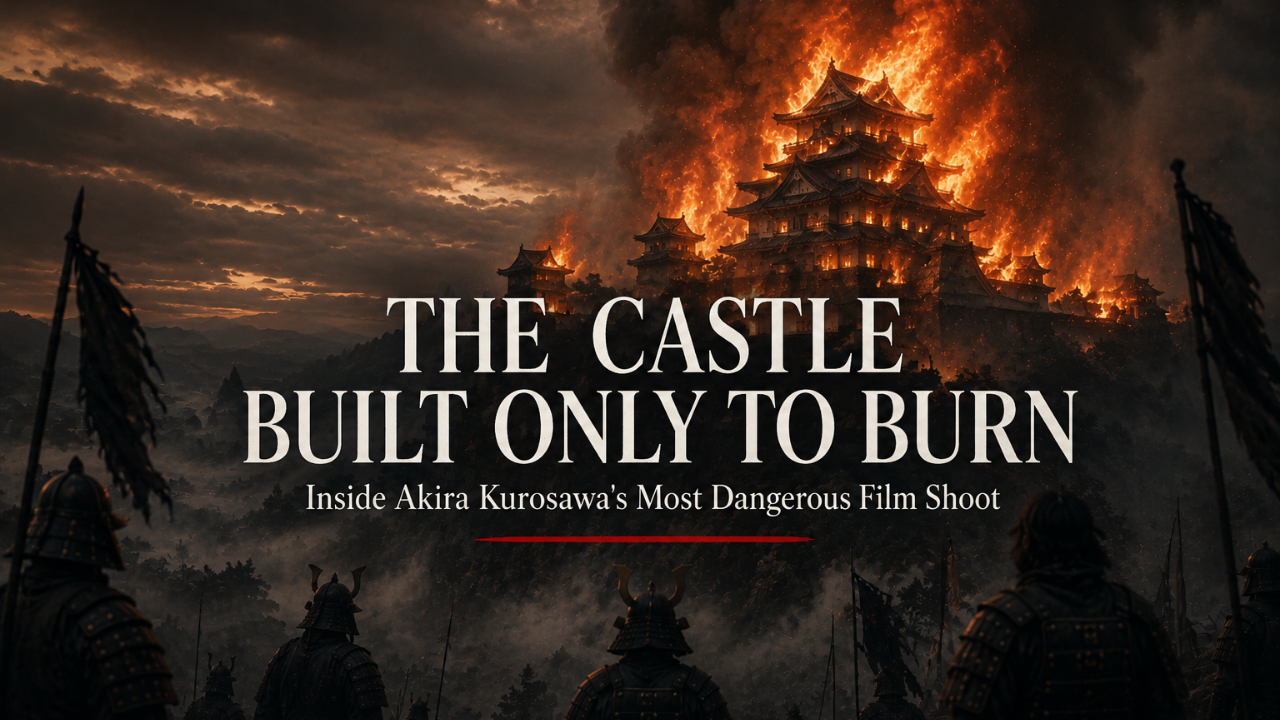
Akira Kurosawa is remembered as one of cinema’s boldest directors – a filmmaker who built a real castle, filled it with real fire, and filmed it burning to the ground with no second chances. This wasn’t a stunt for a blockbuster franchise or a Hollywood spectacle. It happened in Japan, in 1984, on the slopes of Mount Fuji, for a film that would go on to become one of the most acclaimed epics in cinema history: Ran.
A Director Who Refused to Fake It
By the time Kurosawa began working on Ran, he was 75 years old and largely written off by an industry that no longer wanted to fund his ambitions. Japanese studios had grown cautious, preferring safe, formulaic productions over the kind of sweeping, expensive vision Kurosawa was known for. Yet he pushed forward anyway, eventually securing Japanese-French financing that allowed him to build Ran into what became, at the time, the most expensive Japanese film ever made, with a budget reported between $11 and $12 million.
Ran is loosely based on Shakespeare’s King Lear, reimagined as a Sengoku-era tale of an aging warlord who divides his kingdom among his three sons, only to watch the decision unravel into betrayal and destruction. But it was Kurosawa’s obsession with authenticity that turned the production into cinema legend, and nowhere was that obsession more extreme than in the filming of the third castle’s destruction.
Building a Castle Designed to Die
For the film’s most devastating sequence, Kurosawa’s team didn’t rely on models or trick photography. They constructed a genuine, full-scale castle set on the black volcanic slopes near Mount Fuji. The structure’s outer walls stood 21 feet high, with the inner keep towering to roughly 51 feet. Built from wood and styrofoam stones shaped to mimic real castle masonry taken from photographs of authentic structures, the set was then coated in cement four separate times and painted, a process that took months to complete.
None of it was meant to survive the shoot. The keep was packed with lumber and soaked in 400 liters of kerosene, with wire netting rigged around the structure to keep burning debris from raining down on the surrounding walls and cast. To create the ghostly white smoke needed for one character’s descent through the flames, the crew dropped bags of dry ice into containers of heated water.
One Take, No Second Chances
The burning of the castle was filmed on December 15, 1984, with roughly 400 costumed extras split into opposing red and yellow armies, and five cameras rolling simultaneously to capture every angle of the blaze. There was no room for error. Once the fire was lit, there was no rebuilding the set for a retake.
At the center of the chaos was veteran actor Tatsuya Nakadai, playing the doomed warlord Hidetora. Nakadai had to walk down the castle’s burning steps and flee the flames in a single continuous take, with no miniatures, no stunt doubles for the wide shots, and no digital safety net. His elaborate makeup alone took three hours to apply before each day of filming, and the punishing physical demands of the shoot, combined with brutal winter weather, pushed the aging cast and crew to their limits. Thick fog frequently rolled across the mountain, at times reducing visibility to almost nothing and forcing the production to wait for conditions to clear.
A Gamble That Could Have Ended in Disaster
Kurosawa’s method wasn’t simply about spectacle for its own sake. Throughout his career, he had built a reputation for using long, wide shots rather than close-ups, favoring composition that resembled moving paintings over conventional editing tricks. Faking the castle’s destruction with models or forced perspective would have undercut the very visual language that defined his filmmaking. He needed the fire, the smoke, and the collapsing structure to be real, because his camera was built to capture reality at a distance, not manufactured illusion up close.
The financial stakes were enormous. Ran’s budget already exceeded that of Kurosawa’s previous epic, Kagemusha, and a botched or unusable take on the castle sequence would have meant either an astronomical reshoot cost or the loss of the film’s most critical scene entirely. There was no digital backup plan in 1984. If the fire didn’t behave, if the wind shifted wrong, or if a camera failed at the wrong moment, the sequence – and potentially the production itself – could have collapsed along with the set.
It didn’t. The scene was captured successfully, and it remains one of the most staggering practical sequences ever filmed, a moment frequently cited by later filmmakers as a benchmark for large-scale, in-camera spectacle long before computer-generated imagery made such feats far easier to fake.
The Cost of Chasing Perfection
The castle sequence wasn’t an isolated indulgence. Costume designer Emi Wada spent roughly two years working alongside Kurosawa on the film’s 1,400 hand-made costumes and suits of armor, a level of craftsmanship that later earned her an Academy Award. Kurosawa reportedly even considered, at one particularly tense point in production, abandoning a traditional musical score altogether in favor of sound effects alone, before eventually working with longtime composer Tôru Takemitsu on Ran’s haunting orchestral score.
Every element of the production reflected the same underlying philosophy: nothing was allowed to look artificial if there was any way to make it real. That philosophy nearly broke the production financially and physically, but it also produced some of the most visually powerful sequences in film history, images that still feel startlingly immediate decades later, precisely because audiences are watching something that actually happened in front of the camera.
A Legacy Built From Real Fire
When Ran premiered at the Tokyo International Film Festival in May 1985, it marked something of a comeback for a director many had assumed was past his prime. The film went on to be widely regarded as one of Kurosawa’s finest achievements, and the castle-burning sequence in particular has endured as a touchstone for filmmakers who still believe practical spectacle carries a weight that digital effects struggle to replicate.
It’s a reminder of just how far filmmakers once had to go to make audiences believe what they were seeing, not through pixels and rendering software, but through wood, kerosene, careful engineering, and an extraordinary amount of nerve. Kurosawa built a castle knowing its entire purpose was to be destroyed, and in doing so, created one of cinema’s most unforgettable moments of controlled destruction.