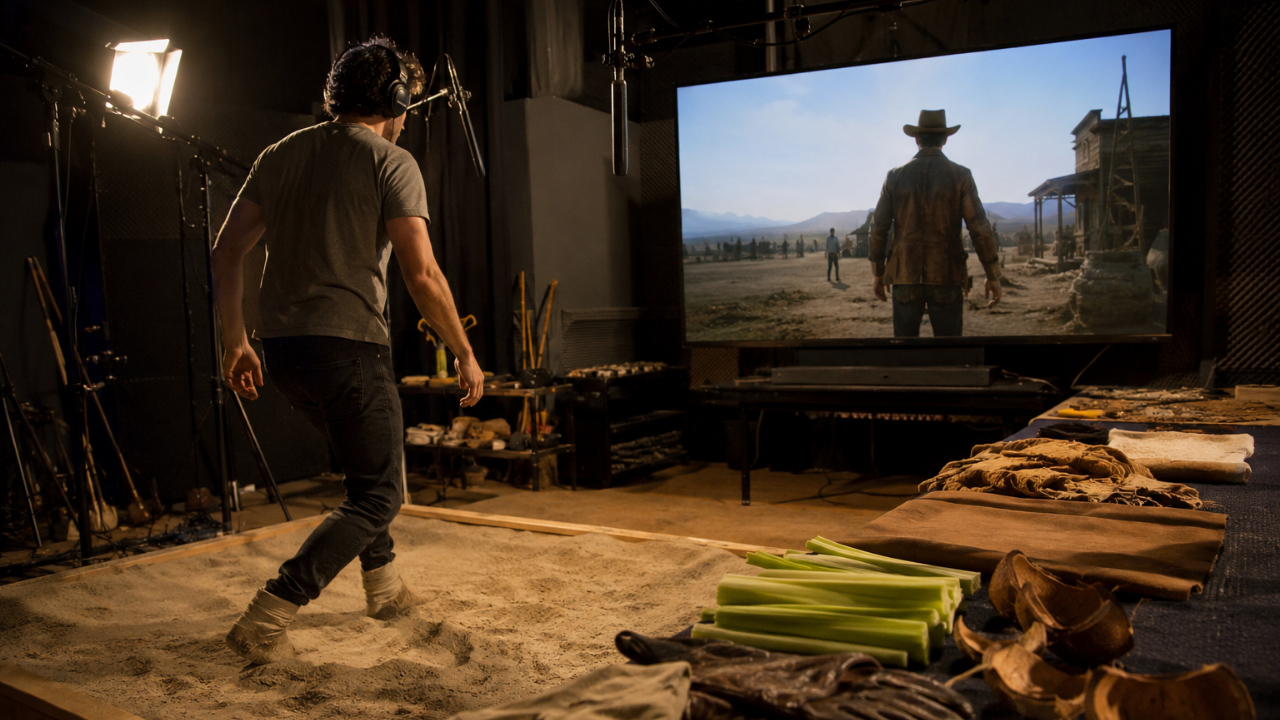
Somewhere inside a padded studio, far removed from any film set, a person is standing in a sandbox, twisting a leather wallet, and violently snapping a stalk of celery, all while staring intently at a movie screen. None of what they’re doing looks remotely like what’s happening on screen. And yet, once mixed into the final soundtrack, it becomes the exact footsteps, bone-cracking violence, and body impact the audience believes they’re hearing directly from the actors. This is Foley sound design, one of filmmaking’s strangest and most essential crafts, and almost nothing about it works the way most moviegoers assume.
The Man Who Gave the Craft Its Name
The technique takes its name from Jack Donovan Foley, a sound technician working at Universal Studios who pioneered the method in the late 1920s, right as Hollywood was making its chaotic transition from silent films into “talkies.” Before Foley’s work, filmmakers had no reliable system for recreating the countless small, physical sounds, footsteps, doors, clothing, that microphones on set simply couldn’t capture cleanly during filming.
Foley spent close to three decades perfecting the craft, working on productions including Dracula in 1931 and Spartacus in 1960, recording the ordinary textures of human movement, chewing, knocking, walking, and turning them into something reliable enough to build an entire industry practice around. Somewhat remarkably, Foley himself never received formal on-screen credit for the work during his career, despite the entire profession eventually being named after him.
Why Filmmakers Even Need to Fake Sounds That Already Happened
It’s a reasonable question: if an actor’s footsteps genuinely happened during filming, why recreate them from scratch afterward? The answer comes down to how film production audio actually works. On-set microphones are aimed almost exclusively at capturing clean dialogue, positioned and calibrated specifically for actors’ voices. Every other sound happening in that same physical space, footsteps on gravel, a jacket rustling, a glass being set down on a table, either gets picked up too poorly to use or doesn’t get captured at all.
A Foley artist’s job is to recreate all of that missing texture from scratch, performing each physical action in perfect synchronization with the picture, frame by frame, on a dedicated recording stage built specifically for this purpose.
The Object on Screen Is Almost Never the Object Making the Sound
Here’s the detail that surprises most people once they learn how Foley actually works: artists very rarely use the literal object appearing on screen to create its sound. Instead, they search for whatever prop produces the most convincing result, regardless of how unrelated it might seem.
The most famous example involves something most people have in their refrigerator. Celery stalks, snapped sharply near a microphone, have become the industry’s go-to technique for simulating breaking bones, used in productions ranging from The Big Lebowski to countless action and horror films since. Horse hooves rely on an equally unlikely substitute: two halved coconut shells, clapped together in rhythm against different surfaces, a trick old enough that it actually predates cinema itself, having originated in radio and stage productions.
Fistfights and body blows are frequently created using raw meat, thick phone books, or a boxing glove pressed against a leather jacket, sometimes paired with a piece of chamois leather specifically to add a wet, fleshy quality to the impact. Falling snow becomes the sound of cornstarch squeezed rhythmically inside a sealed bag. Fire crackling is often nothing more than stiff cellophane or plastic wrapping, crumpled precisely in sync with visible flames on screen.
The Exorcist’s Most Disturbing Sound Wasn’t What You Think
Few examples capture Foley’s strange genius better than one of horror cinema’s most infamous scenes. In The Exorcist, the unsettling sound of the possessed girl’s head twisting a full 360 degrees wasn’t generated through any special mechanical or vocal effect at all. It was created using an old leather wallet, held directly up to a microphone and twisted with several credit cards still tucked inside it, reportedly borrowed on the spot from a member of the sound crew.
Animated films rely on the same fundamentally human-driven process, despite having no literal on-set sound to replace. For WALL-E, the sound designers needed to invent an entirely convincing sense of physical weight and mechanical presence for a character that doesn’t actually exist. Their solution involved wrapping a tree stump in leather and dropping it onto different surfaces, producing exactly the kind of grounded, tactile thud a small robot’s movements needed to feel genuinely physical rather than digitally hollow.
A Craft Built Entirely Around Belief, Not Accuracy
What ties all of these techniques together is a single guiding principle that runs counter to what most people assume about sound design: the goal was never accuracy to the real object. The goal is belief. A snapping celery stalk doesn’t sound anything like an actual human bone breaking in a literal, physical sense. What it does produce is a sharp, visceral crack that audiences instinctively associate with that kind of violence, precisely because it’s been engineered and performed to feel emotionally and sonically “right” in the context of the scene.
This distinction explains why Foley artists function less like technicians replaying recordings and more like performers in their own right, sometimes nicknamed “Foley walkers” specifically because so much of the job involves physically walking in perfect sync with a character on screen, adjusting gait, footwear texture, and surface to match not just the physical action, but the emotional tone of that specific moment.
Why This Handcrafted Process Still Survives in the Digital Age
Despite decades of technological advancement and enormous digital sound effect libraries now available to every production, the fundamentally handcrafted, performance-based nature of Foley has never been fully replaced. Big-budget productions frequently layer ten or more separate Foley tracks into a single scene, footsteps, fabric movement, weapon handling, environmental texture, each recorded and mixed independently for precise creative control.
The reason this old-fashioned, almost theatrical process persists comes down to something digital libraries still struggle to replicate perfectly: the subtle, human timing and texture of a live performance, synchronized in real time to picture, adjusting instinctively to the specific emotional weight of a single frame in a way that a pre-recorded sound file, however technically clean, still can’t quite match.