
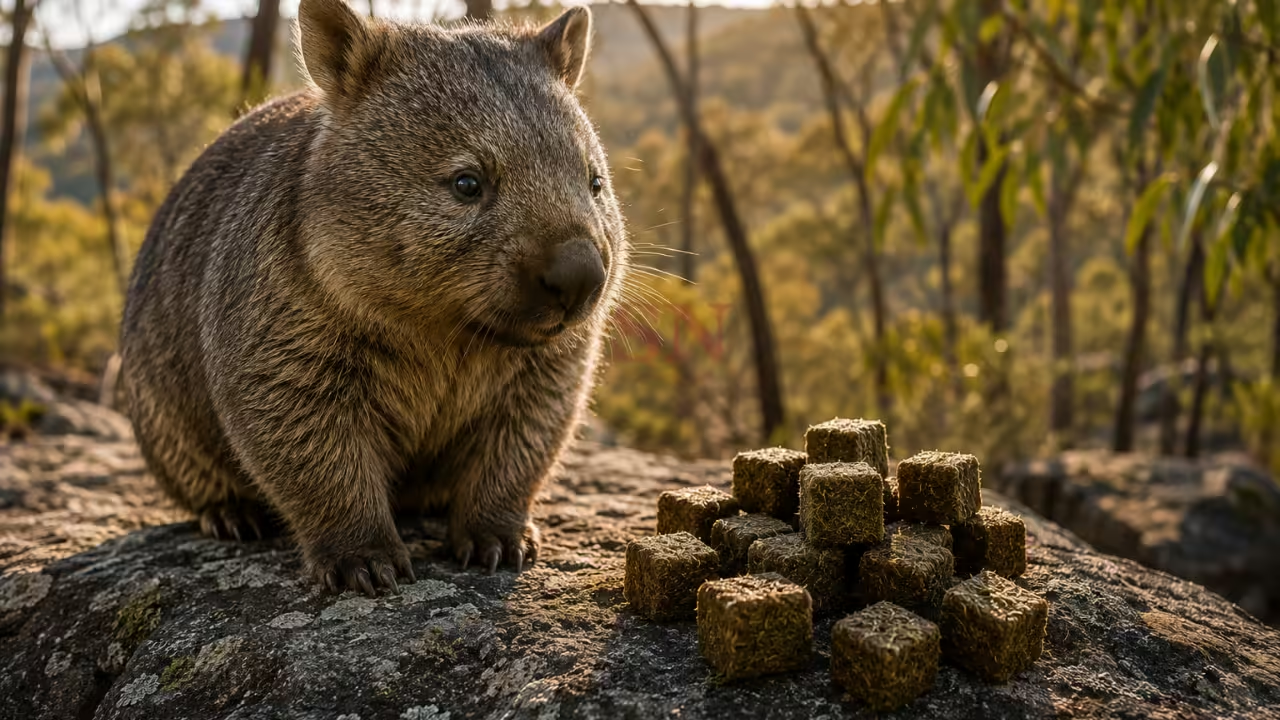
Wombat square poop is one of the strangest mysteries in the animal kingdom – and scientists have finally figured out how it happens. Somewhere in the dense forests and dry plains of Australia, a chubby, waddling marsupial has been quietly pulling off one of the strangest biological tricks in nature – and for decades, nobody could explain how.
The wombat, a slow-moving, burrow-digging creature best known for its round body and grumpy expression, produces something no other animal on Earth does: perfectly cube-shaped poop. Not oval. Not round. Not lumpy. Actual cubes, with sharp, defined edges, almost like tiny dice scattered across the forest floor.
For years, scientists dismissed it as an internet myth or an exaggerated bit of Australian folklore. But it’s real – and now, after extensive research, biologists have finally uncovered the shocking mechanism behind it.
Why Would an Animal Even Need Square Poop?
Before diving into the science, it’s worth asking the obvious question: why does this even matter? Why would evolution bother designing a digestive system capable of producing cubes?
The answer lies in how wombats communicate. Unlike most animals that rely on scent trails, wombats use their droppings as territorial markers – and they place them in very specific, elevated spots: on top of rocks, logs, and raised ground.
Here’s the catch: round poop rolls off these surfaces. It doesn’t stay put. A wombat’s message to other wombats – “this is my territory” — would literally roll away and disappear.
Cube-shaped poop, on the other hand, stays exactly where it’s placed. It doesn’t roll, doesn’t shift, and stands out clearly against natural backgrounds. In other words, wombats accidentally evolved the perfect shape for leaving a message that actually stays visible.
The Scientific Breakthrough Nobody Expected
For a long time, researchers assumed the cube shape was formed by a specialized exit point — perhaps a square-shaped opening in the wombat’s body. It sounds logical, but it turned out to be completely wrong.
A team of scientists, including engineers from Georgia Tech and biologists studying wombat digestive tracts, decided to investigate the mystery properly. They examined the intestines of wombats and discovered something nobody had predicted.
The cube shape isn’t formed at the exit. It’s formed much earlier — deep inside the wombat’s intestines, through an incredibly unusual digestive process.
Here’s what they found:
- A wombat’s intestines are unusually long — around 10 meters, which is extreme for an animal of its size.
- Food takes an incredibly long time to pass through, sometimes up to 18 days, allowing maximum water and nutrient absorption.
- Along the intestinal walls, researchers found regions of varying elasticity — some sections stretch easily, while others are firm and rigid.
- As waste moves through these alternating soft and stiff sections, it gets molded into flat-sided, cube-like segments, almost like dough being pressed into a mold.
In simple terms: the wombat’s gut acts like a natural shaping machine, squeezing and folding waste into cube form long before it ever leaves the body.
Why This Discovery Matters Beyond Biology
What makes this story even more fascinating is that it didn’t just excite biologists — it caught the attention of engineers too.
Understanding how a soft, flexible material like intestinal tissue can shape something into sharp-edged cubes has real-world applications. Researchers believe this mechanism could inspire new manufacturing techniques — particularly in industries that struggle to mold soft materials into precise shapes without using hard molds or cutting tools.
In other words, a wombat’s digestive system may end up teaching engineers how to build better manufacturing processes. It’s a rare example of nature accidentally solving an industrial design problem millions of years before humans even needed the answer.
A Mystery That Puzzled Scientists for Decades
It might sound surprising that something this strange took so long to explain, but wombats are notoriously difficult to study. They’re shy, nocturnal, and spend most of their lives underground in burrows that can stretch tens of meters long.
Early theories ranged from the plausible to the outright bizarre:
- Some believed it was caused by muscle contractions near the exit.
- Others speculated it had something to do with diet and dehydration.
- A few researchers even joked that wombats might have square-shaped intestines altogether.
None of these theories held up under real scientific examination — until researchers finally dissected the digestive tract and watched the shaping process happen in real time.
The Bigger Lesson Hidden in a Weird Fact
At first glance, this might seem like nothing more than a quirky animal fact — the kind of trivia you’d bring up to make someone laugh. But it’s also a reminder of something much bigger: nature often has far more sophisticated engineering than we give it credit for.
A wombat didn’t need blueprints, tools, or conscious design to solve a communication problem. Evolution shaped its body, over thousands of generations, to produce the exact solution needed — a marker that stays put, delivers a message, and survives wind, rain, and time.
It’s easy to underestimate an animal known mostly for being round, sleepy, and slow. But beneath that soft exterior is one of the most surprising biological engineering feats in the animal kingdom.
Final Thoughts
The wombat’s square poop is no longer just an internet joke or a strange rumor – it’s a scientifically confirmed marvel of evolution, shaped by one of the most unusual digestive systems in the natural world. From territorial communication to potential industrial applications, this discovery proves that sometimes, the strangest facts in nature hide the most important lessons.
So the next time someone tells you an animal fact seems “too weird to be true,” remember: in Australia, even wombat poop has a scientific explanation.