
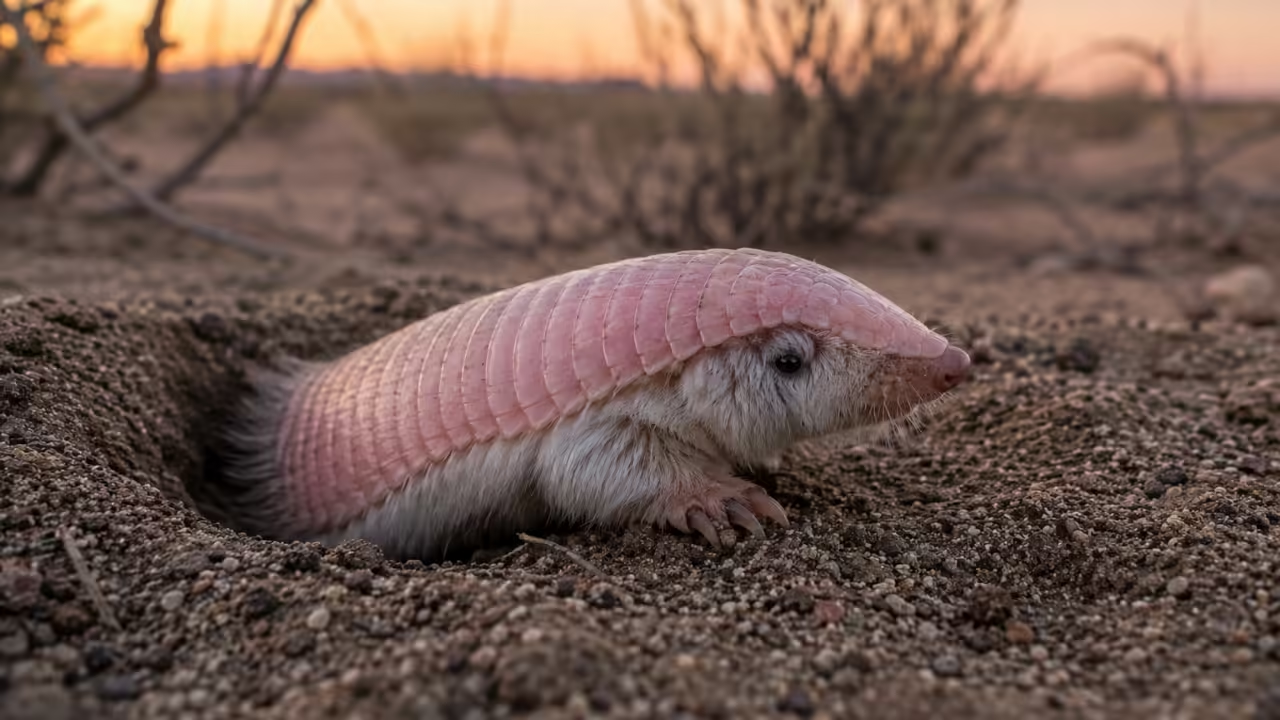
Somewhere beneath the dry, sandy plains of central Argentina lives a creature so small, so secretive, and so rarely seen that many scientists have spent their entire careers without ever spotting one in the wild. It’s called the pink fairy armadillo – and despite its almost cartoonish name, it might be one of the strangest, least understood mammals on the planet.
Weighing barely more than a deck of playing cards and measuring just 10 to 12 centimeters in length, this tiny armadillo looks like something pulled from a fantasy story. Its body is covered in a soft, silky white fur, while a delicate, rose-pink shell – made of tiny bony plates – runs across its back like an armored blanket. It’s an animal that seems almost too unusual to be real.
The World’s Smallest, Strangest Armadillo
There are around 20 known species of armadillo across the Americas, but none come close to matching the pink fairy armadillo in terms of sheer mystery. It is officially the smallest armadillo species on Earth, and unlike its larger, more famous relatives, it spends almost its entire life hidden underground.
Its body is perfectly built for a life beneath the sand. Large, shovel-like front claws allow it to dig through loose soil with incredible speed – witnesses who have seen one in action describe it as appearing to “swim” through sand, disappearing beneath the surface in mere seconds when startled.
Even its unusual pink shell serves a biological purpose beyond appearance. Scientists believe the pink coloring comes from blood vessels close to the surface of the shell, which may help the animal regulate its body temperature in the extreme heat of its desert habitat – essentially acting as a built-in cooling system.
Why Scientists Know So Little About It
For an animal this unique, you’d expect decades of detailed scientific research. Instead, the opposite is true. The pink fairy armadillo is considered one of the least-studied mammals in the world. It’s not officially classified as endangered simply because there isn’t enough population data to make an accurate assessment – researchers don’t know how many exist, where exactly they live in the highest concentrations, or even basic details about their reproductive habits.
There are a few major reasons for this knowledge gap:
- They rarely surface. These animals spend nearly all their time underground, only briefly appearing above ground at night.
- They live in a narrow, remote habitat. Their range is limited almost entirely to the sandy plains and dunes of central Argentina, an area that isn’t heavily monitored by researchers.
- They don’t survive well in captivity. Attempts to study them in controlled environments have largely failed – captive pink fairy armadillos often stop eating and rarely live long, making sustained research extremely difficult.
- Their burrowing lifestyle makes tracking nearly impossible. Unlike larger animals that can be tagged and monitored via GPS, tracking a creature this small and fast-digging is a logistical nightmare.
This combination of factors has turned the pink fairy armadillo into something of a ghost species – scientifically documented, but practically invisible.
A Creature Built Entirely for the Underground
Everything about this animal’s biology reflects a life adapted almost exclusively to living beneath the surface. Its eyes are extremely small, since eyesight matters little in a world of darkness and soil. Its hearing and sense of touch, however, are highly developed, allowing it to detect vibrations and movement in the ground around it – a critical survival skill for avoiding predators it can’t see coming.
Its diet consists mainly of insects, larvae, worms, and roots, all of which it finds by burrowing through soil rather than searching above ground. In many ways, its entire existence unfolds in a hidden world most humans will never witness.
Why This Rare Animal Matters
It’s easy to overlook a species this small and rarely seen, but the pink fairy armadillo represents something important: a reminder of how much of the natural world remains unexplored, even in the modern era.
While technology allows us to map oceans, track migrations, and monitor wildlife populations with satellites, there are still creatures living quietly beneath our feet that resist observation entirely. The pink fairy armadillo isn’t hiding in some remote, unreachable location – it exists in inhabited regions of Argentina – yet it remains one of the most mysterious mammals alive simply because of how effectively it avoids being seen.
Conservationists have raised concerns that habitat destruction, agricultural expansion, and the introduction of predators like domestic dogs could be silently reducing their population – without anyone fully realizing the scale of the impact, precisely because there’s so little baseline data to compare against.
A Species We’re Still Racing to Understand
The story of the pink fairy armadillo isn’t one of a dramatic scientific discovery or a viral rescue — it’s quieter than that. It’s the story of a species that has existed for millions of years, adapting perfectly to a hidden underground life, largely unnoticed by the world above. In a time when so much of nature has been mapped, studied, and categorized, this tiny pink-shelled creature stands out as a rare exception – proof that mystery still exists in the natural world, sometimes just a few inches beneath the ground we walk on.
Final Thoughts
The pink fairy armadillo may be small, rarely seen, and largely misunderstood, but it represents something much bigger: a living reminder that Earth still holds secrets, even in places we assume we’ve already explored. As habitat loss continues to threaten fragile ecosystems worldwide, creatures like this one highlight exactly why undocumented species deserve far more attention before it’s too late to learn what we don’t yet know.