
A Canadian teen lost iPhone story is going viral for all the right reasons – a tale involving a raging river, a flipped raft, and a coincidence so strange that even the people involved struggled to believe it.
It started as an ordinary summer adventure. Sixteen-year-old Hunter Hoffman was rafting on the Coquitlam River in British Columbia with his family, enjoying the kind of carefree day that turns into a core memory. But within seconds, everything changed. The raft flipped.
Hoffman and his family members were thrown into the churning water. No one was seriously hurt – but in the chaos, something small and seemingly insignificant slipped out of his pocket forever: his iPhone. “When the raft flipped, my phone fell out. I went downriver,” Hoffman later recalled.
A Phone Lost to the Current
For most people, that would be the end of the story. A phone lost in a fast-moving river is, realistically, gone. Rivers don’t return what they take – they carry belongings for miles, burying them under rocks, silt, and debris, or sweeping them out toward the ocean entirely.
Hoffman assumed the same. He got a new phone, moved on with his summer, and the incident became just another “remember that time” story his family would bring up occasionally. But nature had other plans.
Eight Months Later, Hundreds of Kilometers Away
Months passed. Summer turned into fall, fall into winter, and winter eventually gave way to spring. Meanwhile, on a quiet beach on Mayne Island – a small island in the Gulf Islands of British Columbia – a local resident named Patti Bachus was taking her usual walk along the shoreline. That’s when something caught her eye.
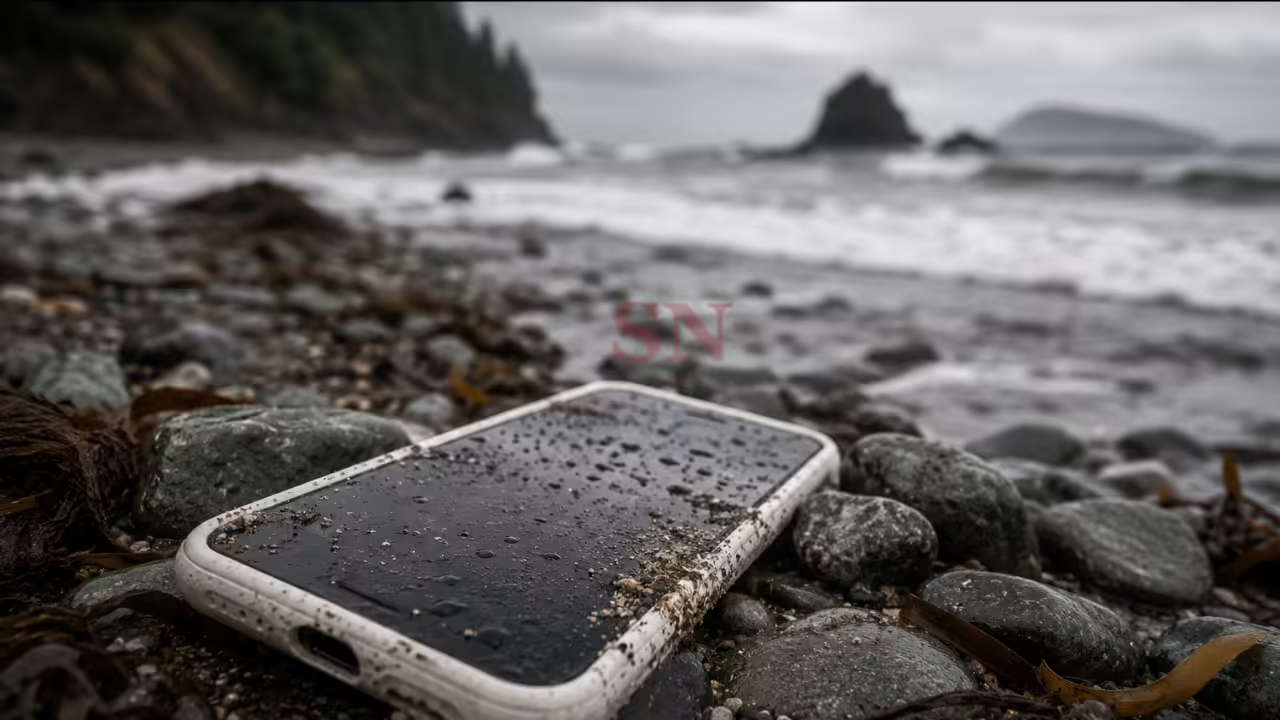
“I came across a white plastic thing that I picked up, and it was fairly heavy. I looked at it and realized it was a phone case,” she said. At first glance, it looked like ordinary beach debris – the kind of thing that washes ashore and gets tossed without a second thought. But something told her to look closer. Inside the case was a phone. And astonishingly, it still had enough battery life – or was dry enough internally – to be identified.
The Journey Nobody Could Explain
Here’s where the story becomes almost impossible to believe: Mayne Island is nowhere near the Coquitlam River. The two locations are separated by open water, currents, and a route that would require the phone to travel through river systems, into the strait, and across ocean currents before washing up on a completely different piece of land, months later.
There’s no clean explanation for exactly how the phone made that journey. It likely drifted through the river into open water, got caught in tidal currents, and slowly, silently made its way across the region – surviving submersion, saltwater exposure, and months of being tossed around by nature, all while somehow staying intact enough to be identified later. It’s the kind of coincidence that feels scripted – except it wasn’t.
Reuniting a Family With a Piece of Their Past
Once Bachus realized what she’d found, she didn’t just toss it aside. She took the extra step of trying to track down the owner, eventually connecting the pieces back to the Hoffman family in Vancouver.
For Hunter Hoffman and his family, the moment they learned the phone had been found was a mix of disbelief and nostalgia. It wasn’t just a piece of technology – it was a small time capsule from a day they remembered vividly: the rafting trip, the flip, the chaos, and now, unexpectedly, a strange and heartwarming ending to that memory.
Why This Story Captivated People
Stories like this spread quickly, and it’s not hard to understand why. There’s something deeply satisfying about lost things finding their way back – especially against odds that seem almost impossible.
A few reasons this story resonates so strongly:
- The distance involved – traveling from a river to a completely different island isn’t a short trip; it defies simple explanation.
- The time gap – eight months is long enough that most people would have completely given up hope.
- The human element – a stranger who could have ignored a “piece of plastic” instead took the time to investigate and reconnect it with its owner.
- The randomness of nature – currents, tides, and geography rarely cooperate this perfectly, making the outcome feel almost fated.
A Reminder of How Small the World Can Feel
Beyond the surprise factor, this story taps into something bigger – the idea that even in a world full of chaos, connection, and coincidence still exist. A raft flips on a river. A phone disappears into the current. Months pass. Life moves on. And then, on a quiet beach, a stranger picks up something ordinary-looking and decides to care enough to find out where it came from.
It’s a small story in the grand scheme of things, but it carries a bigger lesson: sometimes the things we assume are lost forever aren’t gone – they’re just on a longer journey than we expected.
Final Thoughts
Hunter Hoffman’s lost iPhone didn’t just survive months underwater and an improbable journey across open water – it became a story about human kindness, coincidence, and the strange, quiet ways the world sometimes puts things back where they belong.For a generation that treats phones as practically irreplaceable extensions of daily life, this story is a reminder: sometimes, what feels permanently lost has a way of finding its way home.