
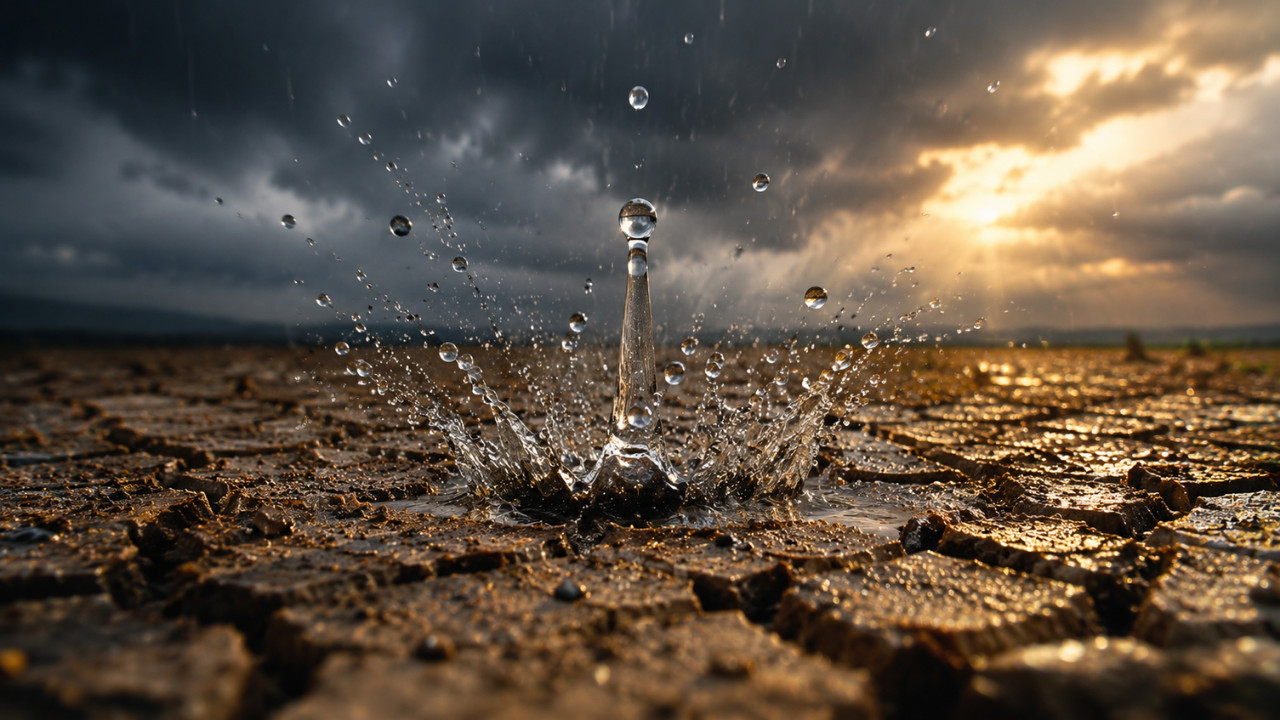
There’s a specific, unmistakable scent that arrives just before or right as the first drops of a storm hit dry ground, earthy, faintly sweet, almost impossible to describe accurately but instantly recognizable to nearly everyone. Scientists gave this smell a name in 1964: petrichor. What makes it genuinely fascinating isn’t just the scent itself, but the precise, almost engineered chemical process required to produce it, one involving soil bacteria, plant defense chemicals, atmospheric electricity, and a burst of microscopic bubbles happening inside every single raindrop.
A Word Borrowed From Mythology
The term itself comes from Australian researchers Isabel Joy Bear and Richard G. Thomas, who coined it in a 1964 paper published in the journal Nature. They built the word from two pieces of Greek: petra, meaning stone, and ichor, the mythical fluid said to flow through the veins of the gods instead of blood. Before their paper gave the phenomenon a proper name, scientists had simply been referring to it by the far less poetic term “argillaceous odour.”
The Compound Doing Most of the Work
If petrichor has one true signature ingredient, it’s a compound called geosmin, an organic alcohol produced primarily by soil-dwelling bacteria known as actinobacteria, particularly a genus called Streptomyces. These microorganisms live throughout ordinary soil, quietly producing geosmin as part of their normal biological activity, and the compound is also responsible for the earthy taste sometimes detected in beets and certain freshwater fish.
What makes geosmin remarkable is how absurdly sensitive the human nose is to it. People can detect geosmin at concentrations as low as five parts per trillion, making it one of the most easily perceptible odor compounds known, far more sensitive than our detection threshold for most other scents. This extreme sensitivity may not be accidental. Some researchers suspect humans evolved this heightened awareness of geosmin because reliably detecting freshwater sources, often signaled by this same earthy compound, offered a genuine survival advantage throughout human evolutionary history.
Plants Are Quietly Involved Too
Geosmin isn’t working alone. During dry stretches, plants secrete aromatic oils that gradually accumulate on rocks, soil, and dead leaf litter. Research suggests these plant oils may serve a defensive function, potentially suppressing seed germination during unfavorable dry conditions, holding back growth until sufficient rainfall signals it’s actually safe to sprout. Because many of these oil compounds are hydrophobic, meaning they resist mixing with water, they stay put on exposed surfaces throughout the dry period rather than washing away, patiently waiting for the exact trigger that eventually releases them.
The Smell That Arrives Before the Rain Does
There’s a third component to petrichor that technically isn’t petrichor at all, though it often gets lumped in with the same experience: ozone. During a thunderstorm, lightning splits oxygen molecules in the atmosphere apart, and those fragments recombine into ozone (O3), producing a sharp, faintly metallic smell. Storm downdrafts frequently push this ozone ahead of the actual rainfall, which is why many people notice a distinct, clean scent in the air several minutes before a single drop actually reaches the ground, technically smelling the storm’s electrical activity rather than the rain itself.
The Physics of How a Raindrop Launches a Scent Into the Air
Understanding what produces petrichor’s ingredients only answers half the mystery. The far more interesting question is how these compounds, sitting inert on dry rock and soil, suddenly become airborne the instant rain begins falling. The answer came from high-speed photography research conducted at MIT in 2015.
Using ultra-high-speed cameras, researchers discovered that when a raindrop strikes a porous surface like dry soil, the impact traps tiny pockets of air directly inside the droplet, forming microscopic bubbles. As those bubbles rise rapidly to the droplet’s surface and burst, they eject an extremely fine spray of aerosols, tiny airborne particles ranging from roughly 1 to 100 micrometers across, carrying geosmin, plant oils, and other accumulated compounds directly up into the surrounding air. This precise mechanism, now known as splash-induced aerosolization, explains exactly how scent molecules sitting motionless on the ground moments earlier suddenly become something you’re actively breathing in.
Interestingly, the intensity of petrichor depends heavily on rainfall intensity itself. Light to moderate rain tends to generate noticeably more aerosol release than a heavy downpour, because gentler raindrop impacts create ideal conditions for bubble formation and bursting, while more forceful, heavier rain tends to disrupt that delicate bubble physics before it can fully develop.
Why You Don’t Smell It Every Single Time It Rains
This aerosol mechanism also explains a pattern many people notice but rarely question: petrichor doesn’t appear with every single rainfall, only certain ones. Two specific conditions need to align. First, there needs to be a sufficiently long dry period beforehand, giving geosmin and plant oils enough time to accumulate on exposed surfaces without being washed away by previous rain. Second, the rainfall itself needs to be gentle enough to trigger effective bubble-based aerosolization rather than simply flooding the ground too forcefully for the mechanism to work properly.
This combination also explains regional variation in how petrichor actually smells. In forests and open countryside, the scent draws from decaying organic material and mineral-rich rock surfaces. In urban environments, the same basic chemical process pulls from organic matter clinging to concrete and asphalt instead, producing a subtly different, though still recognizably rain-like, version of the same fundamental scent.
A Smell Written in Bacteria, Bubbles, and Timing
What makes petrichor such a satisfying scientific mystery to unravel is how many separate, precisely timed elements have to align to produce something most people experience as a single, simple sensation. Bacteria quietly manufacturing geosmin underground. Plants stockpiling defensive oils during drought.
Lightning splitting oxygen molecules high above. And, underlying all of it, a physics phenomenon happening inside individual raindrops too small and too fast for the human eye to ever notice without a high-speed camera. The next time that first distinctive whiff of rain arrives, it’s worth remembering: that’s not just “the smell of rain.” That’s a coordinated release of biology, chemistry, and fluid dynamics, all triggered by nothing more than a few drops of water hitting dry ground at exactly the right speed.