
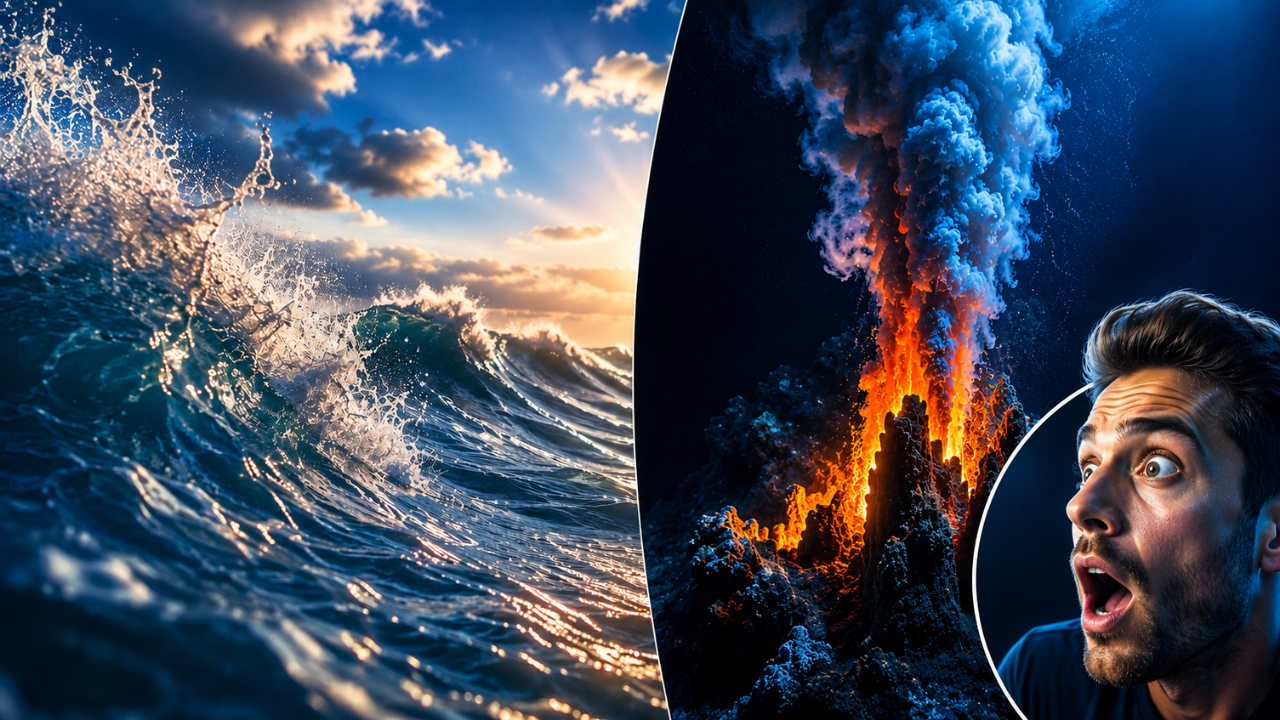
Why is the ocean salty? It’s a question every child who’s ever accidentally swallowed a mouthful of seawater has asked afterward. The standard answer, rivers carry dissolved minerals from rocks into the sea, isn’t wrong, but it’s only the opening chapter of a much stranger geological story, one involving acid rain, underwater volcanoes hot enough to melt lead, and a scientific puzzle explaining why some lakes turn into something you can float on without trying while nearby rivers stay perfectly drinkable.
Rain Isn’t as Pure as It Looks
The journey toward why the ocean is salty begins somewhere unexpected: inside a raindrop, long before it ever touches the ground. As water vapor rises and condenses into clouds, it absorbs carbon dioxide directly from the atmosphere, forming a weak solution known as carbonic acid. That’s right, ordinary rain is mildly acidic by default, a fact that has almost nothing to do with pollution and everything to do with basic atmospheric chemistry that’s been happening since long before humans existed.
When this slightly acidic rain hits solid ground, it begins a slow, relentless process called chemical weathering, dissolving minerals directly out of rock and soil. Sodium, chloride, calcium, and magnesium ions get pulled loose from the ground and carried along with the runoff, eventually funneling into streams, then rivers, then finally reaching the ocean. Scientists estimate that rivers alone transport roughly 4 billion tons of dissolved minerals into the sea every single year, a process that’s been running continuously for billions of years.
The Ocean Floor Has Its Own Salt Factory
Here’s where the story goes beyond the textbook explanation most people learn in school. Rivers aren’t the only source feeding the ocean’s salt content, and arguably not even the most fascinating one. Along the seafloor’s mid-ocean ridges, seawater seeps directly into cracks in the oceanic crust, where it encounters something considerably more intense than a slow riverbed: molten magma sitting just beneath the surface.
That seawater gets superheated to temperatures exceeding 400 degrees Celsius, hot enough to melt lead, and in the process, it aggressively strips minerals directly out of the surrounding basaltic rock. The mineral-saturated fluid then vents back out through structures called hydrothermal vents, essentially underwater geysers continuously injecting concentrated dissolved minerals directly into the ocean from below, completely independent of anything happening on land. Some of these vents, discovered near active submarine volcanoes, have even been observed releasing visible plumes of minerals and gas rising directly from cracks in the Earth’s crust.
Between chemical weathering on land and hydrothermal circulation on the seafloor, the ocean has essentially been fed salt from two completely different directions simultaneously, for the entirety of its geological history.
Why the Ocean Doesn’t Just Keep Getting Saltier Forever
A reasonable question follows naturally: if rivers and hydrothermal vents have been adding salt for billions of years, why isn’t the ocean saltier than it already is? The answer involves a delicate, ongoing balance. Marine organisms actively absorb many dissolved minerals, calcium in particular gets pulled out of seawater to build shells and skeletons, eventually settling on the ocean floor as sediment once those organisms die. Other minerals precipitate out through chemical reactions or get cycled back into the crust through hydrothermal circulation itself.
Two elements, however, remain remarkably resistant to all of this removal: sodium and chloride, the exact ingredients of table salt. These ions are unusually stable and soluble, meaning they largely avoid getting absorbed or filtered out the way other minerals do. Over immense stretches of geological time, sodium and chloride have simply accumulated while other minerals cycled through and out, which is precisely why they now make up more than 90 percent of all dissolved ions in seawater.
The Dead Sea Reveals What Rivers Never Show You
This raises an obvious follow-up question: if rivers carry dissolved salts the entire way to the ocean, why doesn’t river water taste salty itself? The answer lies in something rivers have that oceans, and certain isolated lakes, fundamentally lack: a continuous outflow.
A typical river is essentially a corridor. Water and dissolved minerals move through it constantly, arriving from upstream and departing downstream toward the sea, never sitting still long enough to concentrate. The ocean, despite being the final destination, loses water primarily through evaporation, a process that removes pure water while leaving virtually all dissolved salt behind, concentrating it gradually over enormous timescales.
Certain inland bodies of water take this same principle to an extreme. The Dead Sea, bordering Jordan and Israel, sits in what’s known as a closed drainage basin, meaning water flows in from surrounding rivers and streams, but has no outlet flowing back out. The only way water leaves the Dead Sea is through evaporation, which removes pure water molecules while leaving every dissolved mineral behind, permanently. Decade after decade, incoming minerals accumulate with essentially nowhere to go, which is precisely why the Dead Sea reaches salinity levels roughly ten times higher than the ocean itself, dense enough that swimmers famously float on the surface without effort.
A Planetary Process Written in Rock, Heat, and Time
What makes ocean salinity such a genuinely compelling scientific story isn’t any single mechanism, it’s the sheer number of interlocking processes required to produce something as seemingly simple as salty water. Acid rain chemically dismantling solid rock. Underwater volcanoes superheating seawater hot enough to strip minerals directly from the crust. A precise, billions-of-years-long balance between mineral input and biological removal. And a stark demonstration, sitting in the Dead Sea, of exactly what happens when that outflow disappears entirely.
The next time ocean water finds its way into your mouth uninvited, it’s worth remembering that the taste isn’t just “salt.” It’s the accumulated chemical residue of billions of years of rainfall, volcanic activity, and geological patience, distilled into roughly 3.5 percent of every drop.