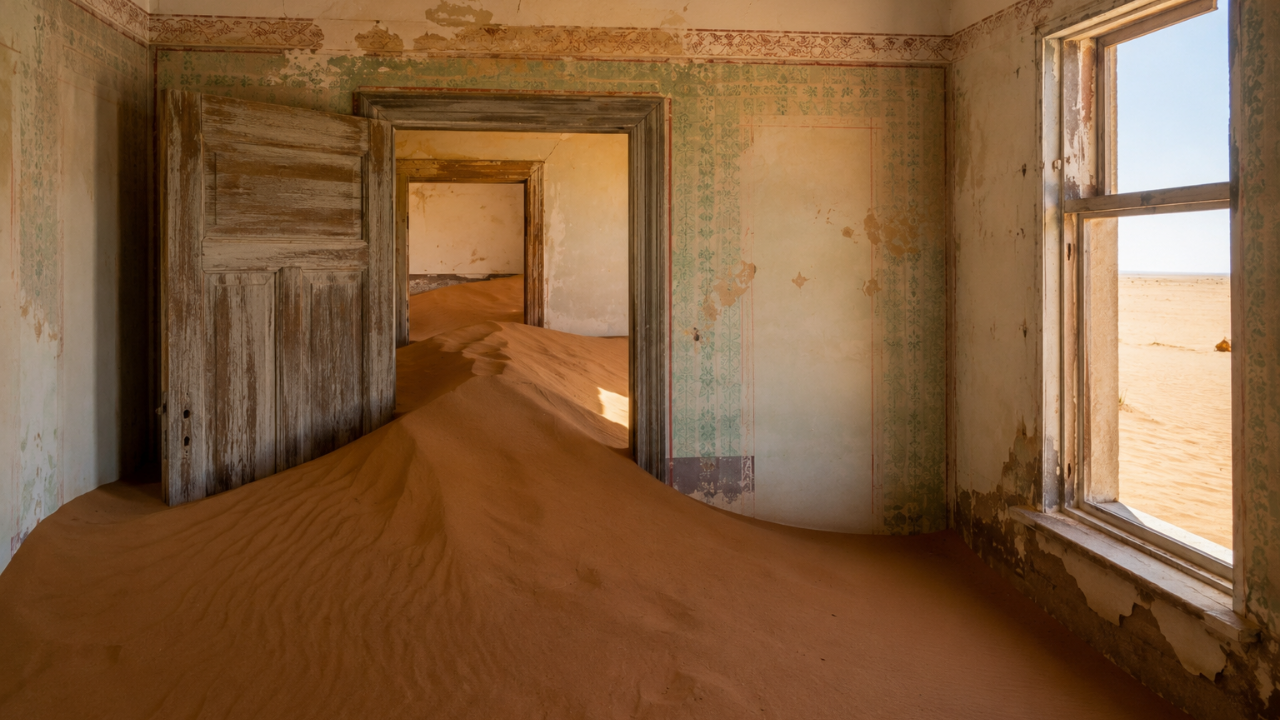
Somewhere in the remote southwestern corner of Namibia sits a house with a bathtub still standing in its bathroom. Sunlight pours in through a gap where the roof used to be. And where the floor should be, there’s nothing but a smooth, curving wave of sand, rising nearly to the ceiling, spilling in through broken doorways like a tide that never receded. This is Kolmanskop, once one of the wealthiest towns on the entire African continent, now being patiently, silently reclaimed by the desert that made it rich in the first place.
A Diamond Found by Accident
The story begins in 1908, with a railway worker named Zacharias Lewala, who was clearing sand off train tracks in the middle of the Namib Desert when something caught his eye, glinting faintly in the low light. He handed the stone to his German supervisor, who recognized immediately what Lewala had stumbled onto: a diamond, lying loose on the desert floor.
Lewala received no payment or recognition for the discovery. Word spread quickly regardless, and prospectors began pouring into the area almost immediately. What they found stunned even seasoned diamond hunters: gemstones weren’t buried deep underground requiring extensive mining operations. In some areas, diamonds were simply lying on the surface, scattered across the sand, waiting to be picked up by hand.
A Boomtown Rises From Nothing
Within just a few years, a full town had materialized in one of the most inhospitable environments on Earth. By 1912, Kolmanskop was producing roughly one million carats of diamonds annually, accounting for nearly 12 percent of the entire world’s diamond production at the time. German colonial authorities, recognizing the value of what they’d found, declared the surrounding region a restricted “forbidden zone,” tightly controlling who could enter and who could prospect.
The wealth that flowed into Kolmanskop built something almost surreal in the middle of the desert. The town had a hospital equipped with the first x-ray machine in the entire southern hemisphere of Africa, a grand ballroom, a casino, a theater, a power station, and even an ice factory, an extraordinary luxury considering the town’s location. At its peak, roughly a thousand people called Kolmanskop home, living in elaborately decorated houses with imported furniture, all funded by diamonds pulled directly from the surrounding sand.
The Beginning of the End
Kolmanskop’s downfall wasn’t caused by war, disaster, or violence. It was caused, quite simply, by geology. In 1928, an even larger diamond deposit was discovered further south, near a location called Oranjemund. The new site offered richer, more accessible reserves, and prospectors and mining companies began relocating there almost immediately.
The shift happened gradually at first, then all at once. By 1943, the mining company that had purchased the rights to Kolmanskop’s diamond fields formally pulled out of the town. Mining operations continued to wind down over the following years, and by 1950, extraction had effectively stopped entirely. Within a few more years, the last residents packed up and left. By the mid-1950s, Kolmanskop stood completely empty.
The Desert Moves In
What happened next is what makes Kolmanskop genuinely unique among the world’s abandoned places. The Namib Desert didn’t wait long to begin reclaiming what had briefly been taken from it. Strong winds continuously swept sand through broken windows, beneath doorframes, and through any gap the elements could find. With no one left to sweep it back out, the sand simply kept accumulating, year after year, decade after decade.
Today, walking through Kolmanskop feels less like visiting a ruin and more like witnessing an ongoing process. In some rooms, sand has piled up in smooth, sweeping drifts that reach halfway up interior walls. In others, dunes have poured through doorways and settled into perfect, undisturbed curves, as if the desert deliberately sculpted them. Wallpaper, once carefully chosen by wealthy German colonists, now peels away in strips above the encroaching sand line, a visible boundary between the world humans built and the one steadily taking it back.
From Abandonment to Attraction
For decades after its abandonment, Kolmanskop remained largely forgotten, sealed off within Namibia’s restricted diamond zone. That began to change when the site was opened to tourism, and today, as many as 35,000 visitors travel to Kolmanskop each year, many of them photographers drawn specifically to the surreal collision of colonial architecture and desert reclamation.
The nearby coastal town of Lüderitz has grown to rely partly on this steady stream of visitors, offering guided tours into the forbidden zone that once excluded almost everyone. Ironically, the very desolation that emptied Kolmanskop is now precisely what draws people back to it.
A Monument to How Quickly Fortune Fades
There’s something genuinely humbling about standing inside a house that once held champagne parties and imported furniture, now filled almost to the ceiling with sand. Kolmanskop wasn’t destroyed by catastrophe. It wasn’t bombed, burned, or torn down. It was simply outlived by the very desert that made it briefly, spectacularly wealthy.
The diamonds that built Kolmanskop are long gone, shipped out decades ago to markets across the world. What remains is something the desert never stopped offering in the first place: an unlimited, patient supply of sand, slowly filling in every room, every hallway, every trace of a town that once believed, however briefly, that it had tamed the desert around it.