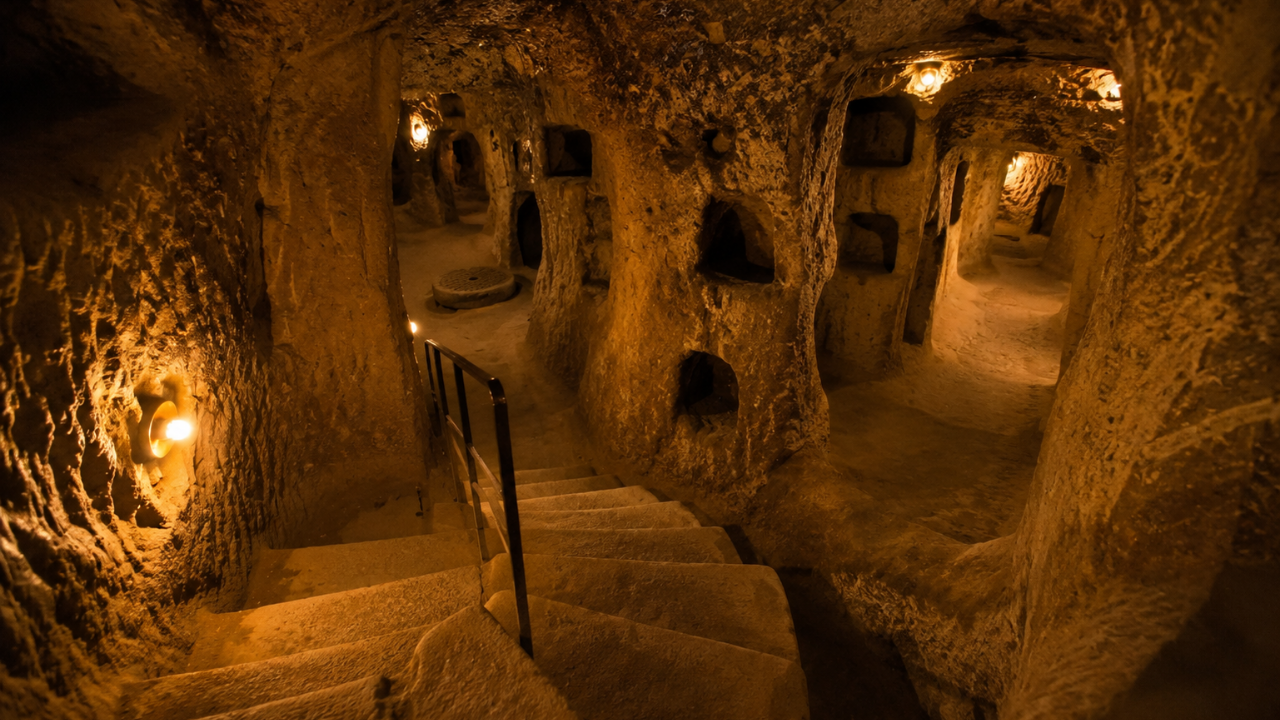
In 1963, a man in central Turkey was renovating the basement of his house when he knocked down a wall and found something that shouldn’t have existed: a hidden passageway leading deeper into the earth. He kept following it. What he eventually uncovered wasn’t a cellar, a tunnel, or a forgotten storage room. It was an entire underground city, carved directly into volcanic rock, extending roughly 18 levels beneath the surface and large enough to shelter 20,000 people at once. This is Derinkuyu, and it remains one of the most staggering feats of ancient engineering ever discovered.
A City Built to Disappear
Derinkuyu sits in the Cappadocia region of central Turkey, an area shaped by ancient volcanic eruptions that left behind vast layers of soft, easily carved rock called tuff. That soft volcanic stone turned out to be perfect for excavation, and over centuries, successive civilizations dug deeper and deeper into it, eventually creating a labyrinth extending to a depth of approximately 85 meters, nearly 280 feet below ground.
The scale is difficult to overstate. Derinkuyu wasn’t a single cave system or a handful of connected tunnels. It was a fully functioning underground settlement, complete with living quarters, stables for livestock, storage rooms for food and wine, churches, and communal gathering spaces, all carved by hand out of solid rock, layer by layer, over an enormous span of time.
Layers Built for Survival, Not Comfort
The earliest sections of Derinkuyu are believed to date back to around the 8th or 7th century BC, carved by the ancient Phrygians, though the city was significantly expanded over the following centuries, particularly during the Byzantine era. The structure was built in a spiral pattern around a large central shaft, with different levels serving distinct purposes based on how deep they sat.
Near the surface, the upper levels housed the most practical spaces: stables, storage rooms, and armories, areas that needed frequent access. Deeper down, rooms opened up for living quarters, kitchens, and communal areas, connected by narrow tunnels functioning as underground streets. The lowest and most secure levels held religious spaces, including a cruciform church, positioned as far from the surface, and any potential threat, as possible.
An Engineering System Built to Keep 20,000 People Alive
Housing thousands of people underground for extended periods required solving problems most ancient engineers never had to consider. Chief among them: how do you keep breathable air circulating through dozens of meters of solid rock?
The answer was more than 15,000 individual ventilation shafts, most only about 10 centimeters wide, threading down through the upper levels of the complex to keep air moving even when the city was completely sealed off from the outside world. Some of these shafts extended deep enough to double as water wells, and remarkably, local residents living above ground continued drawing water from some of these shafts for generations, entirely unaware that their buckets were passing directly through a hidden city beneath their feet.
Massive circular stone doors, some weighing close to a thousand pounds, could be rolled into place from the inside to seal off individual tunnels and levels entirely, blocking access from anyone attempting to force their way in from above. The engineering wasn’t just about hiding. It was about creating a space that could be completely sealed and defended from within, indefinitely if necessary.
What the City Was Actually Hiding From
Derinkuyu’s purpose becomes clearer when placed against the historical backdrop of the region. Cappadocia sat along contested frontier territory for centuries, and the underground city saw its heaviest use during the prolonged conflicts between the Byzantine Empire and invading Arab armies, spanning roughly from the late 8th to the late 12th century AD.
When raids threatened the surface settlements, entire communities could descend into Derinkuyu, seal the stone doors behind them, and wait out the danger with enough stored food, water, and livestock to survive for extended periods, all while remaining completely hidden from armies passing directly overhead. Historical accounts suggest that even centuries later, local populations continued instinctively retreating underground during moments of danger, a survival instinct passed down long after the original threats had faded into history.
A City Too Well-Built to Fail
Perhaps the most remarkable engineering detail about Derinkuyu is what hasn’t happened since its construction. Despite being carved entirely from rock, supporting the weight of dozens of interconnected levels, and existing for well over two thousand years, none of Derinkuyu’s floors have ever collapsed. The structural planning, including strategically placed support pillars throughout the complex, has held for millennia without modern engineering tools, materials, or techniques.
Today, only a fraction of Derinkuyu, roughly eight of its estimated levels, has been excavated and opened to visitors, with the remainder still considered too structurally uncertain or archaeologically sensitive for public access. Researchers continue to study the site, and portions of the underground network likely remain entirely unexplored even now.
A Reminder of What Fear Can Build
Derinkuyu wasn’t built as a monument or a marvel meant to impress anyone. It was built out of necessity, by people facing the very real, recurring threat of invasion, with no technology beyond hand tools and an intimate understanding of the soft volcanic rock beneath their homes. What they created instead became something extraordinary almost by accident: a underground civilization capable of sustaining thousands of lives, indefinitely, entirely out of sight.
More than two thousand years later, Derinkuyu still stands as one of the clearest examples in human history of what people are capable of building when survival leaves no other option.