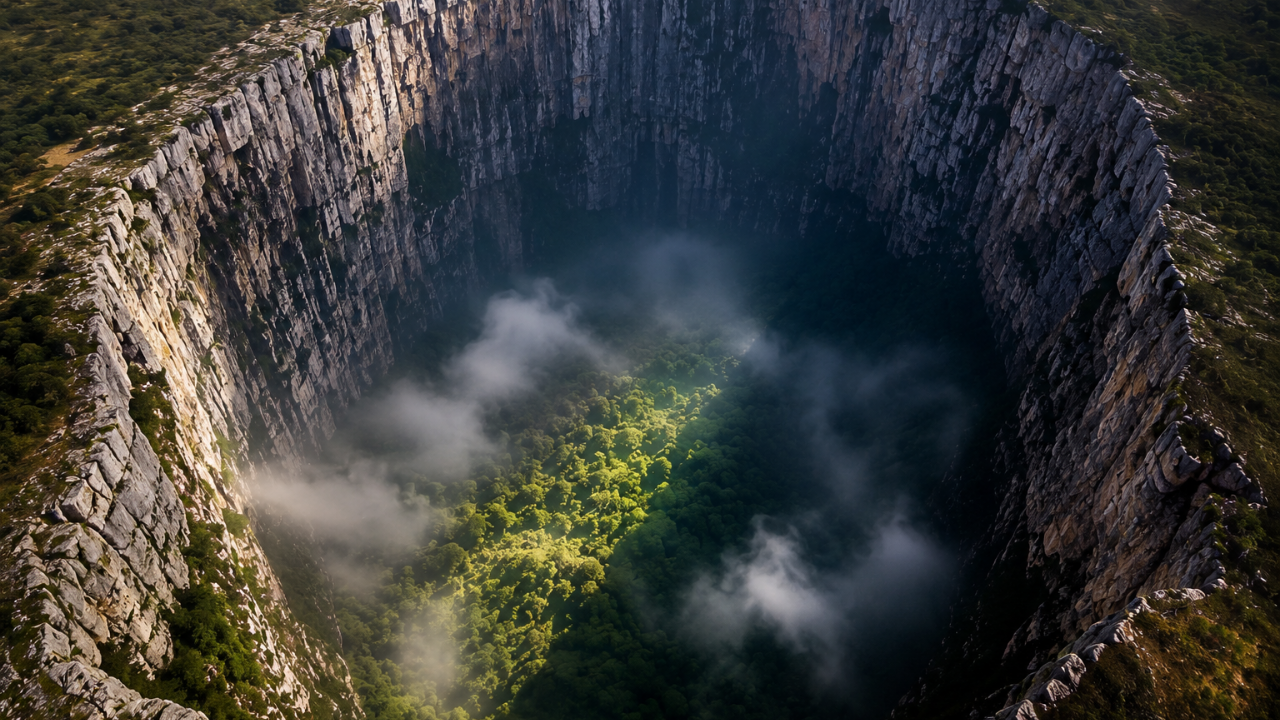
A sinkhole forest in southern China is doing something that shouldn’t be possible: growing 40-meter-tall ancient trees, sheltering an endangered big cat, and preserving plant species that vanished from the rest of the planet millions of years ago – all at the bottom of a hole so deep it could swallow a 200-story skyscraper. This isn’t a fantasy movie set. It’s a real, scientifically documented place, and it’s rewriting what scientists thought was possible underground.
A Hole Deep Enough to Hide a City Block
Located in Chongqing Municipality, Xiaozhai Tiankeng plunges 626 meters (roughly 2,053 feet) straight down and stretches 527 meters across – dimensions so massive that its total volume could contain approximately 40,000 Olympic-sized swimming pools. Locals in the surrounding villages have known about this pit for centuries, treating it as little more than local folklore, but Chinese geologists didn’t accurately measure its true scale until 1994.
The name itself carries weight: “Tiankeng” translates to “heavenly pit” in the local karst vocabulary, while Xiaozhai refers to a now-abandoned hamlet nearby. It’s a fitting name for a place that looks, from above, like something scooped the earth’s crust out with an oversized ice-cream scoop.
What’s Waiting at the Bottom Will Surprise You
Here’s the part that defies every intuition about deep, sunless holes: instead of barren rock and darkness, the floor of Xiaozhai Tiankeng supports a fully mature subtropical forest. A cool, humid microclimate forms naturally at the bottom, shielded from the harsh sun and wind above, allowing plant life to flourish despite the dramatically limited sunlight.
Botanists have documented more than 1,200 plant species thriving down there, many found nowhere else on the surrounding plateau. Among them is the ginkgo tree – often called a living fossil because its lineage stretches back to the Mesozoic Era, the age of dinosaurs. Alongside it grow rare ferns and mosses uniquely adapted to this shadowy, moisture-rich pocket of the world.
A Predator Nobody Expected to Find Underground
Perhaps the most startling discovery is the presence of the clouded leopard, an elusive wild cat with fewer than 10,000 individuals believed to remain anywhere on Earth. This arboreal predator can open its jaw to an extraordinary 100-degree angle, and its presence at the sinkhole’s floor tells scientists something important: an ecological corridor still connects this hidden forest to the surrounding wilderness above.
Joining the leopard is the Chinese giant salamander, the largest amphibian species alive today, which breeds in the crystal-clear pools fed by an underground river running through the pit. Each vertical layer of the sinkhole, researchers say, shelters a slightly different mix of plants and animals – walking from the rim to the floor feels almost like descending through several distinct ecosystems stacked on top of each other.
The River That Carved a World Beneath the World
This entire ecosystem exists because of geology working in slow motion over thousands of years. The sinkhole formed above Difeng Cave, where an underground river traceable for roughly 8.5 kilometers has steadily dissolved the soluble limestone beneath the surface, eventually causing the ground above to collapse inward. During the rainy season, this same river produces a dramatic waterfall roughly 46 meters high, crashing down into the pit in scenes that genuinely resemble nature documentaries filmed in South America.
China happens to host more of these giant sinkholes, known locally as tiankengs, than anywhere else on the planet – the country contains over 200 large sinkholes, with the Guangxi region alone home to around 30 major examples. Scientists studying an adjacent cluster called the Dashiwei Tiankeng Group have started treating these formations as natural laboratories, each one functioning like an enormous, isolated terrarium built by geology rather than human hands.
Why These Forests Matter Far Beyond Their Novelty
It would be easy to treat Xiaozhai Tiankeng as simply a striking photograph – but researchers are discovering it holds genuine scientific weight. A 2024 genetic study on the rare Manglietia aromatica tree, native to China’s tiankeng regions, found that populations growing inside these sinkholes carried roughly 20 to 25 percent higher genetic diversity than similar populations growing on the surface nearby. That finding has led scientists to increasingly describe these hidden forests as “genetic libraries” – natural vaults preserving plant lineages that are disappearing or already extinct at ground level.
Isolation, it turns out, isn’t just protecting these ecosystems from human disturbance; it may actually be strengthening their genetic resilience over time, insulating them from many of the environmental pressures reshaping the surface world above.
A Delicate Balance Between Curiosity and Preservation
Naturally, a discovery this dramatic has attracted visitors, and Xiaozhai Tiankeng now includes a constructed staircase with roughly 2,800 steps descending from the rim down to the forest floor, opened for both tourism and scientific access. Local authorities in Fengjie County actively regulate how many visitors are allowed into the designated area at any given time.
This tension isn’t unique to one sinkhole. Across China’s karst regions, researchers have repeatedly warned that opening these fragile pits to tourism risks permanently damaging ecosystems that took thousands of years to develop in complete isolation. Scientists now widely advocate for controlled access, viewing platforms positioned safely away from sensitive habitats, and strict daily limits on how many people are permitted to descend.
A World That Was Never Supposed to Exist
What makes Xiaozhai Tiankeng so genuinely remarkable isn’t just its size, or even its ancient trees and rare wildlife – it’s the fact that it exists at all. Everything about a deep, sunlight-starved pit in the earth suggests it should be lifeless: cold stone, still air, nothing growing. Instead, geology accidentally built a shelter, and life quietly moved in and never left, preserving pieces of a much older world that vanished everywhere else. Sometimes the most extraordinary discoveries aren’t found by looking further out into the unknown – they’re found by looking straight down.