For 80 years, Japan refused to build a single, unified spy agency. That’s changing right now – and it could quietly touch American jobs, US troops overseas, and even the phone in your pocket.
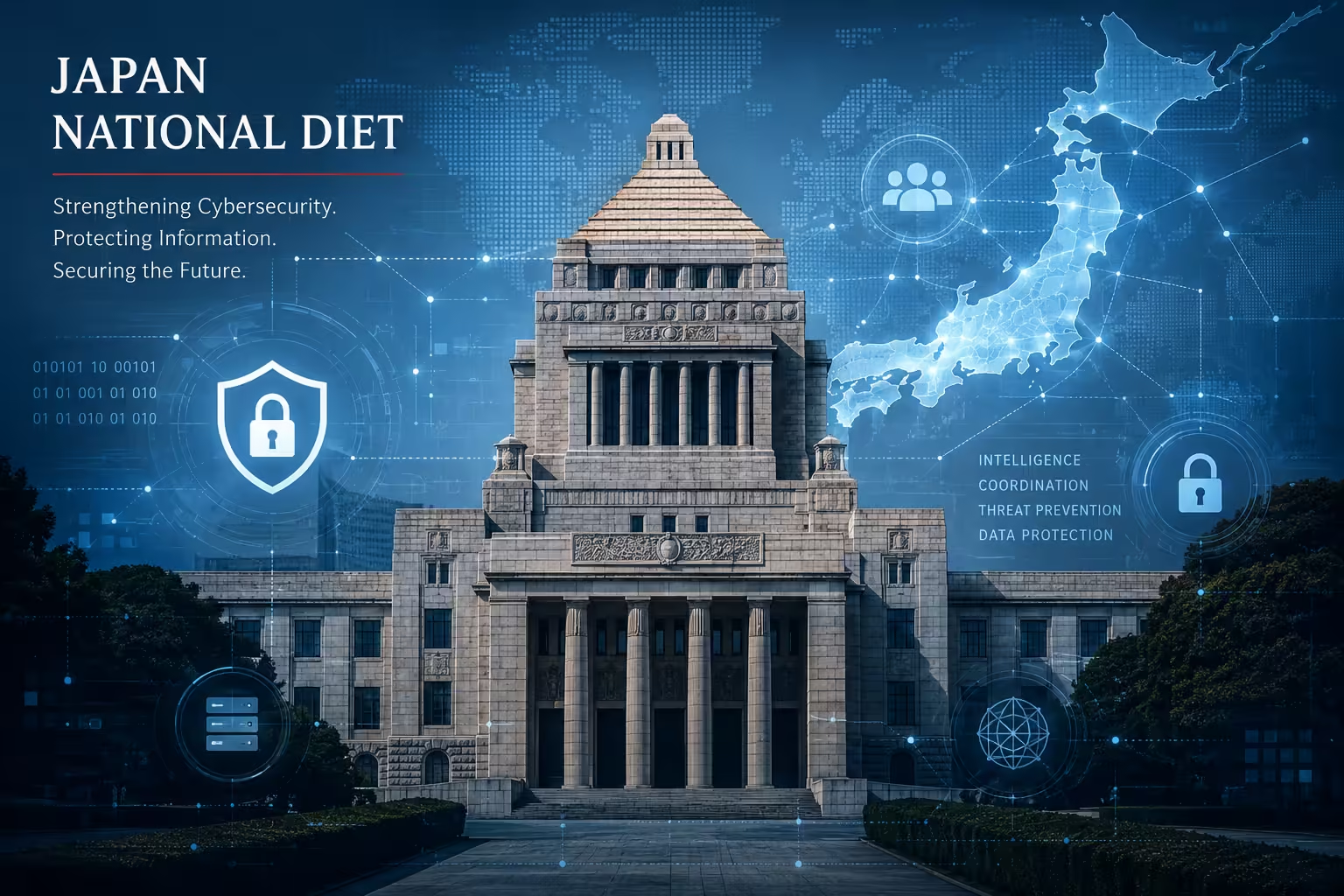
Japan is building its first Japan centralized intelligence agency since World War II, created specifically to counter espionage and interference from China, Russia, and North Korea. Those three countries already shape American foreign policy and defense spending. Their activities are increasingly reaching into everyday life for US families, too – from the security of military bases to the supply chains behind everyday electronics. For a country that has spent eight decades deliberately avoiding a centralized intelligence apparatus, this is one of the most significant defense reforms in modern Japanese history, and it’s happening in close coordination with Washington.
Japan’s National Diet passed the legislation creating the new intelligence body earlier this year – clearing the lower house in April and the upper house in May, according to Al Jazeera’s review of the reform. The push comes from Prime Minister Sanae Takaichi’s government, which has already lifted long-standing restrictions on weapons exports and launched what’s being described as Japan’s largest defense buildup since the postwar era began.
Quick Facts
- Japan is creating its first centralized intelligence agency since World War II, built around a new National Intelligence Council.
- The legislation passed Japan’s National Diet in stages, clearing the lower house in April 2026 and the upper house in May 2026.
- Japan has consulted the United States, Australia, and Germany on technology, staffing, and operational priorities for the new agency.
- The reform follows New York Times reporting that Russian intelligence has used Japan as a hub to acquire sanctioned dual-use technology and weapons components.
- Japan’s intelligence gathering has historically been split across separate defense, diplomatic, and police agencies, limiting coordination.
Keep reading – the section on American families below explains exactly how a spy agency being built 6,000 miles away could still show up in a US household budget.
What Happened?
For decades, Japan avoided building a single, unified intelligence agency similar to the CIA or Britain’s MI6. Instead, intelligence work was spread across the defense ministry, the foreign ministry, the national police, and other bodies working largely in isolation from one another. That fragmented structure is now being replaced.
Under Prime Minister Takaichi, Japan’s Diet passed legislation establishing a National Intelligence Council to centralize the country’s counterespionage, cybersecurity, and intelligence-sharing functions. Japanese officials have privately consulted with counterparts in the United States, Australia, and Germany in recent months on how to build the new system, according to reporting from the Japan Times. American intelligence officials have reportedly offered input on cyber-defense systems and methods for countering industrial espionage, while the head of Germany’s foreign intelligence service, the BND, traveled to Tokyo to discuss the plans directly.
The timing isn’t a coincidence. Just before the reform gained wider attention, the New York Times reported that Russian intelligence operatives had turned Japan into what one source described as a hub for acquiring sanctioned technology – using the country’s historically weak counterespionage laws to buy weapons components and route them toward Russia, evading Western sanctions tied to the war in Ukraine. Andrew Shearer, a security official quoted in coverage of the reform, said it was significant that Japan’s prime minister had chosen to prioritize the issue at the highest level of government.
Why This Matters
Japan’s decision to build a centralized spy agency is as much about symbolism as capability. Since its defeat in World War II, Japan has maintained a deliberately limited security posture, shaped by a constitution that restricts military power and a public wary of returning to any form of centralized state surveillance apparatus. Breaking from that posture – even in the narrower area of counterintelligence – signals how seriously Tokyo now views the combined threat from China, Russia, and North Korea.
Sanshiro Hosaka, a research fellow at the Estonia-based International Centre for Defence and Security, said the reform is meant to improve Japan’s ability to produce useful intelligence by cutting down on the barriers between agencies and better matching intelligence products to what policymakers actually need. He noted that Japan remains an important target for foreign intelligence services precisely because it’s a major U.S. ally in Asia with an advanced technology sector – the kind of country Cold War-era Soviet intelligence once treated as a rich source of industrial and military secrets, and that China, Russia, and North Korea continue to treat the same way today.
Impact on American Families: Why the Japan Centralized Intelligence Agency Reaches Your Household
This is the part most readers skip past – and shouldn’t. A new intelligence agency in Tokyo sounds like distant foreign policy news. It isn’t. Here’s exactly how it connects to American households.
National security and troop safety: Japan hosts one of the largest concentrations of US military personnel anywhere in the world, including bases central to America’s Pacific defense strategy. A more capable Japanese intelligence system means better protection for shared military technology, intelligence, and potentially for American service members and their families stationed there.
Jobs and defense spending: As Japan expands its defense and intelligence capacity, it’s also expanding its reliance on American defense technology, cybersecurity partnerships, and training programs. That can translate into contracts and jobs for US defense and tech companies working with allied governments.
Technology and data security: The same Russian and Chinese espionage tactics that targeted Japan – exploiting weak oversight to acquire sensitive dual-use technology – have also targeted American companies and universities. Watching how Japan tightens its counterespionage laws offers a preview of policy debates that may eventually reach Washington, particularly around technology export controls and foreign investment screening.
Consumer technology and supply chains: Japan remains a critical link in global semiconductor and electronics supply chains that touch everyday American products, from smartphones to cars. Reduced foreign interference and espionage risk in Japan’s tech sector supports the stability of supply chains that US consumers depend on.
While there’s no evidence this reform will directly change prices or taxes for American families in the short term, it strengthens one of the pillars of the broader US-led security network in the Pacific – a network that underpins regional stability affecting global trade, including goods that eventually reach American shelves.
International Perspective
United States: Washington has been directly involved in shaping the new agency, with American officials offering guidance on cyber-defense systems and industrial espionage countermeasures. A stronger, centralized Japanese intelligence partner strengthens the broader US-Japan alliance and could deepen intelligence-sharing arrangements that already exist between the two countries.
United Kingdom: UK defense analysts view the reform as a stabilizing step for East Asian supply chains and security architecture, particularly as Britain deepens its own economic and defense ties with Indo-Pacific partners.
Canada: The move adds momentum to Canada’s own recent push to expand intelligence-sharing arrangements with Japan and other Pacific partners, part of a broader effort to counter foreign interference operations that Canadian officials say increasingly originate from China and Russia.
Indo-Pacific region: Germany’s direct involvement – including a visit to Tokyo by the head of its foreign intelligence service — reflects how European powers are increasingly treating Indo-Pacific security as connected to their own interests, not a separate regional issue.
What Experts Say
Analysts covering the reform, including those cited by Al Jazeera, describe it as addressing a long-standing structural weakness: Japan’s intelligence functions have been scattered across agencies that don’t coordinate well, leaving gaps that foreign intelligence services have been able to exploit. Sanshiro Hosaka argues the reform’s real test will be whether Japan pairs it with a foreign-influence transparency law, which he says is needed to increase visibility into foreign lobbying and deter illegal interference – something the current reform, focused mainly on counterespionage and cyber defense, does not fully address on its own.
What Readers Should Watch Next
- Implementation timeline: How quickly Japan staffs and operationalizes the new National Intelligence Council following the Diet’s approval.
- Deeper US-Japan intelligence integration: Whether this reform leads to expanded formal intelligence-sharing agreements between Washington and Tokyo.
- Foreign-influence legislation: Whether Japan follows up with a transparency law targeting foreign lobbying, as some analysts argue is still missing.
- China and Russia’s response: Whether Beijing or Moscow adjust their intelligence operations in Japan in response to the tightened legal environment.
- Broader Pacific alliance-building: Whether other regional players, such as Australia, South Korea, or New Zealand, deepen similar counterintelligence cooperation with Japan.
Practical Takeaways
For American readers following this story, the main takeaway is that US-Japan security cooperation is entering a more formal, intelligence-focused phase, not just a military one. That’s likely to shape future defense budgets, technology-export policy debates, and cybersecurity standards that indirectly touch American businesses working with Japanese partners. Anyone in tech, defense contracting, or supply-chain-dependent industries may want to watch how Japan’s new counterespionage rules affect data-sharing and technology-transfer requirements going forward.
Conclusion
Japan’s move to build its first centralized intelligence agency since World War II marks a historic break from decades of deliberate restraint, driven by mounting concern over Chinese, Russian, and North Korean espionage. For American readers, it’s a reminder that US security in the Pacific increasingly depends on how well allied nations like Japan can protect their own technology, institutions, and secrets – not just on US military strength alone.
It’s also a reminder that the safety of the phone you’re holding, the job market your kids may enter, and the troops stationed overseas are all connected to decisions being made in rooms most Americans will never see. How quickly Tokyo builds out this new system, and how deeply it integrates with US intelligence partners, will shape the security landscape in the Pacific – and quietly, the lives of American families – for years to come.