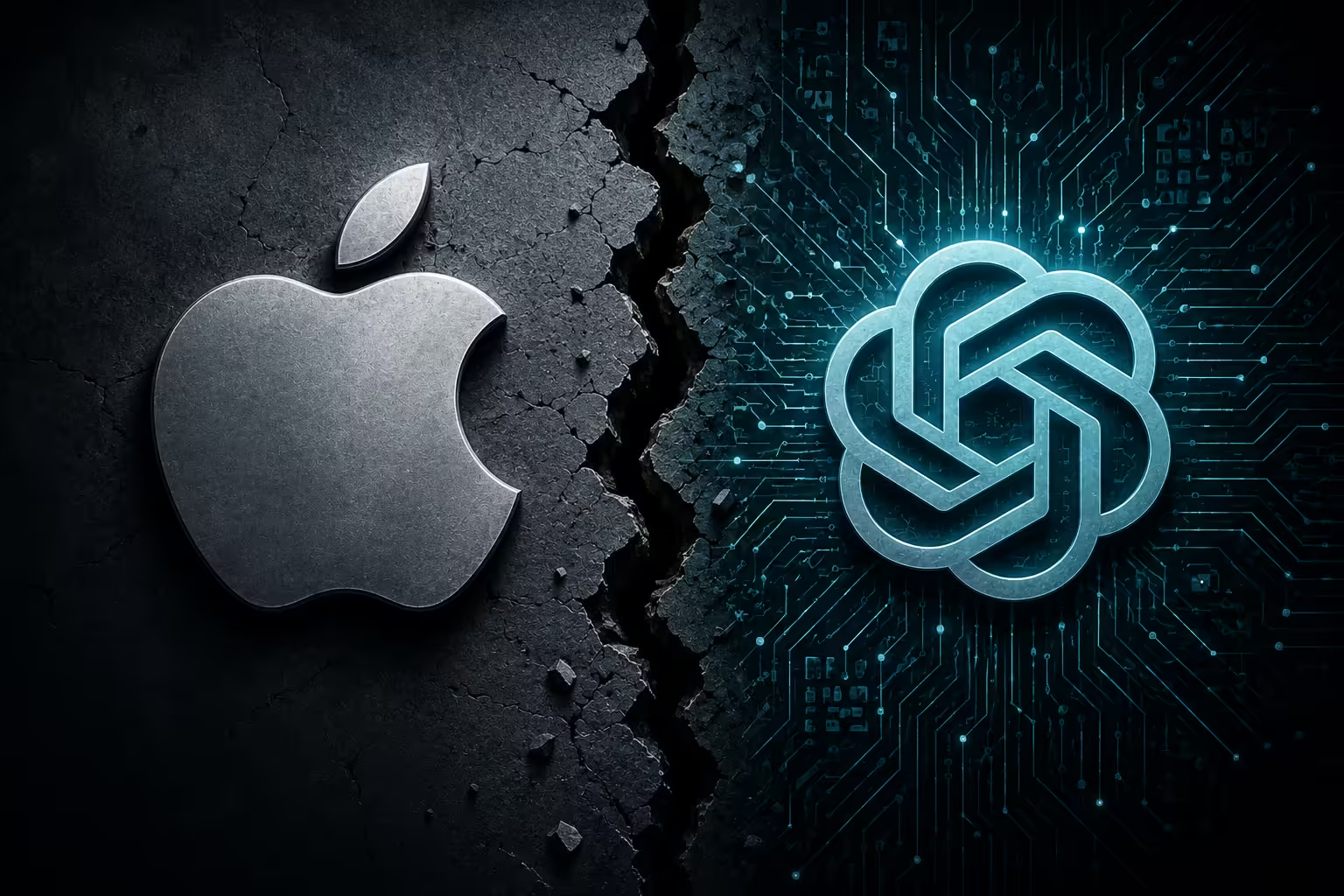
Apple sues OpenAI trade secrets – that’s now a federal court case, not just tech gossip. On July 10, 2026, Apple filed a lawsuit in the US District Court for the Northern District of California accusing OpenAI, its Chief Hardware Officer Tang Tan, former Apple engineer Chang Liu, and the hardware company io Products of systematically stealing Apple’s confidential hardware designs. Apple says the theft wasn’t a one-off mistake by a rogue employee. In its own words, the alleged scheme operated “at every level” of OpenAI, from technical staff up through its chief hardware officer.
The case marks a stunning breakdown between two companies that, just two years earlier, announced a partnership to integrate ChatGPT directly into Apple’s iPhone software. It also lands at an especially sensitive moment for OpenAI, which is reportedly preparing for one of the most anticipated initial public offerings in tech history.
Quick Facts
- Apple filed suit against OpenAI, hardware chief Tang Tan, former engineer Chang Liu, and io Products on July 10, 2026, in federal court in Northern California.
- Apple alleges former employees took confidential engineering, manufacturing, and supply-chain information to help OpenAI build consumer hardware.
- The complaint claims Tan directed job candidates still employed at Apple to bring physical hardware components to interviews for “show and tell” sessions.
- Apple says it has identified a pattern involving more than 400 former employees who now work at OpenAI.
- OpenAI has denied wrongdoing, with a spokesperson saying the company has “no interest in other companies’ trade secrets.”
What Happened?
According to Apple’s complaint, the trouble traces back to Tang Tan, a 24-year Apple veteran who led product design for the iPhone and Apple Watch before leaving the company in February 2024. Tan went on to co-found io Products alongside Apple’s former chief design officer, Jony Ive – the designer widely credited with shaping the look of the iPhone, iPad, and iPod. OpenAI acquired io Products in 2025 in a deal reportedly worth around $6.5 billion, bringing in more than 50 engineers and designers to help build what OpenAI executives have described as a new category of AI-powered consumer hardware.
Apple’s lawsuit alleges Tan began emailing himself confidential information about Apple’s suppliers before he even left the company. It also claims that once at OpenAI, Tan used Apple’s internal project code names while interviewing job candidates who still worked at Apple – and in some cases asked those candidates to bring actual Apple hardware components to interviews for hands-on “show and tell” sessions where he and his team could extract further details.
The second named defendant, Chang Liu, spent eight years at Apple as a senior systems electrical engineer before leaving for OpenAI in January 2026. Apple alleges Liu failed to return his Apple-issued laptop, used it to access Apple’s internal network, exploited a previously unknown security flaw, and downloaded confidential technical documents covering unannounced products, engineering presentations, and proprietary project data.
Apple’s complaint goes further, alleging that OpenAI used the stolen information to approach Apple’s own manufacturing partners – in one case, according to the filing, persuading a partner to carry out a specific metal-finishing technique for OpenAI while leading that partner to believe Apple had authorized it.
Notably, while io Products is named as a defendant, Jony Ive himself is not accused of wrongdoing in the suit. Apple said it first raised its concerns with OpenAI directly when its internal investigation began, but says it never received a response. In a statement, OpenAI spokesperson Drew Pusateri said the company has no interest in other companies’ trade secrets and remains focused on building technology that empowers people. Apple, for its part, said in a statement that protecting the work and intellectual property behind its breakthrough technologies is something the company takes very seriously.
Why This Matters
This lawsuit is about more than two tech giants trading accusations. It cuts to the center of a much bigger question hanging over Silicon Valley right now: as OpenAI expands from software into consumer hardware, how much of its progress is built on its own innovation, and how much may depend on knowledge pulled from rivals through aggressive recruiting?
The stakes are especially high because OpenAI has been developing what executives have described as an “iPhone of the AI era” – a device expected to be unveiled later this year that could directly challenge Apple’s dominance in consumer hardware. Legal analysts note that Apple isn’t only seeking money in this case. The company is asking the court to block OpenAI from retaining, using, or distributing its trade secrets and to force the return of any misappropriated material – remedies that, if granted, could directly delay or reshape OpenAI’s hardware plans.
The timing also matters. The suit lands just as OpenAI is reportedly preparing for a highly anticipated public stock offering. According to Bloomberg reporting cited by multiple outlets, the damage from the lawsuit may already be spreading beyond the courtroom, chilling OpenAI’s recruiting efforts and casting a shadow over its device launch, regardless of how the legal case ultimately resolves.
Impact on American Families
For most people, a trade secrets lawsuit between two tech companies might seem like distant corporate drama. But this case touches several things that matter directly to American households.
Tech jobs and job-switching: This case puts a spotlight on how far companies can legally go when recruiting talent from competitors, and how seriously courts may treat non-disclosure agreements and exit-security procedures. Tech workers considering a jump to a competitor, especially in hardware and engineering roles, may see companies tighten confidentiality agreements and offboarding procedures as a result.
Future gadgets and prices: If the lawsuit succeeds in delaying or reshaping OpenAI’s hardware device, it could slow the arrival of a major new category of consumer AI gadgets that companies have been racing to bring to market. That affects competition — and competition is often what keeps prices in check and pushes companies to build better products faster.
Retirement accounts and investments: OpenAI’s anticipated public offering has drawn enormous investor interest, and reports suggest the case is already being factored into market expectations around whether — and when — that IPO happens, and at what valuation. Americans with investments in tech-heavy funds, or those hoping to buy shares once OpenAI goes public, have a direct financial stake in how this plays out.
Everyday ChatGPT and Siri users: Apple and OpenAI’s underlying commercial partnership, which brought ChatGPT into Apple’s own AI features, adds another layer of uncertainty. Neither company has said whether the lawsuit will affect that existing product integration, but it does complicate what was already a delicate relationship between two companies now suing each other in federal court.
International Perspective
United Kingdom: London’s deep concentration of tech investment and venture capital firms is watching the case closely, given its potential to influence how trade secret and non-compete law gets applied to fast-moving AI hardware startups more broadly.
Canada: Canadian tech analysts and business commentators are tracking the case as a bellwether for how aggressively AI companies may recruit talent from established hardware makers, a dynamic that also plays out in Canada’s own growing AI sector.
Global tech industry: The case adds to a broader pattern of legal friction around OpenAI this year, including a separate high-profile trial the company recently won against Elon Musk and Tesla over unrelated governance claims. Investors and competitors worldwide are watching whether trade secret disputes become a recurring cost of doing business as AI companies race into hardware.
What Experts Say
Financial and legal analysts have cautioned that the lawsuit doesn’t make an OpenAI IPO impossible, noting that companies have gone public while facing legal challenges before. But they’ve also emphasized that public offerings require detailed disclosure of material legal risks, and a complex dispute touching intellectual property, former employees, and future product development adds real complexity for underwriters and investors trying to value the company. Some analysts have distinguished between a simple financial settlement, which markets could absorb relatively easily, and a legal outcome that delays products or forces a hardware redesign, which they say would be far more consequential for OpenAI’s valuation story.
What Readers Should Watch Next
- OpenAI’s formal legal response: Whether and how OpenAI, Tang Tan, and Chang Liu respond to the specific allegations in court filings.
- Impact on the hardware device launch: Whether OpenAI’s previously teased consumer hardware product proceeds on schedule later this year or faces delays.
- IPO timeline and valuation: Whether the lawsuit affects the timing or size of OpenAI’s anticipated public stock offering.
- The Apple-OpenAI software partnership: Whether the existing ChatGPT integration in Apple’s products is affected as the legal relationship between the two companies deteriorates.
- Industry-wide hiring practices: Whether other tech companies revisit their own recruiting and exit-security policies in response to the allegations detailed in the case.
Practical Takeaways
For tech professionals, this case is a reminder to read employment and non-disclosure agreements carefully before switching companies, especially in hardware and engineering roles where physical prototypes, supplier relationships, and manufacturing know-how can carry legal weight long after someone leaves a job. For investors watching OpenAI’s path toward a public offering, it’s worth treating this as an active legal risk rather than settled news – the case is expected to take years to resolve, and its outcome could meaningfully affect both OpenAI’s hardware roadmap and how the company is valued when and if it goes public.
Conclusion
Apple’s lawsuit against OpenAI is more than a courtroom fight between two of the most recognizable names in technology – it’s a test case for how trade secret law applies to the fast-moving world of AI hardware, and a preview of the kind of legal battles that may become more common as AI companies race to build physical products. Whether or not Apple ultimately wins in court, the case has already added uncertainty to OpenAI’s hardware ambitions and its high-profile path toward going public, with consequences that could reach everyday consumers, tech workers, and investors long before a judge issues a final ruling.