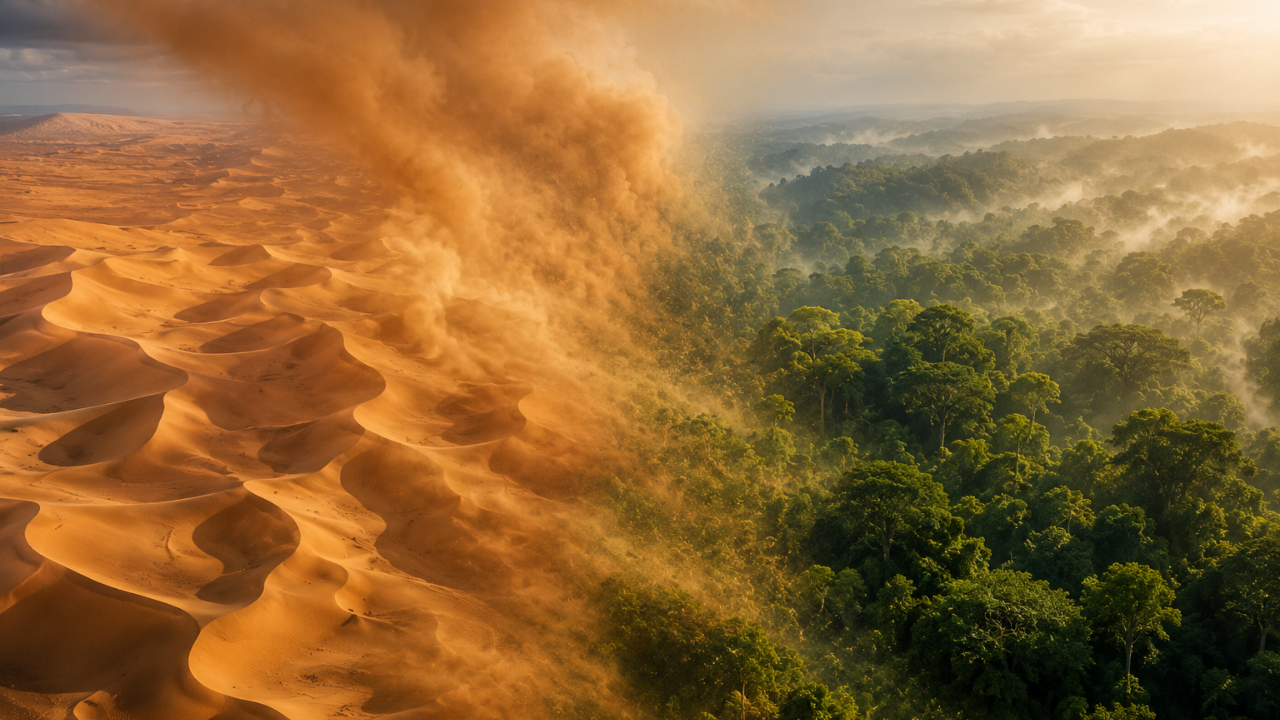
Imagine standing in the driest, most lifeless stretch of the Sahara Desert and being told that the sand beneath your feet is, at this very moment, feeding one of the most biologically rich rainforests on the planet. It sounds like an environmental myth. It isn’t. Sahara dust genuinely crosses an entire ocean every year to sustain the Amazon rainforest, and the mechanism behind it is one of the more elegant accidents of planetary geography.
An Ecosystem Living on Borrowed Nutrients
Here’s a paradox that puzzled scientists for years: the Amazon rainforest, despite being extraordinarily lush, sits on soil that should, by all rights, be nutrient-poor. The region’s relentless rainfall constantly washes essential elements like phosphorus out of the ground and into rivers before plants can fully absorb them. A forest this dense, growing this aggressively, should be steadily draining its own soil of what it needs to survive.
Something had to be replacing those lost nutrients. For decades, that “something” remained a genuine scientific mystery.
Following the Dust Across an Ocean
The answer came from an unlikely direction, quite literally an ocean away. Researchers using NASA’s CALIPSO satellite tracked dust plumes lifting off the Sahara Desert and drifting westward across the Atlantic on consistent trade winds. What they found was staggering in scale: an estimated 182 million tons of dust leaves the Sahara region each year, with roughly 27.7 million tons completing the full journey and settling directly onto the Amazon Basin.
Embedded within that dust cloud is phosphorus, the exact nutrient the Amazon’s rainfall keeps stripping away. Scientists calculated that the dust delivers approximately 22,000 tons of phosphorus annually, a figure remarkably close to what the rainforest loses each year to runoff. The math works out almost too perfectly: one ecosystem’s loss becomes another’s steady supply, delivered automatically, every year, without either landscape “knowing” the other exists.
The Ancient Lakebed Behind It All
Not every grain of Saharan sand carries this fertilizing power. Much of the phosphorus-rich dust traces back to a specific location: the Bodélé Depression, a wind-scoured valley in northern Chad. Thousands of years ago, this entire basin was the floor of a massive freshwater lake, part of what’s now called the African Humid Period. When that ancient lake eventually evaporated, it left behind thick deposits of diatomite, fossilized remains of microorganisms that lived and died in the lake, unusually concentrated with phosphorus.
Powerful wind corridors, funneled between surrounding mountain ranges, now regularly whip this ancient lakebed material into the sky, launching it on a multi-thousand-mile journey it wasn’t designed for, toward a rainforest that happens to desperately need what it’s carrying.
Science Still Refining the Details
The story doesn’t end with a tidy, settled conclusion. For over a decade, the Bodélé Depression was treated as the dominant, near-exclusive source of the Amazon’s fertilizing dust, a narrative that took hold after early NASA imagery and research publications in the mid-2000s. That framing has since been challenged. A 2020 study from researchers at Princeton and NASA’s Jet Propulsion Laboratory pushed back directly against the idea that the Bodélé alone explains most of the phenomenon, suggesting the broader Sahara plays a larger, more distributed role than previously assumed.
This isn’t a case of scientists getting it wrong. It’s a case of research doing exactly what it’s supposed to do, refining an already-solid finding as better tools and data become available. The core discovery, that Saharan dust meaningfully fertilizes the Amazon, remains firmly established. The finer details of exactly where within the Sahara that dust originates are still actively being worked out.
A Planet Quietly Wired Together
What makes this connection so striking isn’t just the chemistry. It’s the sheer indifference of the mechanism to distance, borders, or biome. Wind doesn’t recognize the difference between a desert and a rainforest. It simply moves particles from wherever they’re loose to wherever air currents happen to carry them, and in this case, that happens to link two of Earth’s most visually opposite landscapes into a single, functioning nutrient cycle.
There’s no coordination behind this. No planning, no intention. Just physics, geology, and a few thousand miles of consistent trade winds, quietly keeping one of the world’s most important ecosystems alive using material blown off the surface of one of its driest.