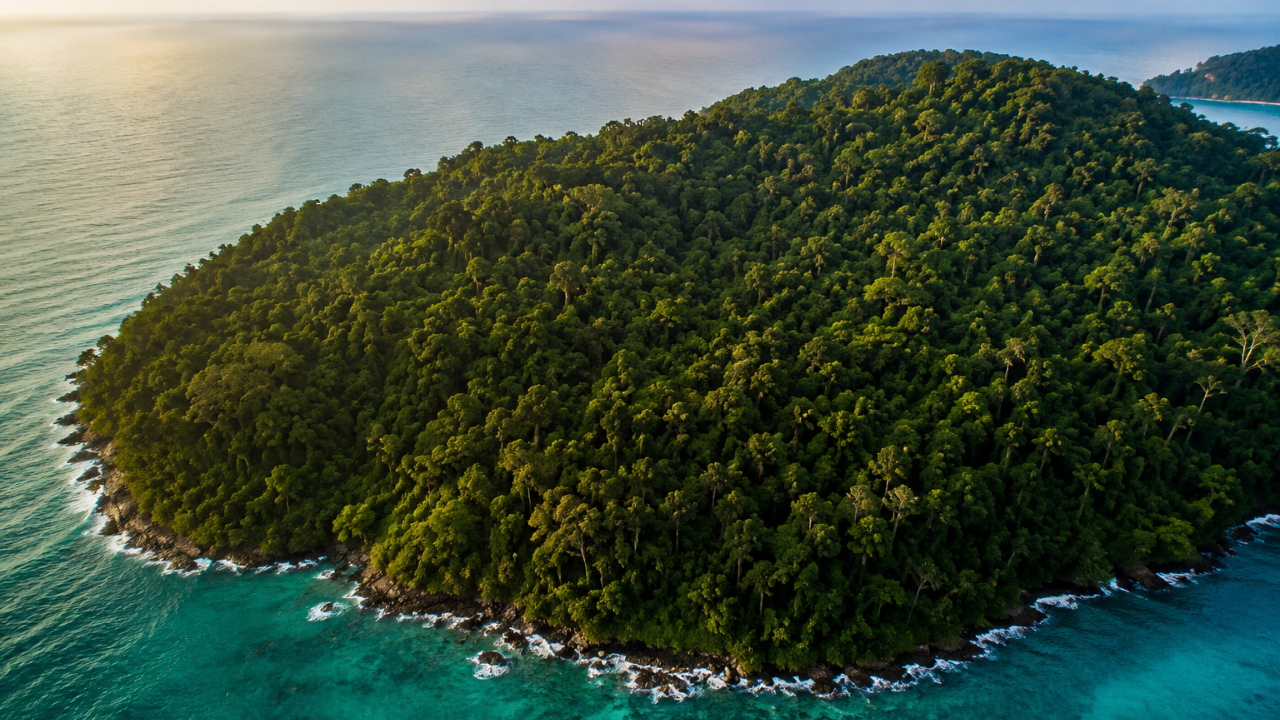
Roughly 33 kilometers off the coast of São Paulo, Brazil, sits a small island covered in dense, sun-dappled rainforest. From a passing boat, it looks almost peaceful, the kind of untouched paradise most people would want to explore. Getting any closer than that, though, is against the law. Snake Island Brazil, officially known as Ilha da Queimada Grande, is one of the only places on Earth where an entire government has banned human beings from setting foot, not to protect a monument or a military secret, but to protect people from a creature that rules the island completely.
An Island Sealed Off by Federal Decree
Since the 1920s, the Brazilian Navy has enforced a strict ban on civilian access to Ilha da Queimada Grande. Nearly a century later, that restriction has never been lifted. The only people permitted to set foot on the island today are licensed scientific researchers, and even they are required to travel with a physician on board and follow federal permit requirements before the Navy allows their boat anywhere near the shoreline.
This isn’t a case of restricted access for tourism management or environmental sensitivity in the usual sense. The island is closed because walking across it poses a genuine, well-documented risk to human life, and Brazilian authorities have decided, for exactly the reason you’d expect, that the safest policy is simply not letting anyone go there at all.
The Creature That Claimed the Entire Island
The reason for the ban lives in the island’s lower canopy, and there are a great many of them. Ilha da Queimada Grande is the only place on the planet where the golden lancehead pit viper (Bothrops insularis) exists in the wild. Estimates place the population somewhere between 2,000 and 4,000 individual snakes, concentrated almost entirely within roughly 26 hectares of rainforest on an island that spans only about 43 hectares in total.
That density puts golden lancehead vipers among the highest concentrations of venomous snakes found anywhere in the world. The species is a close relative of the fer-de-lance, already considered one of the most dangerous snakes across the Americas, but the golden lancehead’s venom is estimated to be three to five times more potent than that of its closest mainland relatives.
Why the Venom Evolved to Be This Strong
The intensity of the golden lancehead’s venom isn’t random. Scientists believe it developed as a direct evolutionary response to the island’s limited food supply. Unlike mainland lancehead vipers, which can afford to bite prey and then track it as the venom slowly takes effect, the island’s snakes rely almost entirely on birds as their primary food source, specifically two species: the southern house wren and the Chilean elaenia.
A bird that’s bitten but manages to fly even a short distance before dying represents a meal permanently lost in dense rainforest canopy. Researchers believe this pressure drove the evolution of exceptionally fast-acting, high-potency venom, capable of killing prey almost instantly rather than allowing it time to escape. In humans, a bite from a golden lancehead can cause severe tissue damage, internal hemorrhaging, kidney failure, and, without immediate antivenom treatment, death within a matter of hours.
Trapped by Rising Seas, Not Design
The story of how so many venomous snakes ended up concentrated on one small island begins roughly 11,000 years ago, at the close of the last Ice Age. As global sea levels rose, the landmass that would become Ilha da Queimada Grande separated from the Brazilian mainland, stranding a population of lancehead vipers on an increasingly isolated patch of rainforest.
Cut off from mainland predators and cut off from the option of retreating elsewhere, the isolated snake population adapted to their new, contained environment over thousands of years of evolutionary pressure. With no ground-dwelling predators to keep their numbers in check and a stable food source in the island’s migratory bird population, the vipers thrived, eventually reaching the extraordinary density found today.
A Protection That Runs in Both Directions
It would be easy to assume the restriction exists purely to keep humans safe from the snakes, but conservationists frame the relationship as protection running in both directions. The golden lancehead viper is currently classified as critically endangered, existing nowhere else on the planet outside this single island. Uncontrolled human visitation carries real risks for the species itself, including the accidental introduction of invasive predators, disease, or simple habitat disruption from increased foot traffic.
By strictly limiting access to permitted researchers, Brazilian authorities are simultaneously protecting a uniquely evolved, irreplaceable species while also preventing what would almost certainly become a steady stream of snakebite emergencies if the island were ever opened to public visitation.
A Reminder of What Nature Looks Like Without Human Interference
Ilha da Queimada Grande offers something genuinely rare in the modern world: a fully intact ecosystem that has developed for thousands of years with almost zero human interference. No settlements, no agriculture, no roads, no tourism infrastructure, just a rainforest ecosystem that evolved entirely on its own terms, shaped exclusively by the pressures of isolation, prey availability, and survival.
It stands as one of the few places left on Earth where wildlife, quite literally, still holds the deed to the land, defended not by fences or security guards, but by a federal decree acknowledging what any visitor would quickly discover on their own: this particular island was never really meant for us.