
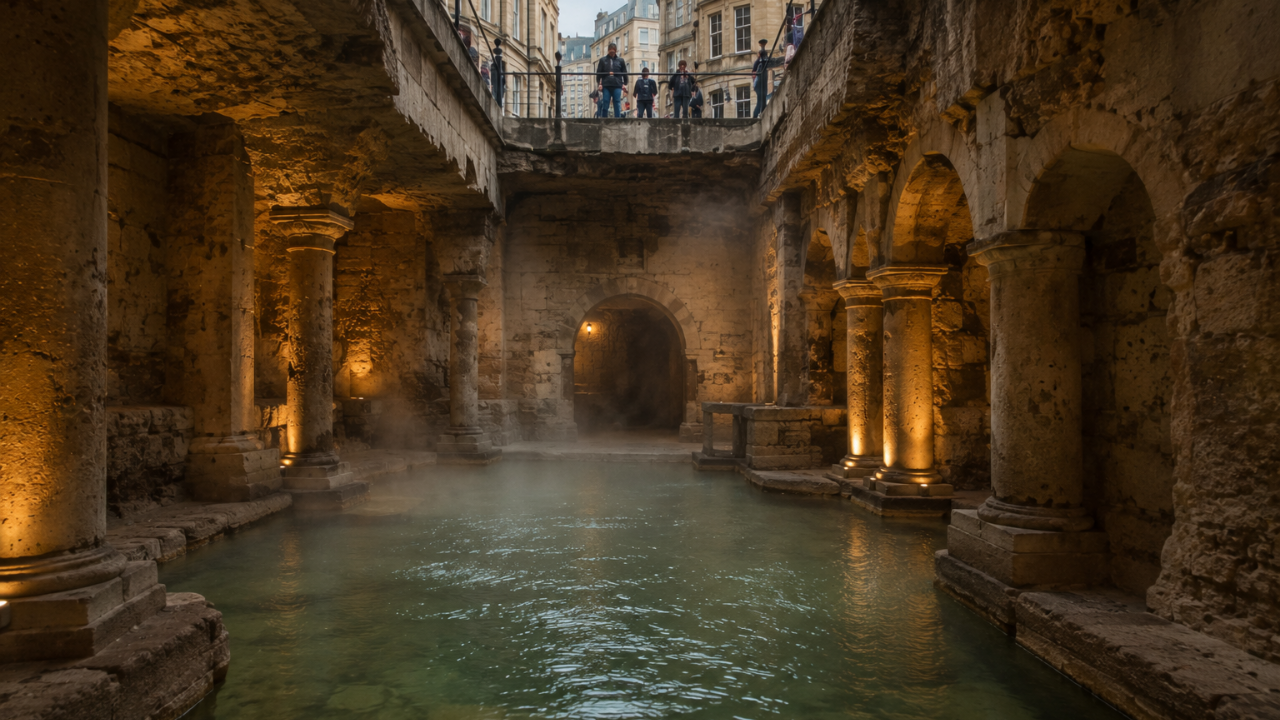
The Roman Baths in Bath, England, are one of the best-preserved examples of ancient engineering still standing today, hidden for centuries directly beneath a busy modern city. Walk through the city on any ordinary afternoon, and you’ll see exactly what you’d expect from a modern town: pubs, shops, restaurants, tourists weaving through traffic. What most people don’t realize as they walk those streets is that directly beneath their feet sits a nearly 2,000-year-old bathhouse, still fed by the same natural hot spring the Romans built around almost two millennia ago.
A Spring the Romans Didn’t Discover, But Perfected
Long before the Romans ever arrived in Britain, the hot spring beneath Bath was already considered special. Archaeological evidence suggests the site functioned as a place of worship for local Celtic tribes, who dedicated the spring to a goddess named Sulis. When Roman forces eventually settled the area, they didn’t dismiss the existing spiritual significance of the site. Instead, they merged it with their own religious traditions, associating Sulis with their goddess Minerva, and began constructing an elaborate temple and bathing complex around the naturally occurring hot water.
What made this location genuinely remarkable, then and now, is the spring itself. Unlike most Roman baths across the empire, which relied on aqueducts and fires to heat water artificially, Bath’s spring produces genuinely hot water naturally, rising from deep underground at a consistent temperature of around 46 degrees Celsius, or roughly 115 degrees Fahrenheit. The Romans recognized this as something worth building an entire complex around, and they engineered it with striking sophistication for the era, including lead-lined pools, elaborate plumbing, and a network of rooms specifically designed for the ritual of Roman bathing culture.
Buried Without Anyone Meaning to Hide It
The bathhouse wasn’t deliberately concealed. It simply disappeared gradually, the way so many ancient structures do, buried under centuries of flooding, rebuilding, and the slow accumulation of a city growing directly on top of its own history. As the Roman presence in Britain faded and the surrounding town changed hands across generations, the original bath complex sank beneath layers of silt, debris, and new construction, eventually vanishing almost entirely from view and public memory.
For close to 1,500 years, the elaborate Roman engineering beneath Bath sat essentially forgotten, buried directly under a town that had no clear idea of the scale of what was sitting beneath its streets.
An Accidental Rediscovery
The bathhouse’s return to the surface happened almost by accident. In the late 19th century, a local official named Major Charles Davis was investigating what seemed like a routine plumbing issue, a leak connected to the city’s bathing facilities. What began as an unglamorous maintenance inquiry quickly turned into one of Britain’s most significant archaeological discoveries. As excavation continued, it became clear that Davis hadn’t stumbled onto a minor Roman relic. He had uncovered an entire, remarkably intact Roman bathing complex, still structurally coherent after nearly two thousand years underground.
The scale of the discovery reshaped what historians understood about Roman Britain. What emerged wasn’t a few scattered stones or fragments, but a genuinely complete complex: a Sacred Spring chamber, a Great Bath lined with the original Roman lead, changing rooms, heated chambers known as a laconicum, and a temple courtyard, all connected by the same channels and structures the Romans had originally engineered.
A City Built Directly on Top of Its Own Past
What makes Bath such a striking example of hidden history isn’t just the age of the ruins, it’s how completely ordinary modern life continues directly above them. Pubs, shops, churches, and restaurants operate in buildings that sit just above ancient stonework still channeling the same thermal water the Romans once bathed in. Tourists and locals walk past these buildings every day, largely unaware that a fully preserved Roman religious and social complex exists just beneath the pavement.
Today, visitors can descend directly into the excavated remains, walking through rooms and passageways that Roman citizens used nearly two thousand years earlier, while the modern city continues operating at street level immediately above them. The hot spring itself never stopped flowing throughout any of this. It continued producing hot water uninterrupted through the site’s abandonment, burial, and eventual rediscovery, indifferent to the centuries of human history unfolding above it.
Engineering That Outlasted the Empire That Built It
There’s something quietly humbling about a piece of infrastructure this old still functioning, in some form, this many centuries later. The Roman Empire that built Bath’s original complex collapsed more than 1,500 years ago. The language spoken by the people who engineered it hasn’t been the dominant tongue of the region in centuries. And yet the physical water channels, lead lining, and structural engineering they designed remained intact enough to be recognized, excavated, and preserved almost fully intact when rediscovered.
It’s a rare, tangible reminder that beneath the surface of modern cities, in more places than most people realize, entire chapters of human history are still sitting exactly where they were built, simply waiting for the right leak, excavation, or accident to bring them back into view.