
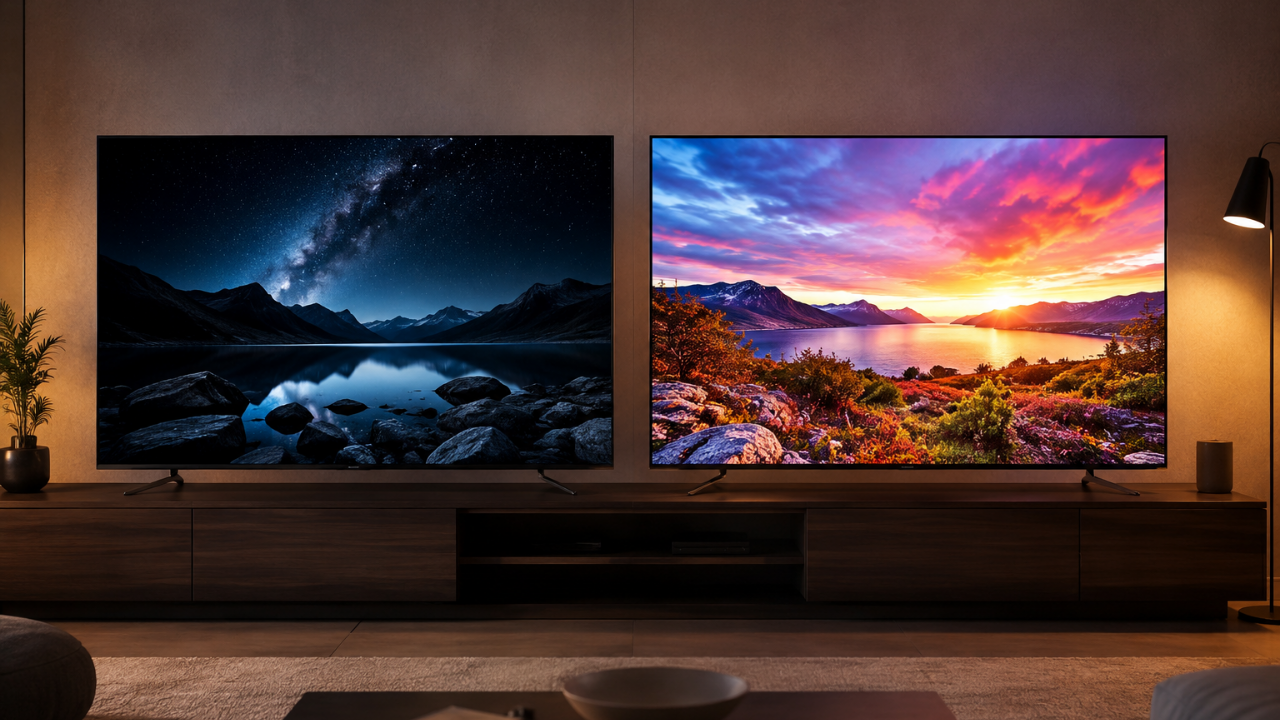
A few years ago, a gaming enthusiast noticed something strange on his OLED television. A faint outline of his game’s health bar and minimap had started appearing on screen, even when he switched to watching a movie. The images weren’t a glitch. They were permanently burned into specific pixels, worn down after thousands of hours of the same static graphics sitting in the exact same spot. His television wasn’t broken. It was doing exactly what OLED chemistry predicts it will do under those conditions.
Stories like this sit at the center of one of the most common questions TV shoppers ask without realizing they’re really asking about chemistry: is OLED or QLED the smarter long-term investment? The answer has less to do with marketing claims and everything to do with how each panel physically produces light in the first place.
Two Screens, Two Completely Different Ways of Glowing
OLED panels are built from organic compounds, materials that emit their own light the moment electricity passes through them. Every single pixel controls its own brightness individually, which is why OLED can produce a true, absolute black, simply by switching individual pixels off entirely.
QLED, despite the name’s visual similarity to OLED, works on an entirely different principle. It’s fundamentally a standard LED-backlit LCD screen, enhanced with a quantum dot filter layer that sharpens color accuracy and boosts brightness. There’s no self-illuminating pixel technology involved. An inorganic backlight sits behind the entire panel, shining uniformly through the display layer.
That single distinction, organic self-lit pixels versus an inorganic backlight, is the root cause of nearly every difference in how these two technologies age over years of use.
Why That Gaming Screen Got Permanently Marked
Organic material, by its nature, wears down with use. Every time an OLED pixel lights up, it degrades microscopically. Under normal, varied viewing, movies one night, a different streaming show the next, a browser window the day after, that wear spreads evenly across the panel and stays invisible for years.
The problem starts when the same image sits in the same spot for extended stretches: a channel logo, a persistent scoreboard, or, as in the gaming case above, a fixed health bar and map overlay. Those specific pixels age faster than the surrounding ones, eventually leaving a faint, permanent ghost image behind, visible even after the content changes. This is the phenomenon known as burn-in, and independent testing labs have documented it clearly: OLED panels forced to display identical static content around 20 hours a day showed visible burn-in within months, while panels running varied content showed little to no degradation even after passing 4,000 to 5,000 cumulative hours of use.
QLED sidesteps this entire category of risk. Because its inorganic backlight doesn’t wear the way organic material does, manufacturers can rate QLED panels for tens of thousands of operating hours without the same asterisk OLED carries.
The Quieter Aging Process Almost No One Talks About
Burn-in gets the headlines, but there’s a second, more universal aging mechanism happening inside every OLED screen, regardless of what’s displayed on it. OLED color comes from red, green, and blue organic subpixels working together, and blue subpixels require noticeably more energy to produce light than red or green ones do.
That extra energy demand means blue elements physically wear out faster than the rest of the panel, even under completely normal, varied use. Over years of ownership, this shows up in two subtle but measurable ways: a gradual dimming of overall picture brightness, and a slow shift in color accuracy as the weakening blue channel throws off the panel’s original color balance. QLED, running on a more chemically stable inorganic backlight, tends to hold its original brightness and color balance more consistently across the same multi-year stretch.
What This Actually Looks Like in Real Households
For a typical household watching a healthy mix of content, roughly six hours a day, both current-generation OLED and QLED panels are realistically expected to remain visually solid for five to seven years before either burn-in concerns or general backlight aging become noticeable to an average viewer.
The real difference isn’t the overall timeline. It’s the failure pattern. OLED’s risk concentrates specifically around static, repetitive content: gaming HUDs, 24-hour news tickers, security feeds left running for hours on end. Outside those specific scenarios, modern OLED panels include active defenses, automatic pixel shifting, periodic panel refresh cycles, that meaningfully reduce burn-in risk for ordinary, varied home viewing. QLED’s aging pattern, by contrast, is more uniform: a slow, even decline in backlight brightness across the entire screen, without the localized image-retention risk that worries some OLED owners.
The One Variable That Affects Both Technologies Equally
Regardless of which panel sits in the living room, heat quietly accelerates wear on both technologies, just through different mechanisms. Elevated operating temperatures speed up degradation in organic OLED compounds and in the LED components powering a QLED backlight alike. Running either display at consistently high brightness generates more internal heat, compounding long-term wear either way.
Owners looking to genuinely extend a screen’s working life can do so simply by keeping brightness around 75 percent or below in typical home lighting, rather than defaulting to maximum brightness out of the box.
So Which Screen Actually Wins the Long Game?
The honest answer isn’t about which technology is objectively “better built.” It’s about matching each screen’s specific vulnerability to how it will actually be used. A household that watches varied streaming content and rarely leaves static images on screen for hours will likely never encounter OLED’s burn-in risk in any meaningful way, and some flagship OLED models now carry manufacturer warranties explicitly covering burn-in for up to a decade. A household that leans heavily on static-heavy use, competitive gaming, continuous news, security monitoring, will find QLED’s inorganic backlight offers a more predictable, lower-maintenance lifespan without needing to think about it at all.
That gamer’s ghost-imaged health bar wasn’t a manufacturing defect or bad luck. It was organic chemistry behaving exactly as physics predicts under sustained, repetitive stress, a small but genuinely useful reminder that the technology sitting behind your screen matters just as much as what’s playing on it.