Doctor Who Daleks are now instantly recognizable across popular culture, but their origin story starts with a shockingly small budget. In 1963, a BBC designer named Raymond Cusick was handed a script description for a new alien villain: “hideous machine-like creatures, no human features, legless, moving on a round base.” He also received something far less inspiring: a production budget of just £250 to bring the entire concept to life.
A Job Nobody Expected to Matter
The show was Doctor Who, and the creatures were the Daleks, now instantly recognizable across popular culture as the series’ signature villains. At the time, though, nobody involved treated the assignment as anything particularly significant. Cusick wasn’t even the BBC’s first choice for the job. The design had originally been assigned to a young staff designer named Ridley Scott, who would later go on to direct Alien and Blade Runner, but scheduling conflicts meant the task landed with Cusick instead.
Working from writer Terry Nation’s vague, unsettling script description, Cusick reportedly demonstrated his early concept for how the creatures should move by sliding a salt or pepper pot across a table to a colleague, illustrating the gliding, legless motion he wanted the final design to achieve.
Building a Monster From a £250 Budget
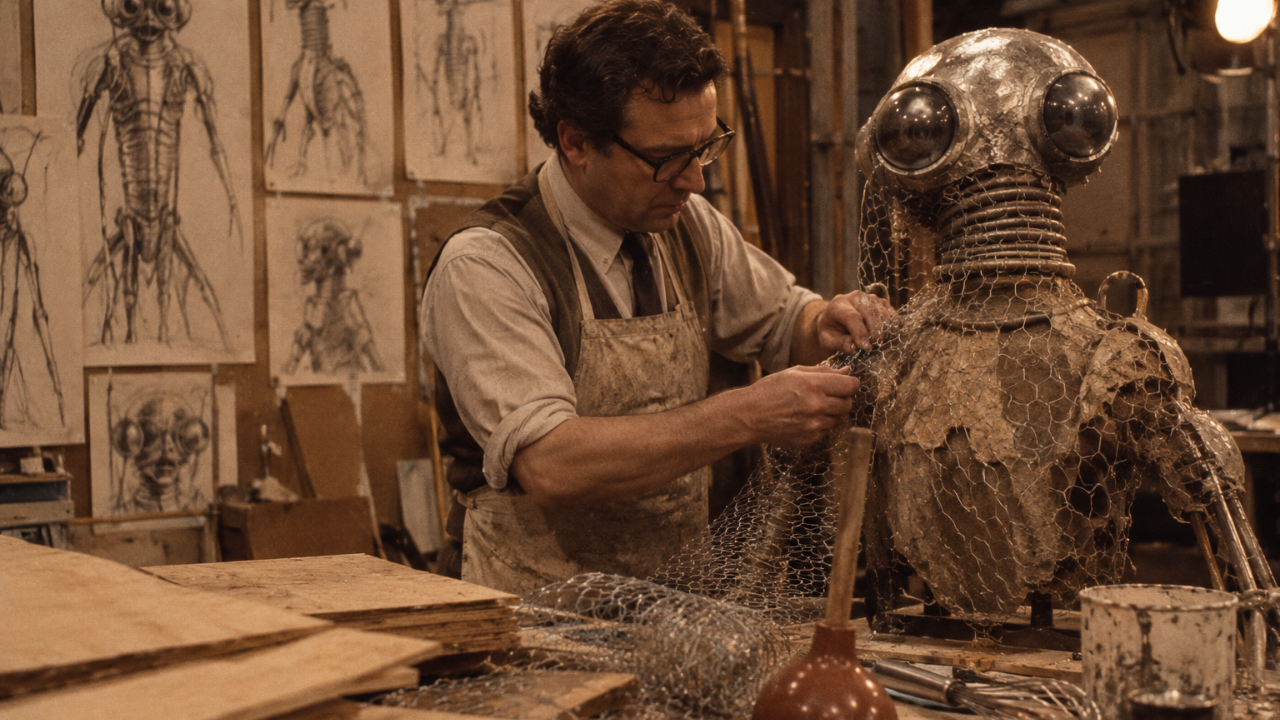
What Cusick didn’t have was money, and in early 1960s British television, that constraint shaped almost every creative decision on set. Rather than commissioning custom-built mechanical components, Cusick and the production team assembled the now-iconic Dalek shape out of ordinary, inexpensive materials readily available around the studio: plywood for the body’s core structure, chicken wire to help form its rounded shape, and a repurposed car gear stick incorporated into the internal mechanics.
The most famous decision, though, involved the creature’s signature front appendage. Nation’s original vision called for something resembling a sinister mechanical claw. With no budget to engineer anything close to that, the production settled instead on an object pulled directly from everyday household use: a sink plunger, mounted on the Dalek’s front as its primary manipulator arm. Paired alongside it was another kitchen staple repurposed for menace: a kitchen whisk, transformed into the creature’s weapon appendage.
From Household Objects to Cultural Icon
It would have been reasonable to assume that a monster built from plumbing tools and kitchen utensils might come across as unintentionally comedic rather than frightening. Instead, the finished design became genuinely unsettling to audiences, an alien form so mechanically alien and visually strange that its household origins were nearly impossible to detect once assembled, painted, and filmed under studio lighting.
The impact on the show itself was immediate and dramatic. Doctor Who’s viewership had hovered around six to seven million viewers before the Daleks’ debut. Once the creatures appeared on screen, audience figures reportedly surged past nine million, roughly doubling the show’s popularity almost overnight and helping secure its future at a time when the series had faced real cancellation concerns.
No Recognition, No Royalties
Despite designing what would become one of the most commercially successful and culturally embedded creature designs in television history, Cusick received no financial windfall from his creation. As a salaried BBC staff designer at the time, he wasn’t entitled to royalties from Dalek merchandise, unlike scriptwriter Terry Nation, who did receive ongoing royalty payments as the creatures’ credited creator. Cusick reportedly felt this arrangement was unfair given the sheer scale of merchandising revenue the Dalek design eventually generated, though the design itself remained his most significant professional legacy regardless.
A Prop Philosophy Born From Necessity
What makes the Daleks’ origin story genuinely compelling isn’t just the specific household items involved, it’s what the entire approach reveals about early British television production more broadly. In an era without the budgets, technology, or visual effects resources available to film productions, BBC designers routinely had to solve enormous creative problems using whatever ordinary materials happened to be available and affordable.
Rather than limiting the show’s imagination, this constraint arguably helped define its distinctive visual identity. The Dalek’s design has remained recognizably intact for more than sixty years, undergoing only minor refinements while retaining the same fundamental silhouette Cusick assembled from plywood, chicken wire, a plunger, and a whisk on a budget that wouldn’t cover a single day’s catering on most modern film productions.
A Reminder That Constraint Can Build Icons
There’s something quietly remarkable about the fact that one of science fiction’s most enduring visual designs wasn’t the product of unlimited resources or cutting-edge technology, but of a single designer working within a budget so tight it eliminated almost every conventional option available to him. Cusick didn’t have the means to build the menacing mechanical claw originally envisioned in the script. What he built instead, out of necessity rather than artistic preference, became something far more lasting: a design so effective that audiences never noticed, and largely still don’t, that they were looking at repurposed plumbing and kitchenware.