
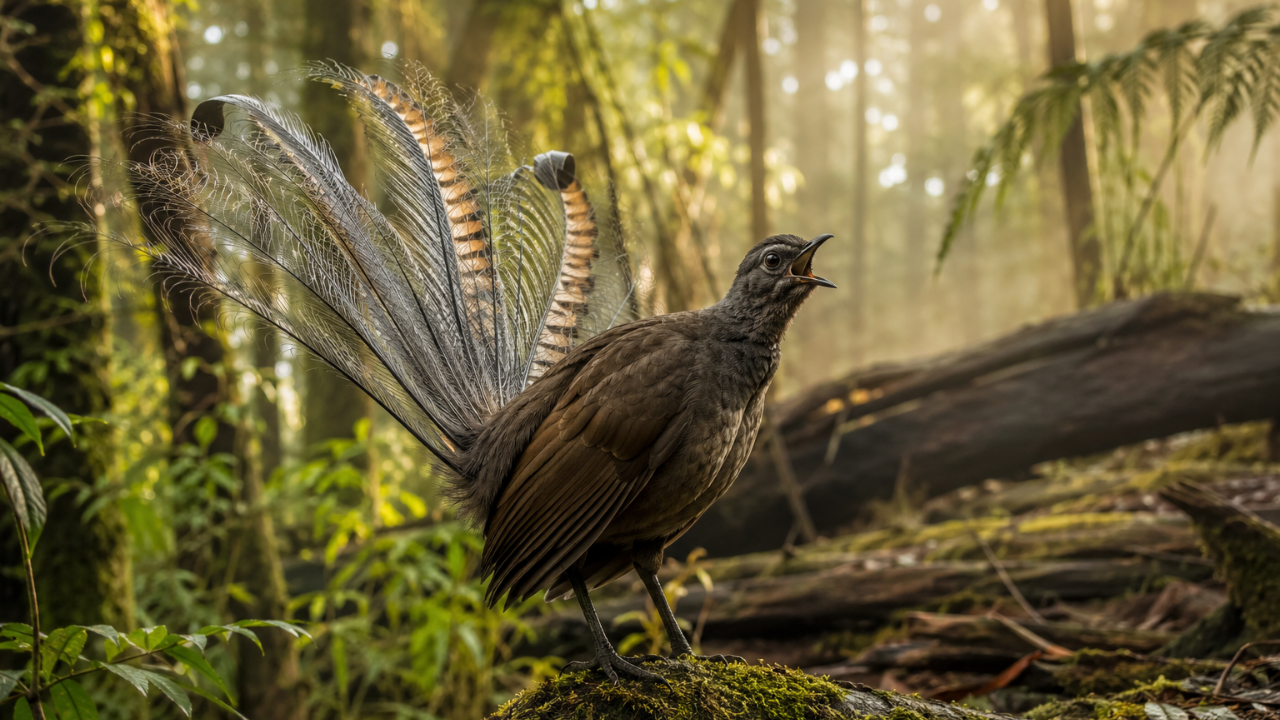
Lyrebird mimicry is the reason a forest in southeastern Australia can suddenly sound like a construction site with no machine anywhere in sight. Somewhere in the damp, fern-choked undergrowth, a bird just made a noise that sounds exactly like a chainsaw revving up. There’s no logging crew nearby. There’s no engine hidden in the bushes. Just a brown, pheasant-sized creature standing on a mound of dirt, doing what the superb lyrebird does better than almost any other animal on Earth – turning itself into a living tape recorder.
Meet the Bird With a Built-In Microphone
The superb lyrebird doesn’t look like it should be capable of anything extraordinary. It’s ground-dwelling, shy, and would rather sprint into the undergrowth than be seen. But open its beak, and the illusion shatters immediately. This bird can reproduce kookaburra calls, other forest species, and even mechanical sounds with a level of accuracy that regularly fools scientists, birdwatchers, and other birds themselves.
Males are the real showmen. During courtship season, they build small display mounds and belt out performances where roughly 70 to 80 percent of what they sing isn’t even their own song – it’s borrowed, stitched together from everything they’ve ever heard. A female lyrebird isn’t just listening to a mate; she’s essentially auditioning a one-bird cover band.
The Secret Weapon: An Organ Humans Don’t Have
Humans make sound with a larynx, a fairly simple structure sitting at the top of the windpipe. Birds use something entirely different: the syrinx, located deeper down, right where the trachea splits toward the lungs. Unlike our larynx, the syrinx can be controlled on two independent sides at once, giving birds the theoretical ability to produce two different sounds simultaneously.
In lyrebirds, this organ is extraordinarily refined. Fine muscular control lets them shape pitch, rhythm, and even the resonance and texture of a sound, not just its rough melody. That’s the difference between a bird that can “sort of” sound like a car alarm and one that can trigger a genuine double-take from a person standing nearby.
When the Forest Starts Sounding Like a Construction Site
This is where the story gets genuinely strange. Lyrebirds don’t limit their repertoire to the natural world. Individuals living near logging operations, roads, or construction sites have been documented picking up chainsaws, car alarms, camera shutters, drills, and even human voices, weaving them seamlessly into their calls.
One of the most famous cases involves a lyrebird named Chook, who lived at Adelaide Zoo and became internationally known for mimicking construction equipment he had heard years earlier during nearby building work – a striking demonstration of just how long-term the bird’s vocal memory can be. Footage of lyrebirds imitating camera shutters and chainsaws, popularized in part by David Attenborough’s nature documentaries, is what first introduced millions of people to this species and made it something of a viral sensation decades before “viral” was even a word for it.
It’s worth noting, though, that scientists have pointed out an important nuance here: many of the most famous chainsaw and machinery recordings trace back to captive birds in zoo environments rather than wild populations recorded in the forest. Wild lyrebirds are absolutely prolific mimics – but the specific, headline-grabbing “chainsaw impression” clips that circulate online are disproportionately associated with birds like Chook, not necessarily typical behavior across the wild population. That distinction doesn’t make the ability any less real; it just means the full picture is a little more layered than the viral clips suggest.
Fooling the Experts – Literally
It isn’t just casual observers who get taken in. A study fittingly titled “Fooling the Experts,” led by researcher Anastasia Dalziell alongside Robert Magrath, tested how convincing lyrebird mimicry really is. Researchers played recordings of lyrebirds imitating the grey shrike-thrush, a species with a notably complex song, back to real shrike-thrushes in the wild.
The result was striking: the shrike-thrushes often approached the speaker as though responding to one of their own, struggling to reliably tell the mimicry apart from the genuine article. As Dalziell put it, the sophistication of the copy was enough to catch out the very species being imitated. Researchers do caution that this was measured for one specific model species under playback conditions, and that shrike-thrushes performed better at telling the difference when given other contextual clues – so it’s more accurate to say the birds are “often fooled” rather than “always fooled.” Even with that caveat, it’s a rare case of an animal’s vocal trickery being tested and validated against the very creatures it’s supposed to be deceiving.
Why Would a Bird Bother Learning a Car Alarm?
It’s tempting to assume this is just a quirky party trick, but biologists generally frame it around survival and reproduction. A male lyrebird’s mimicry showcases vocal control, memory, and overall fitness – qualities that matter enormously when trying to attract a mate. The more elaborate and varied the performance, the more impressive the male appears.
There’s also a simpler explanation for why human sounds specifically show up in the mix: lyrebirds mimic whatever is loud, distinctive, and repeated often enough in their environment. If a chainsaw runs for hours near a nesting territory, or a construction site hammers away for weeks, that noise becomes part of the local soundscape – and lyrebirds are, at their core, expert listeners. They don’t distinguish between “natural” and “artificial” sound; they simply absorb what’s around them.
A Living Record of a Changing World
There’s something quietly poignant buried in all of this. Every time a lyrebird incorporates the whine of machinery into its song, it’s essentially preserving a moment of human intrusion into wild spaces, replaying it back for decades. A bird recorded today mimicking a chainsaw is, in a sense, holding onto an acoustic memory of a forest disturbed by logging – long after the machines have gone silent and moved on.
It reframes the lyrebird as something more than an oddity. It becomes an unintentional historian of sound, cataloguing whatever intrudes into its world, whether that’s the call of a neighboring bird species or the mechanical hum of industry creeping closer to its habitat. In an era where human noise increasingly overlaps with wild spaces almost everywhere on the planet, the lyrebird might be one of the few creatures actually documenting that overlap, one perfectly mimicked chainsaw at a time.