
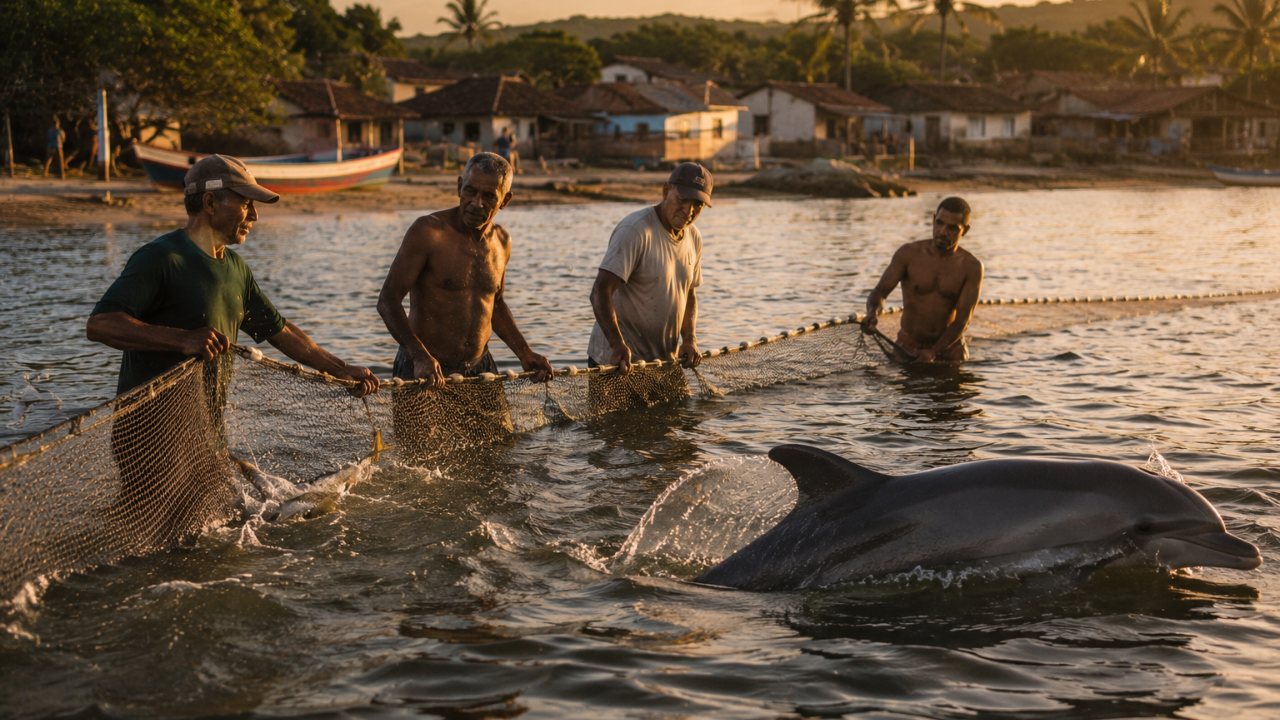
Laguna dolphins do something almost no other wild animals on Earth are known to do: they actively work alongside humans to catch fish. In a quiet coastal town in southern Brazil, something happens every fishing season that sounds almost too strange to be real. Fishermen wade waist-deep into murky lagoon water, nets in hand, unable to see a single fish beneath the surface. They aren’t guessing. They’re watching the wild dolphins swimming beside them, waiting for a signal that tells them exactly when to throw their nets.
A Partnership Passed Down for Generations
The town is Laguna, on Brazil’s southern coast, and local newspaper records document this dolphin-fisher relationship stretching back more than 140 years. The tradition has been passed down through generations of both fishing families and, remarkably, dolphin families, making it one of the longest continuously observed examples of wild animal-human cooperation ever recorded.
The species involved are common bottlenose dolphins, and the fish they’re after are silvery mullet that migrate through the region’s estuaries in large schools. On their own, the fishermen would struggle to locate these schools in the lagoon’s murky water. The dolphins solve that problem for them, and in return, get something valuable out of the arrangement themselves.
How the Underwater Signal System Actually Works
The mechanics of this cooperation are surprisingly precise. As mullet schools move through the lagoon, cooperative dolphins actively herd the fish toward shore, driving them into the shallow water where fishermen are standing ready. Because the fishermen can’t see through the murky water to track the fish directly, they instead watch the dolphins for cues.
When a dolphin gives a distinctive signal, typically a deep dive, a tail slap, or lifting its head above the surface, that’s the fishermen’s cue to cast their nets immediately. The timing matters enormously. Cast too early or too late, and the opportunity is lost. Researchers who spent years studying the partnership found that fishermen who paid closer attention to specific, reliable dolphin partners consistently caught more fish than those who didn’t.
Proof That Both Sides Actually Benefit
For decades, scientists understood that the fishermen clearly profited from this arrangement, but they weren’t certain whether the dolphins actually gained anything in return, or if they were simply present incidentally, with the humans learning to interpret behavior that had nothing to do with cooperation at all.
That uncertainty was resolved through more than a decade of dedicated research led by biologist Mauricio Cantor and colleagues at Oregon State University’s Marine Mammal Institute, working alongside researchers at Brazil’s Federal University of Santa Catarina. Using drones, underwater sonar, sound recordings, and GPS tracking on 177 human fishers, the team confirmed that when fishermen cast their nets in response to a dolphin’s signal, it breaks up the tightly packed mullet school, making individual fish significantly easier for the dolphins to catch on their own. The nets essentially do the dolphins’ work for them, scattering prey that would otherwise stay clustered and harder to isolate.
This is now considered a genuinely rare example in nature: two top predators, from entirely different species, actively coordinating their hunting strategies for mutual gain, without any training, captivity, or artificial incentive involved.
Not Every Dolphin Joins In
One of the more fascinating discoveries from this research is that cooperative behavior isn’t universal, even among dolphins living in the exact same waters. Of a local population of roughly 60 to 65 dolphins studied in Laguna, researchers found that only about 40 regularly participated in cooperative fishing with humans. The rest never engaged in the practice at all, despite having identical access to the same fish and the same fishermen.
Researchers also discovered that the cooperative dolphins tend to socialize with each other more than with non-cooperative dolphins in the same population, suggesting the behavior may function almost like a shared cultural tradition passed between closely bonded individuals rather than something hardwired into the species. Fishermen in Laguna have even given individual names to their most reliable dolphin partners, some of whom have cooperated consistently for more than 15 years.
A Fragile Tradition Facing an Uncertain Future
As remarkable as this partnership is, researchers studying it have raised serious concerns about its long-term survival. Mullet populations in the region have declined significantly over the past decade due to overfishing, and as fish numbers drop, so does the incentive for either species to maintain the cooperative relationship. Scientists involved in the research estimate that, if current trends continue, this unique alliance could fade out entirely within the next 40 to 60 years.
Similar human-dolphin fishing partnerships have historically existed in scattered locations from Mauritania to Myanmar, but most have already disappeared over time. Laguna remains one of the last places on Earth where this kind of wild cooperation still survives, which has led some researchers to formally propose that Brazil designate the practice as protected cultural heritage, in hopes of preserving both the tradition and the specific population of dolphins that sustains it.
A Rare Kind of Trust Between Species
What makes the Laguna partnership so remarkable isn’t just its age or its practical benefits. It’s the sheer level of mutual trust required to sustain it, built entirely without captivity, training, or force, across generations of animals and humans who have simply learned to read each other’s behavior with extraordinary precision.
In a world where human-wildlife interactions are so often defined by conflict, displacement, or exploitation, Laguna offers something genuinely rare: proof that two intelligent species, given the right conditions, can build a working relationship based entirely on shared benefit, patiently maintained one fishing season at a time.