
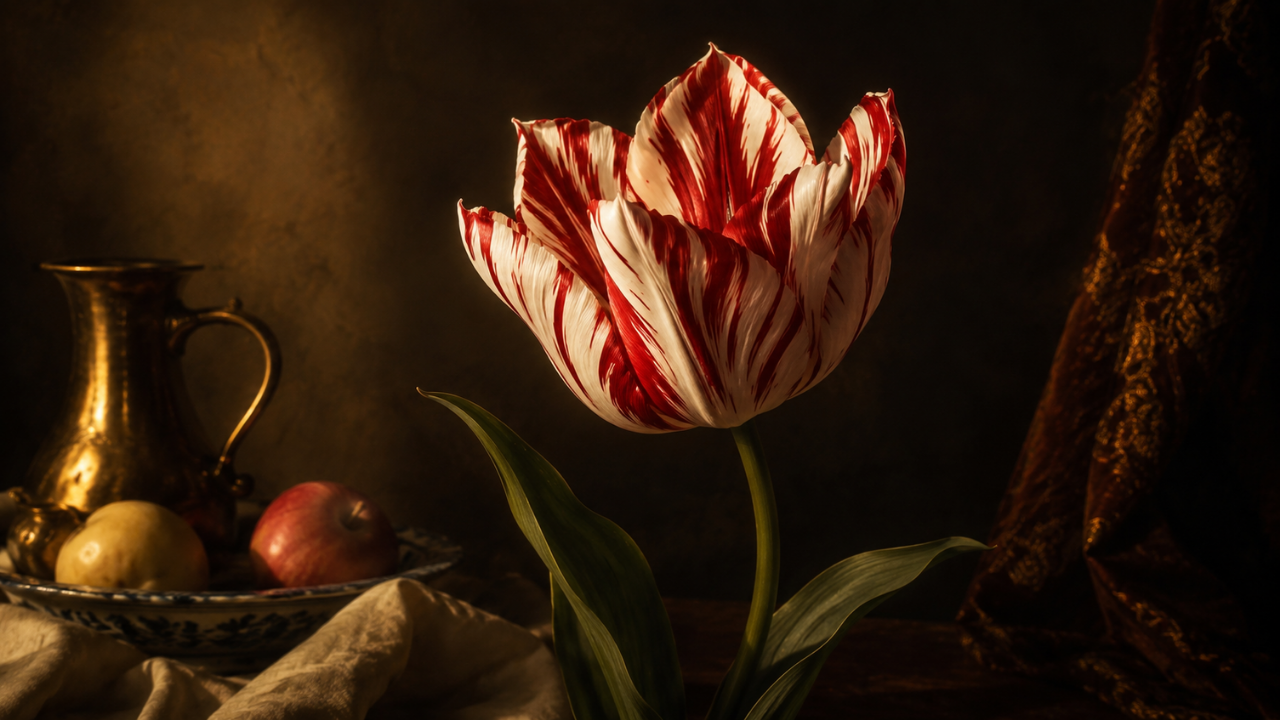
Tulip Mania began with a single strange fact: in February 1637, a flower bulb in Holland was worth more than a house on an Amsterdam canal – and within days, it was worth almost nothing. That flower wasn’t rare because of its beauty alone. It was rare because it was sick. A virus, invisible and completely misunderstood at the time, was quietly painting streaks onto tulip petals, and that accident of infection triggered the first documented financial bubble in human history. What follows is the strange, true story of how a plant disease convinced an entire country that flowers could make them rich.
A Flower That Wasn’t Supposed to Look Like That
Tulips themselves weren’t originally Dutch at all. The flowers arrived in the Netherlands from the Ottoman Empire in the mid-1500s, and Dutch botanist Carolus Clusius is credited with first cultivating them at the University of Leiden. Solid, single-colored tulips became popular fairly quickly – elegant, exotic, and fashionable among the wealthy merchant class of the Dutch Golden Age.
But every so often, a tulip would emerge looking nothing like its parent bulb. Instead of a clean, solid color, its petals displayed dramatic flame-like streaks – one color bleeding into another in unpredictable, almost hand-painted patterns. Growers had no idea why this happened, and because the effect couldn’t be reliably reproduced through breeding, these “broken” tulips became instant rarities.
The Culprit Nobody Could See
Centuries later, scientists identified what was actually happening: these dramatic color breaks were caused by what researchers now call the “Tulip breaking virus,” a pathogen that disrupts pigment distribution in the petals, creating the striped, flame-like patterns collectors prized so highly. In the 1600s, with no concept of viruses or microbiology, growers simply saw an unpredictable, seemingly magical mutation – and pursued it obsessively.
What made the situation even more explosive economically was a cruel irony built into the virus itself. The very same infection responsible for a bulb’s stunning coloration also gradually weakened the plant, meaning any given “broken” strain would slowly decline in supply over time, which only pushed its price higher as demand kept climbing. In other words, the more desirable a bulb became, the sicker – and rarer – it was simultaneously getting.
When a Flower Became Worth More Than a House
By the mid-1630s, this scarcity had spiraled into full-blown speculation. In 1636, an Amsterdam canal house cost somewhere between 3,000 and 5,000 guilders, while certain prized tulip bulbs were being valued at 4,000 to 6,000 guilders – meaning a single flower bulb could theoretically outprice a home. The most legendary variety of all, the Semper Augustus, became something like the Dutch Golden Age’s version of a supercar: a status symbol so extreme that owning one signaled serious wealth.
The speculative frenzy accelerated fast. At the peak of the mania, tulip bulb prices reportedly surged twentyfold within a single month, and by February 1637 a single bulb could theoretically be worth ten times a skilled craftsman’s entire annual income. Much of this trading didn’t even involve physical bulbs changing hands — buyers and sellers were often trading contracts and promissory notes for bulbs still sitting in the ground, flipping the paperwork multiple times before the flower had even bloomed.
The Collapse That Gave Economics a New Warning Label
The bubble peaked and then collapsed abruptly in February 1637, reportedly triggered by a failed bulb auction in the city of Haarlem where buyers simply stopped showing up. Once that happened, confidence evaporated almost instantly. Speculators who could no longer afford even the cheapest bulbs began to doubt prices would keep climbing, and the entire price structure for tulips collapsed almost overnight.
This crash is now widely cited as history’s earliest well-documented case of a speculative asset bubble – a moment when the price of something became completely detached from its actual, practical value, driven purely by the belief that someone else would pay even more for it later. It’s the same basic psychological pattern seen in dot-com stocks, cryptocurrency spikes, and housing markets centuries later.
Separating the Legend From What Actually Happened
Here’s where the story gets a genuinely interesting correction. The popular image of tulip mania – entire households bankrupted, ordinary chimney-sweeps and maids gambling away their life savings, people drowning themselves in canals out of financial despair – largely comes from a colorful 19th-century account written long after the fact.
Modern historian Anne Goldgar, who authored a detailed study of the period, has argued that many of these dramatic ruin stories are more myth than documented fact. Her research found only 37 individuals who could be confirmed to have paid more than 300 guilders for a single bulb – roughly a skilled craftsman’s annual wage – suggesting the truly extreme prices were rare outliers rather than a society-wide phenomenon. Goldgar’s findings suggest the actual buyers tended to be successful merchants and artisans already accustomed to speculating in luxury goods, not desperate members of the lower classes risking everything.
This doesn’t make tulip mania any less real – the price spike and crash genuinely happened – but it’s a useful reminder that even our most famous cautionary tales about market madness often get exaggerated with each retelling.
What a 400-Year-Old Flower Bubble Teaches Modern Markets
What makes tulip mania endlessly relevant isn’t really the flowers at all – it’s the underlying human behavior the story exposes. A biological accident created genuine scarcity, scarcity created status appeal, status appeal created speculation, and speculation eventually detached completely from the object’s actual usefulness. None of that requires tulips specifically; it’s a template that has repeated itself with railway stocks, real estate, internet startups, and digital currencies ever since.
The virus is almost a footnote to the real lesson: markets don’t actually price objects, they price stories about objects – stories about rarity, status, and the expectation that value will keep climbing. Once enough people believe the story, the price can genuinely detach from anything the underlying asset can objectively deliver. Tulip breaking virus just happened to be the biological accident that got that story started first.
The Flower That Outlived Its Own Bubble
There’s a strange kind of poetry in how this story ends. Most of the original “broken” tulip strains that fueled the mania, including the legendary Semper Augustus, have since died out entirely, ultimately overwhelmed by the very virus that made them famous. The flowers that once rivaled houses in value simply don’t exist anymore – but the pattern of human behavior they triggered never went away. Every generation since has found its own version of the broken tulip: something rare, something desirable, and something that convinces enough people, at least for a while, that the price can only go up.