
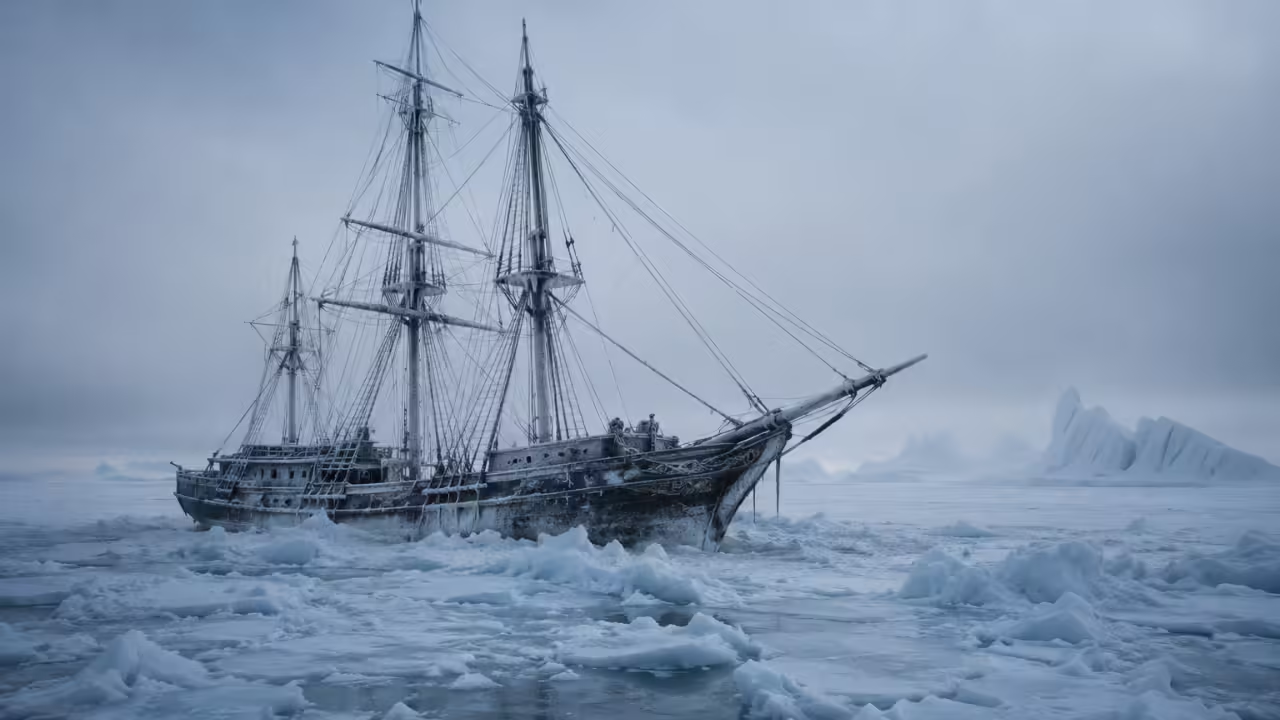
In the summer of 1845, two ships sailed out of England carrying 129 men, a mission to chart the final unmapped stretch of the Northwest Passage, and enough confidence in British naval superiority that failure was barely considered a possibility. None of those men ever returned home.
For nearly two centuries, the Franklin Expedition mystery has haunted historians, obsessed researchers, and inspired countless theories – some scientific, some closer to folklore. But in the last few years, something remarkable has happened. Modern forensic science, powered by DNA technology that didn’t exist even a generation ago, has begun pulling names, faces, and final moments out of the ice – piece by piece, bone by bone.
A Mission Built on Overconfidence
Sir John Franklin, an experienced Arctic explorer, was handed command of what was, at the time, considered a near-guaranteed success. His two ships – HMS Erebus and HMS Terror – were reinforced for ice travel, stocked with several years’ worth of preserved food, and crewed by some of the Royal Navy’s most capable sailors.
The expedition’s goal was straightforward on paper: find and chart the final missing link of the Northwest Passage, a sea route connecting the Atlantic and Pacific through the Canadian Arctic. Britain had spent decades chasing this route, and Franklin’s voyage was expected to finally close the gap. Instead, both ships vanished into the ice, and with them, every single man aboard.
Silence, Then Search Parties
When no word came back for over a year, concern turned into alarm. Eventually, more than three decades of search expeditions were launched – funded by the British government, the Navy, and even Franklin’s own wife, Lady Jane Franklin, who refused to accept that her husband’s fate would remain unknown.
What those search parties gradually pieced together painted a grim picture. Both ships had become trapped in thick pack ice near King William Island. After enduring roughly a year and a half stuck in place, the surviving crew made a desperate decision: abandon the ships and attempt to walk toward safety across hundreds of miles of frozen, unforgiving Arctic terrain. Every single one of them died in the attempt.
The Clues Left Behind
For over a century, physical evidence was scarce. A handful of skeletal remains, a stone cairn containing a brief written note, abandoned supplies, and scattered personal items were all researchers had to work with. Inuit oral history, largely dismissed by British investigators at the time, actually contained detailed and accurate accounts of the expedition’s final days – accounts that wouldn’t be taken seriously by Western researchers until decades later.
One detail from that oral history was particularly disturbing, and long resisted by Victorian society: accounts describing evidence of cannibalism among the starving crew during their final march. For years, this was treated as an insult to British honor rather than a credible historical claim. Modern forensic analysis would eventually prove the Inuit accounts correct.
When Bones Started Talking
The real breakthroughs began decades later, when forensic anthropologists gained access to preserved remains from crew members buried on Beechey Island – bodies so well preserved by permafrost that soft tissue, hair, and organs remained intact after more than a century.
What they found was startling. Toxicology testing revealed lead levels dramatically higher than normal – some readings up to twenty times what would be considered safe. Researchers believe the lead likely came from poorly soldered tin cans, a relatively new food preservation technology at the time, that may have leached lead directly into the crew’s rations over months at sea.
Whether lead poisoning alone was fatal, or simply weakened men already suffering from scurvy, malnutrition, and extreme cold, remains debated. But it added an entirely new layer to the tragedy: these men weren’t just fighting the Arctic. Their own food supply may have been quietly poisoning them the entire time.
DNA Finally Puts Names to the Dead
For most of the expedition’s history, the hundreds of scattered bones recovered from King William Island and surrounding areas remained anonymous – physical evidence of suffering, but without identity.
That changed starting in the early 2020s, when researchers began extracting DNA directly from skeletal remains and comparing genetic profiles against samples voluntarily submitted by descendants of the original crew. The process was painstaking, requiring careful matching of mitochondrial DNA passed down through maternal family lines across nearly two centuries.
The first confirmed identification came in 2021. Then, in 2024, researchers confirmed the identity of Captain James Fitzjames himself — one of the expedition’s senior officers. His remains contained something particularly haunting: a jawbone bearing distinct cut marks, physical proof that his body had been cannibalized by surviving crew members during the expedition’s final desperate weeks.
By 2026, that number of confirmed identifications had grown further. Researchers matched additional remains to descendants, identifying more crew members by name – men who had been anonymous skeletal fragments for over 175 years, finally given back their identities.
A New Name, A Stolen Coat
One of the more recent identifications carries an especially strange detail. Researchers confirmed the identity of Harry Peglar, a foretop captain aboard HMS Terror – but his remains were found wearing a uniform coat that didn’t belong to him.
Historians now believe Peglar may have deliberately taken the coat from a deceased shipmate, possibly someone he was close to, in a desperate bid to survive the brutal Arctic cold as his own clothing failed him. It’s a small, human detail buried inside a much larger tragedy – a reminder that behind every skeletal identification is a specific, individual story of suffering and survival instinct.
Questions That Still Remain
Even with DNA slowly identifying individual sailors, massive questions about the Franklin Expedition mystery remain unanswered. Researchers still don’t know exactly how many men died from lead poisoning versus starvation, exposure, or disease. It’s unclear whether any crew members attempted to return to the abandoned ships. And perhaps most puzzling of all: both Erebus and Terror were eventually found by underwater search teams – in 2014 and 2016 respectively – hundreds of miles south of where they were originally abandoned, raising the question of whether the ships drifted on their own, or whether someone tried, and failed, to sail them home.
Why This 180-Year-Old Mystery Still Matters
What makes the Franklin Expedition mystery so enduring isn’t just the tragedy itself – it’s how modern science keeps finding new ways to interrogate evidence that seemed exhausted decades ago. Every DNA match doesn’t just identify a name; it reconstructs a fragment of a story that was nearly erased by ice, time, and institutional denial.
Nearly two centuries after 129 men set out to conquer the Arctic, science is finally giving some of them back their names – and slowly, painfully, filling in the details of exactly how an entire expedition disappeared into the ice without a single survivor.