Undersea cables carry almost the entire world’s internet traffic, yet most people have no idea they exist. Every video call, every online payment, every search you’ve ever typed has traveled, at some point, through a physical wire lying on the bottom of an ocean. Not a satellite. Not “the cloud” floating somewhere abstract in the sky. A cable thinner than a garden hose, resting on the seafloor, sometimes deeper than Mount Everest is tall.
The Wire the World Forgot It Was Standing On
More than 99 percent of international data, voice calls, video, and internet traffic doesn’t travel through space. It travels through undersea fiber-optic cables, hundreds of thousands of miles of them, crisscrossing ocean floors and connecting continent to continent. These cables are surprisingly delicate. Despite carrying the planet’s entire digital nervous system, a single cable is roughly the diameter of a garden hose, protected by layers of steel, copper, and plastic, but still vulnerable to the same threats that have plagued undersea infrastructure for over a century: fishing trawlers, ship anchors, underwater earthquakes, and shifting seafloor currents.
When a cable breaks, the consequences can be immediate and severe. In 2011, a tsunami off the coast of Japan snapped seven of the country’s twelve major undersea cables in a single event. Had just one more line failed, experts believe Japan could have been cut off from large parts of the global internet entirely.
A Global Lifeline Held Together by 22 Ships
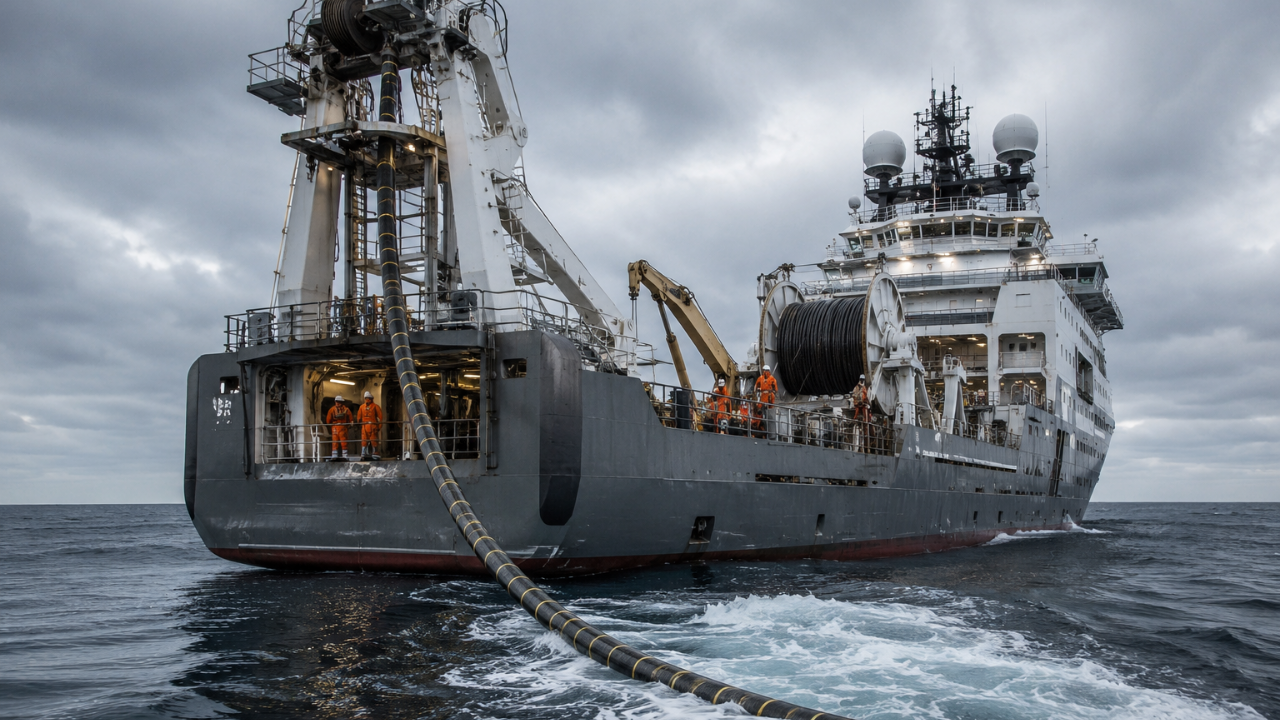
Here’s the part almost no one realizes: keeping this entire system functional falls to a fleet of just 22 specialized cable-repair ships worldwide. Not 22 per country. Twenty-two, total, for the entire planet’s undersea communication network. These vessels are the only ones equipped to locate a break thousands of meters underwater, physically retrieve the cable, splice it back together, and lower it safely back to the ocean floor.
Each ship typically carries a crew ranging from roughly 40 to 80 people, depending on the vessel, working extended rotations that can stretch for weeks or months at sea. One repair ship serving the African coastline, the Léon Thévenin, has been in service for over four decades and is described by its own crew as “a little floating city,” complete with a dining hall, laundry room, bicycle racks, and massive cable tanks that can hold thousands of kilometers of coiled fiber line.
Repairing a Cable Is Still Astonishingly Manual
Given how advanced modern internet infrastructure feels, the actual repair process is surprisingly old-fashioned. Crews first have to pinpoint the break, often by sending a pulse of light down the cable and measuring how long it takes to bounce back from the point of damage. Then, in deep ocean sections, a remotely operated vehicle (ROV) is sent down to physically locate and grasp the cable, or in shallower water, ships still use variations of the same grappling-hook method that was first used to repair transatlantic cables back in 1866.
That original 1866 repair attempt took the crew 29 tries with a hook dragged across the ocean floor before they successfully hauled a broken cable to the surface. Modern crews have far better technology, but the fundamental challenge, physically finding and lifting a thin cable off a pitch-black seafloor, remains largely unchanged more than 150 years later.
Aging Ships, Growing Demand
The tension at the center of this system is hard to ignore. Tech giants like Google, Amazon, and Meta continue laying new undersea cables at a rapid pace to keep up with global data demand. But there’s comparatively little financial incentive to invest in more repair capacity. Most cables are designed to last around 25 years, meaning a large portion of the lines laid during the dot-com boom of the early 2000s are now approaching the end of their working lives, right as global dependence on them has multiplied many times over.
Meanwhile, some of the world’s cable-repair ships, like the Léon Thévenin, are pushing 40-plus years old themselves. The people who crew them describe a job defined by long stretches away from family, sudden emergency call-outs, and an odd kind of quiet pride in doing work almost no one on land ever thinks about, until their internet suddenly stops working.
The Fragile Truth Behind “The Cloud”
There’s a certain irony in how the modern world talks about the internet. We call it “the cloud,” a word that suggests something weightless, distributed, practically immune to physical failure. In reality, it depends on a finite number of aging ships, crewed by a relatively small community of specialized engineers, physically hauling cables up from the ocean floor with technology not far removed from a 19th-century grappling hook.
If a handful of these ships were ever out of commission simultaneously, whether from mechanical failure, geopolitical conflict, or simply being spread too thin across too many emergencies, entire regions could face the kind of blackout Japan narrowly avoided in 2011. It’s a rare example of an entire civilization’s communication system resting on infrastructure most people will never see, maintained by a workforce most people don’t know exists.
The next time a video call loads instantly or a payment clears in seconds, it’s worth remembering: somewhere, on a ship far from land, a small crew is quietly making sure the wire underneath the ocean stays in one piece.