
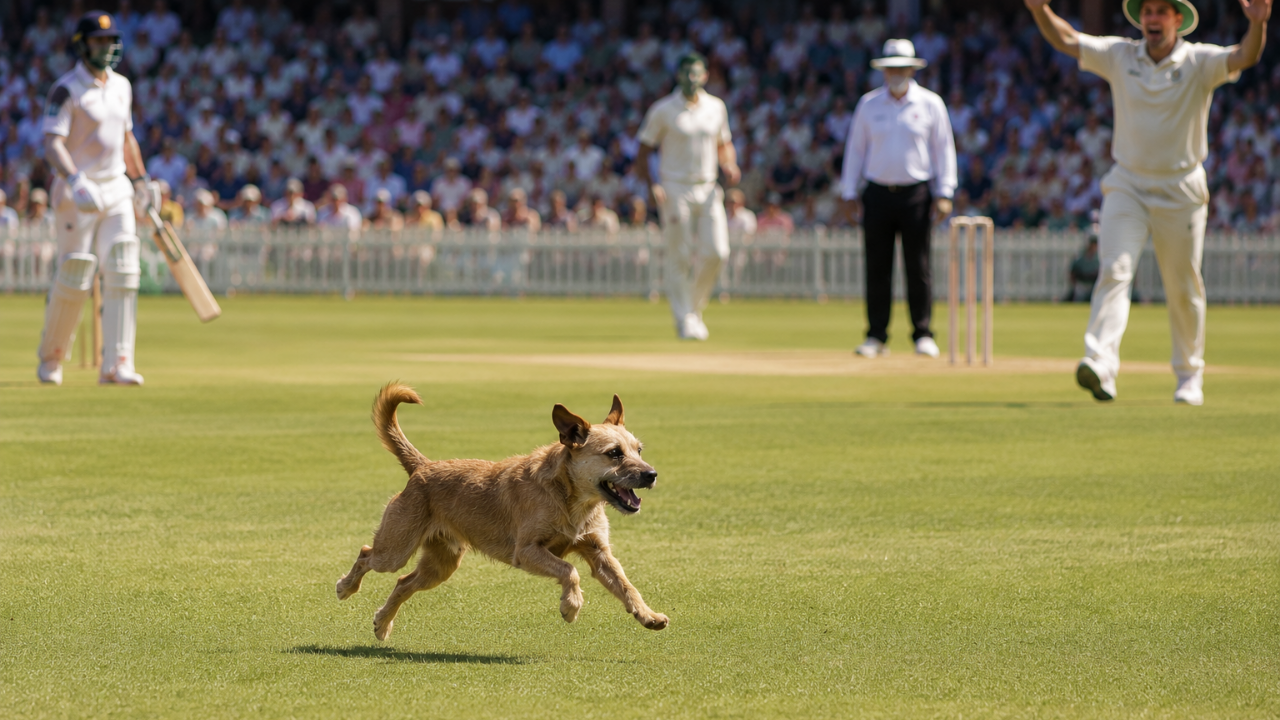
Buried deep inside cricket’s official rulebook is a cricket rule so strange that most fans, and even some players, don’t know it exists: an actual, written law dedicated entirely to what happens when an animal wanders onto the pitch mid-delivery. It sounds like the kind of thing a comedy writer would invent. It isn’t. It’s real, it’s official, and it exists precisely because cricket has spent over a century being interrupted by dogs, pigs, bees, and the occasional squirrel.
The Clause Hiding in Plain Sight
Cricket’s official rulebook, maintained by the Marylebone Cricket Club (MCC), covers everything from bat dimensions to how a batter can legally be dismissed. Tucked inside its section on dead balls sits Law 20.4.2.12 – a clause giving the umpire authority to stop play the moment they believe either side has been disadvantaged by “a person, animal or other object within, or over, the field of play.”
What makes this clause genuinely clever is its built-in fairness check. If both umpires agree the ball would have reached the boundary anyway, regardless of the interruption, the boundary is awarded as normal – the animal’s presence doesn’t get to change the scoreboard for no reason. It’s a rule written specifically to handle chaos while still protecting the actual outcome of the delivery.
Why a Sport Needed a Law Like This At All
Most sports played on enclosed, artificial surfaces never have to think about wildlife. Cricket is different. Matches are often held on large, open grounds — sometimes with minimal fencing, sometimes bordering parks, farmland, or city streets – which means the field itself is never fully sealed off from the outside world.
This openness has made cricket uniquely vulnerable to unscripted wildlife cameos. Stray dogs have interrupted play in international matches in India on multiple occasions, including a well-documented incident during an India-New Zealand ODI in Guwahati, where a dog sprinted straight to the center of the pitch and brought the game to a temporary halt while security scrambled to remove it. In a separate, now-famous Ashes Test at Trent Bridge, a stray dog wandered onto the field mid-delivery – and, in one of cricket’s more surreal moments, was reportedly coaxed off calmly after a bowler knelt down to ask it nicely.
How This Cricket Rule Actually Gets Applied
When an animal does step onto the field, the umpire’s job isn’t as simple as just stopping play. Under this cricket rule, the umpire has to make a split-second judgment call: was the delivery already unfolding in a way that would have produced a fair result regardless of the interruption? If a batter had already struck the ball cleanly toward the boundary before a dog sprinted into view, the umpires can still award the boundary, since the animal never actually changed what would have happened.
This is what separates a genuinely well-designed rule from an overly rigid one. Rather than voiding every delivery the moment something unexpected crosses the boundary rope, this cricket rule asks umpires to weigh intent and outcome together. It protects the batting side from being unfairly denied runs they’d already earned, while still giving officials the authority to nullify a delivery if the animal’s presence genuinely disrupted a fielder, distracted a batter, or created a safety risk.
It’s a small piece of the rulebook, but it reflects something bigger about how cricket’s laws are written: not as rigid, one-size-fits-all commands, but as flexible guidelines built to handle judgment calls in real time.
When Insects Bring an International Match to Its Knees
Dogs aren’t even the most disruptive intruders. During a Cricket World Cup match between South Africa and Sri Lanka, a genuine swarm of bees descended onto the field, forcing players and umpires from both teams to drop flat onto the ground for their own safety rather than risk getting stung mid-play. Remarkably, this wasn’t a one-off: the same two teams had experienced an almost identical bee invasion in a previous series, that time requiring a local beekeeper to rush to the stadium and physically intervene before the match could resume.
These aren’t quick, five-second distractions either. Some of these delays have stretched past an hour, with ground staff resorting to fire extinguishers and makeshift hives just to clear the pitch enough for play to safely continue.
A Sport Constantly Rewriting Itself Around Real-World Chaos
What this obscure clause really reveals is something bigger about how open-air sports evolve. Unlike a controlled arena, a cricket ground can never fully predict what will wander into frame – a pig released by mischievous fans, a bird chasing a ball mid-flight, a squirrel darting across the outfield mere overs into an innings. Rather than pretending these disruptions can’t happen, cricket’s rulebook quietly built a mechanism to absorb them without letting chaos unfairly swing the result.
It’s a small, almost invisible example of a much larger truth: the rules governing any sport played outdoors are never really finished. They’re a living document, constantly being patched and refined in response to whatever unpredictable thing shows up next – whether that’s a hallucinating marathon runner, a hitchhiking cheat, or, in cricket’s case, an animal that never got the memo it wasn’t invited to play.
This is exactly why the cricket rule around animal interference deserves more attention than a passing meme or highlight-reel clip – it’s a working example of a sport writing contingencies for scenarios almost no other game has ever had to consider.
The Real Takeaway
Cricket didn’t write a rule about animals wandering onto the field because someone imagined it might happen someday – it wrote that rule because, again and again, across decades and continents, animals simply kept showing up. And in a sport obsessed with precision, statistics, and centuries of tradition, there’s something oddly charming about the fact that one of its official laws exists purely to handle a dog that didn’t know it was interrupting an international cricket match.