


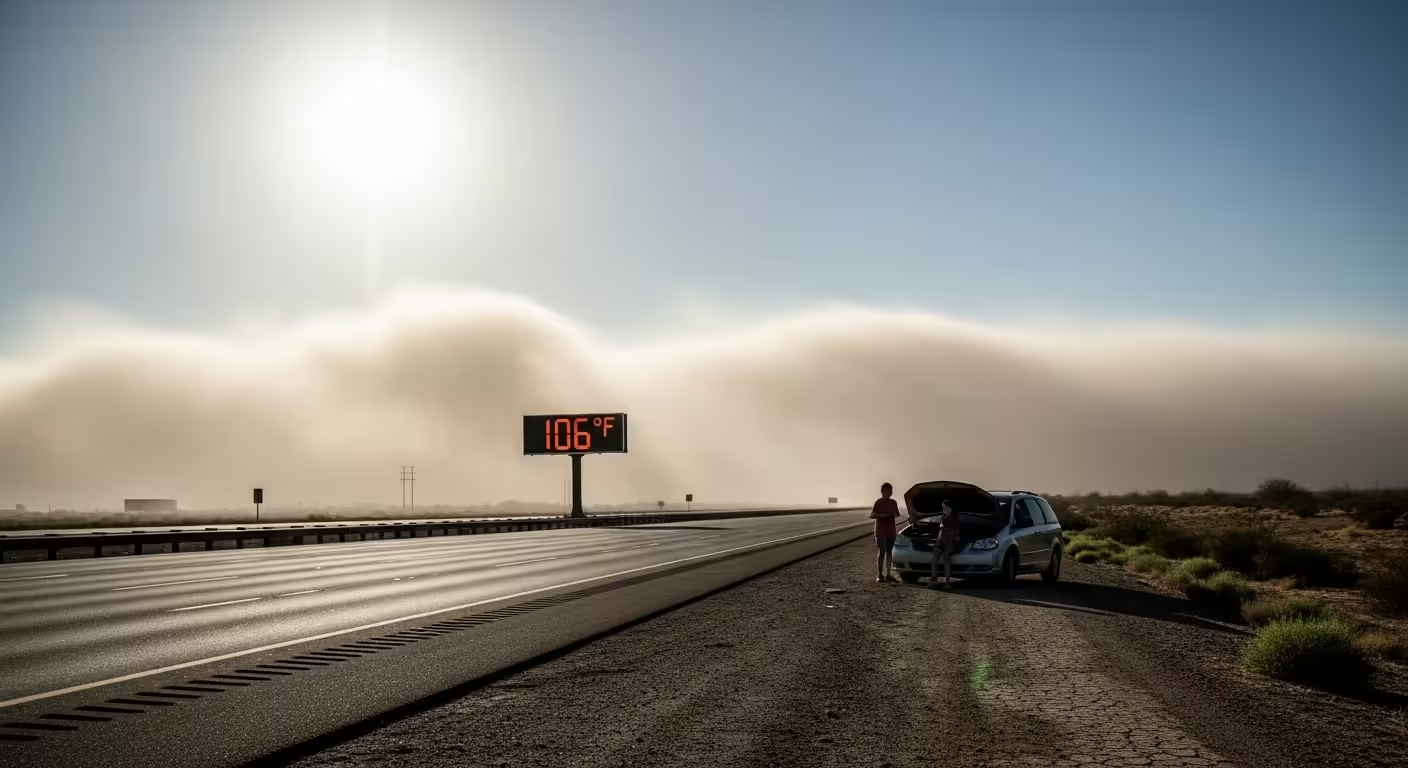
It is March. It is supposed to be spring. Children are supposed to be playing outside. Families are supposed to be heading to baseball games and hiking trails and parks.
Instead, 40 million Americans are under Extreme Heat Warnings this week. Phoenix hit 106 degrees -temperatures that normally do not arrive until June. A small California community reached 110 degrees the highest March temperature ever recorded in United States history. And in Nebraska, the largest wildfires in the state’s recorded history have already burned through 800,000 acres of land.
Climate scientists at World Weather Attribution found that events as warm as March 2026 would have been virtually impossible without human-induced climate change. That warming, from the burning of coal, oil and natural gas, added between 4.7 degrees to 7.2 degrees Fahrenheit to the temperatures being felt right now.
This is not a weather story. This is a warning – for your family, your home, and your future.
What Is Happening Right Now – The Numbers That Should Shock You
High temperatures are soaring as much as 35 degrees above average for this time of year from California to the Great Plains, as a dangerous March heat wave affects more than 40 million people. Phoenix rose to 102 degrees on Wednesday and parts of California also reached triple digits. More than 400 record highs have been set since March 11, with dozens more expected to be shattered through next week.
Let those numbers sink in for a moment. Not one record. Not ten records. More than 400 records broken in nine days – across dozens of cities, in a month when most of these places should still be experiencing cool spring weather.
Las Vegas hit 99 degrees on Wednesday, smashing its hottest March day on record, which had been 93 degrees in 2022. Downtown Los Angeles reached 94 degrees, beating its previous daily high of 87 degrees in 1997. Palm Springs hit 107 degrees, tying its hottest March day on record from 1966.
The community of Martinez Lake in Arizona hit a jaw-dropping 110 degrees on Thursday – the highest March temperature in United States recorded history.
Phoenix Sky Harbor International Airport reached 97 degrees before noon on Thursday to rewrite the record book for the second consecutive day. Thursday went on to become the hottest March day ever recorded in Phoenix, peaking at 105 degrees and besting a mark that was just one day old.
Think about what that means. Phoenix broke its all-time March temperature record on Wednesday. Then broke it again on Thursday. The records are not just being broken – they are being shattered and immediately replaced.
Why Is This Happening – In Plain English
You have probably heard about climate change for years. You have probably wondered whether it was really as serious as scientists said. The heat dome sitting over America’s Southwest right now is the answer – and it is not a comfortable one.
This week’s heat dome is caused by a stubborn ridge of high pressure that has trapped hot air over the West like a lid on a pot. In scientific terms, this is called an amplified pattern – a high-pressure system so strong and so persistent that it prevents normal weather from moving through the region.
What is occurring is called an amplified pattern, which builds a strong high-pressure system across the Southwest United States. The jet stream is so far to the north that it is creating blizzards off the east coast, flooding rains in Hawaii, and record heat in the Southwest – all at the same time.
But here is the critical point that scientists are making very clearly this week: this heat dome would have existed without climate change. What would not have existed – what was virtually impossible in the climate of previous decades – is the extreme temperatures being recorded right now.
Climate Central ranks the temperatures forecast for this week at the highest end of its Climate Shift Index scale, meaning these conditions have been made at least five times more likely due to human-caused carbon pollution.
Five times more likely. That is not a marginal effect. That is the difference between a manageable heat event and the record-shattering catastrophe currently unfolding across the American West.
The United States is breaking 77% more hot weather records now than in the 1970s and 19% more than the 2010s. In the United States, the number and average cost of inflation-adjusted billion-dollar weather disasters in the last couple of years is twice as high as just 10 years ago and nearly four times higher than 30 years ago.
Nebraska Is on Fire – The Largest Wildfire in State History
While the heat wave dominates headlines in Phoenix and Los Angeles, something even more catastrophic is happening in Nebraska – and most families outside the region have not heard about it.
Swaths of Nebraska are engulfed in fire, with some 800,000 acres burned and at least one person killed. The wildfires are the largest in the state’s history according to Nebraska Governor Jim Pillen. The fires are being driven by the powerful heat wave across the western United States. Temperatures in the 80s Fahrenheit combined with low humidity, high winds and extreme drought to increase the risk of fire. The largest of the fires, called the Morrill Fire, is less than 20 percent contained. The blaze, which began on March 12, rapidly grew because of high winds.
800,000 acres. To put that in perspective – that is an area larger than the entire state of Rhode Island, burning in a state that most Americans do not associate with wildfires at all. Nebraska is farm country. It is cattle country. It is the kind of place where families have lived for generations without thinking about wildfire as a serious risk.
Extreme heat is considered the deadliest weather-related hazard in the United States, according to the Fifth National Climate Assessment. About 2,000 Americans die each year on average from extreme heat, according to the Centers for Disease Control and Prevention.
The early heat could reverberate for months and have other deadly consequences, including causing the region’s already low snowpack to melt out at least a month ahead of schedule. This raises water supply concerns and wildfire worries for the upcoming dry season. The West entered this heat wave on the heels of its hottest winter on record. Colorado had its thinnest snowpack since 1981.
When the snowpack melts a month early, it does not mean the water disappears. It means the water arrives in rivers and reservoirs all at once – causing flooding – and then is gone before the dry summer months when it is most needed. This is a water crisis playing out in slow motion, accelerated by a heat wave that was not supposed to happen in March.
How This Affects Your Family – Right Now
For the 40 million Americans currently under Extreme Heat Warnings, the immediate risks are direct and serious.
The prolonged heat could be dangerous for high-risk groups, including children, older adults and people with pre-existing health conditions particularly because most are not yet acclimated to summerlike conditions.
Your body’s ability to handle extreme heat depends significantly on how gradually it has been exposed to rising temperatures. In summer, your family has had months of gradually warming weather to physiologically adjust. In March, your body is still in winter mode expecting cool temperatures, not prepared for 106 degrees.
In Phoenix, popular hiking trails including the Echo Canyon and Cholla trails on Camelback Mountain, the Piestewa Peak Summit trail, and several trails on South Mountain have closed from 8 a.m. to 5 p.m. through Sunday in response to the Extreme Heat Warning. Some tourist attractions are adjusting schedules.
For families with spring break travel planned to the Southwest this week – Phoenix, Las Vegas, Palm Springs, the California desert these are not abstract safety advisories. These are real, active closures affecting the places you planned to visit.
As the snow disappears a month early, high-elevation vegetation will begin drying out much sooner, extending the 2026 wildfire season by four to six weeks.
For families in the western United States, this means the wildfire season which already starts earlier and lasts longer than it did a generation ago is now set to begin even earlier in 2026. Home insurance in high-risk areas is already becoming impossible to find at any price. This heat wave is about to make that problem significantly worse.
What UK and Canadian Families Need to Know
For families in the United Kingdom and Canada, the American heat wave of March 2026 is not just a news story from across the Atlantic. It is a preview of weather patterns that are already beginning to affect Europe and Canada, and that will become more frequent and more intense in the years ahead.
This is due to climate change that we see more extreme events, more intense ones and so many records being broken, said Friederike Otto, an Imperial College of London climate scientist who coordinates World Weather Attribution research. It is really hard to even keep up with how extreme our extremes are becoming. It is changing our risk, changing our relationship with weather, putting more people in risky situations and at times we are not used to.
The UK experienced its own record heat events in 2022, when temperatures exceeded 40 degrees Celsius for the first time in recorded British history. Canada experienced its own catastrophic heat dome in British Columbia in 2021, when temperatures reached 49.6 degrees Celsius in Lytton and the town burned to the ground the following day.
The pattern connecting all of these events is the same: a warming planet making extreme weather events more frequent, more intense, and more deadly. What happened in the American Southwest this week is not an isolated anomaly. It is a data point in a trend that is moving in one direction and accelerating.
8 Things Your Family Must Do During Extreme Heat
One – Never leave children or pets in parked cars. Even on a mild day, the interior of a parked car can reach dangerous temperatures within minutes. In 106-degree heat, a parked car becomes a death trap within seconds. This is not an exaggeration it is physics.
Two – Identify your nearest cooling centre. Every major city maintains public cooling centres during extreme heat events air-conditioned public buildings where anyone can shelter for free. Know where yours is before you need it.
Three – Check on elderly neighbours and relatives. Older adults are among the highest-risk groups during extreme heat events because they are less physiologically able to regulate body temperature. A phone call or a knock on the door could save a life.
Four – Stay hydrated – more than you think you need to. By the time you feel thirsty in extreme heat, you are already becoming dehydrated. Drink water consistently throughout the day, even if you do not feel thirsty. Avoid alcohol and excess caffeine, which accelerate dehydration.
Five – Change your outdoor activity schedule completely. If you must be outside, do it before 8 a.m. or after 7 p.m. The hours between 10 a.m. and 5 p.m. in this heat wave are genuinely dangerous for prolonged outdoor activity.
Six – Know the signs of heat exhaustion and heat stroke. Heat exhaustion heavy sweating, weakness, cold pale clammy skin, weak pulse, nausea – is serious but treatable. Heat stroke high body temperature above 103 degrees, hot red dry skin, rapid strong pulse, possible unconsciousness is a medical emergency requiring immediate 911 call.
Seven – Check your home insurance wildfire coverage. If your family lives in the western United States, now is the time to review your wildfire coverage carefully. Insurance companies are withdrawing from high-risk markets across California, Arizona, and Colorado. Understand your actual coverage before a fire approaches.
Eight – Talk to your children honestly about climate change. The heat wave your children are experiencing this week is not normal. It is not bad luck. It is the predictable consequence of decades of carbon emissions – and the generation growing up today will live with its consequences more than any generation before them. They deserve honest answers about what is happening and why.
Conclusion
The dangerous heat wave shattering March records all over the United States Southwest is more than just another extreme weather blip, scientists say. It shows that climate change is already driving more dangerous weather extremes.
What we can very confidently say is that human-caused warming has increased the temperatures being seen as a result of this heat dome, and it is pushing those temperatures from what would have been very uncomfortable into potentially dangerous, said Clair Barnes, an Imperial College of London attribution scientist.
One hundred and ten degrees in March. Eight hundred thousand acres burning in Nebraska. Forty million Americans under Extreme Heat Warnings. Four hundred records broken in nine days.
This is not the new normal. It is the new starting point – a baseline from which the extremes will continue to intensify unless the trajectory of carbon emissions changes. Your family is living through a moment that climate scientists have been warning about for decades. The warning is no longer theoretical.
Stay informed, stay cool, stay safe – and stay one step ahead with SultanNetwork – your trusted source for finance, business, technology, science and global news, updated 24 hours a day, 7 days a week.