
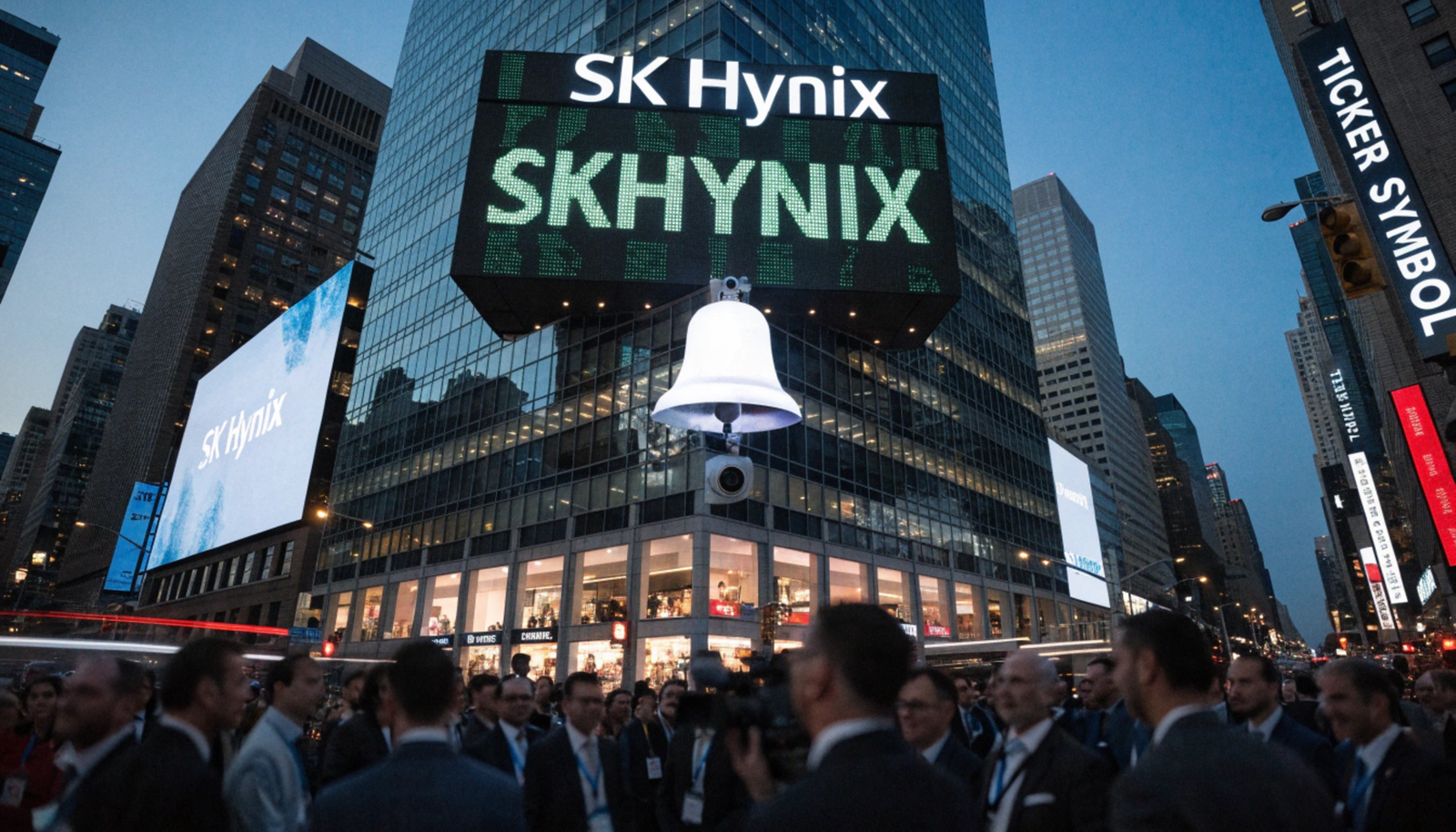
SK Hynix Nasdaq debut day just moved more money in one morning than most people will see in their entire lives, and if you own a 401(k), an RRSP, or even a basic index fund, your family’s money was part of the ride. On Friday, this South Korean memory chip giant opened trading in New York at $170 a share, a jump of more than 14% above its offering price of $149. In one single trading session, the company pulled in over $26.5 billion – that’s more money than the entire yearly budget of a mid-sized US state. This is not some obscure tech stock story you can skip past. It’s the clearest sign yet that the artificial intelligence boom is about to reshape your retirement account, your grocery bill, and the price tag on your next laptop.
KEY FACTS BOX
- SK Hynix raised $26.5 billion in its Nasdaq listing, one of the biggest foreign IPOs in US market history.
- Shares opened at $170, a 14% pop above the $149 IPO price (Source: Bloomberg)
- Nvidia stock jumped 3.5% the same day, riding the wave of AI chip excitement (Source: Everhint market briefing)
- Micron, a direct SK Hynix rival, slipped 1.6% as investors rotated their money (Source: Everhint market briefing)
- SK Hynix’s chairman told CNBC that AI chip “demand is enormous,” a comment that instantly rippled through tech markets worldwide (Source: CNBC)
What Happened at the SK Hynix Nasdaq Debut
Friday morning at the Nasdaq MarketSite in New York, SK Hynix rang in a new chapter for the global chip industry. Chey Tae-won, chairman of parent company SK Group, stood alongside CEO Kwak Noh-jung as their company’s American depositary receipts began trading under the ticker SKHYV, before switching over to SKHY the following Tuesday. Within minutes, the stock had jumped well past its already-strong IPO price, at one point touching close to $175 a share before settling around the $170 mark.
The timing was no accident. SK Hynix is one of the two companies on Earth that makes the high-bandwidth memory chips powering the AI data centers Google, Microsoft, Meta, and Amazon are racing to build. Every ChatGPT-style query, every AI image generated, every AI chatbot conversation runs through hardware SK Hynix helps supply. Investment manager Tim Garratt at Baillie Gifford summed up the mood on Wall Street bluntly, telling reporters SK Hynix looked well positioned to keep benefiting from the imbalance between AI computing needs and available memory supply.
The knock-on effects hit almost instantly. Nvidia, the company whose chips depend on SK Hynix’s memory, rose 3.5% the same day. Micron, an American memory chipmaker competing directly with SK Hynix, dropped 1.6% as traders shuffled their bets between the two rivals. Bank of America analyst Justin Post separately flagged that Meta is now building its own custom AI chip as part of a plan to expand computing power to 14 gigawatts by 2027 – a number so large it would need the output of multiple nuclear power plants running around the clock.
Why Your Family Should Care
Here’s the part most headlines skip: the SK Hynix Nasdaq debut isn’t just a Wall Street story, it’s a household story. If you have a 401(k), a workplace pension, an RRSP, or even a simple S&P 500 index fund, chances are good you already own a slice of Nvidia, Micron, or one of the funds now scrambling to add SK Hynix. When a stock this size moves 14% in a single day, retirement account balances move with it – sometimes up, sometimes down, and often both within the same week.
There’s a real-world price tag attached too. AI chip demand has been a major driver behind rising costs for laptops, gaming consoles, and even cars, since memory chips sit inside almost every piece of modern electronics. Analysts at Bank of America estimate the cost of building AI computing power could run as high as $22 billion per gigawatt of capacity in 2026 – money that eventually gets passed down through higher prices on the devices your family buys.
Think of it like a family grocery budget. When the wholesale price of wheat spikes, bread doesn’t get cheaper at your local store – it gets more expensive, sometimes months later. Memory chips work the same way. A shortage today can mean a pricier phone upgrade or laptop purchase for your family a year from now. This IPO is a signal that the shortage – and the price pressure – isn’t going away soon.
USA Families – Here Is What To Know
American families are sitting closer to this story than they realize. Roughly 60% of US workers hold some form of employer retirement account, and most of those accounts include broad tech exposure through S&P 500 or Nasdaq-tracking funds. That means millions of ordinary households, not just Wall Street traders, felt Friday’s swing in their account balances.
There’s also a jobs angle worth watching. Micron, based in Idaho, has already announced billions in new US investment to compete with rivals like SK Hynix, a move that could mean new American manufacturing jobs in the semiconductor sector. At the same time, rising competition for chip talent and factory capacity could push up wages in tech manufacturing hubs across Texas, Arizona, and Idaho. Families in these regions should watch local job postings closely over the coming months, since chip manufacturing expansion tends to create ripple effects across entire local economies, from construction to logistics to retail.
UK Families – Here Is What To Know
British households are connected to this story mainly through pensions and global investment funds. Many UK workplace pensions, including large providers like Baillie Gifford – whose own investment manager praised SK Hynix’s position this week – hold significant global tech exposure. That means British retirement savings are tied to the same AI chip cycle driving Friday’s headlines, even without a single UK company directly involved in the IPO.
There’s a consumer angle too. UK electronics retailers have already flagged rising component costs tied to AI-driven memory chip shortages, a trend likely to continue as demand keeps climbing. Families budgeting for a new laptop, gaming console, or smartphone this year should expect prices to stay firm or rise slightly rather than fall, as manufacturers pass along higher component costs from suppliers competing for the same limited chip supply.
Canadian Families – Here Is What To Know
Canadian households connect to this story primarily through their RRSPs and TFSAs, many of which hold US tech ETFs that include Nvidia, Micron, and increasingly SK Hynix-linked funds. The Toronto Stock Exchange doesn’t host these specific chip giants directly, but Canadian fund managers have been steadily increasing exposure to US semiconductor stocks over the past two years, meaning the volatility from Friday’s debut likely touched Canadian portfolios too.
Provincially, Ontario and Quebec both host growing tech and AI research hubs that could see indirect investment benefits as global chip demand accelerates. Canadian families with tech-sector jobs in these provinces may see increased hiring activity as companies chase AI infrastructure growth, though pricing pressure on electronics is expected to mirror what’s happening in the US and UK markets.
What Experts Are Saying About the SK Hynix Nasdaq Debut
Tim Garratt, investment manager at Baillie Gifford, pointed to a persistent imbalance between AI computing needs and available memory supply as the core reason SK Hynix remains well positioned for continued growth. His read suggests this isn’t a one-day spike but part of a longer trend investors should track over the coming year.
TheStreet Pro contributor James “Rev Shark” DePorre offered a more cautious note, comparing the situation to SpaceX’s recent IPO, which saw an initial buying rush from investors who missed the opening allocation before the stock rolled over within days. His warning is worth taking seriously: hot IPOs often cool off fast once early excitement fades.
Bank of America analyst Justin Post focused on the bigger infrastructure picture, estimating AI computing buildouts could cost far less than earlier projections suggested if companies like Meta successfully build custom chips. My own read of these three views together: expect short-term stock volatility around SK Hynix specifically, but the underlying AI chip demand story looks durable, not a passing fad.
6 Things Your Family Must Do Right Now
- Check your 401(k) or pension fund holdings. Log into your retirement account provider’s website and look for tech or semiconductor fund exposure – most plans list this for free.
- Avoid panic selling or panic buying. A 14% single-day IPO pop is exciting, but chasing hot stocks after they’ve already spiked is historically one of the riskiest investing moves a household can make.
- Delay major electronics purchases if you can wait. If a laptop or phone upgrade isn’t urgent, waiting a few months could mean avoiding a price bump tied to rising chip costs.
- Set a price alert instead of guessing. Free tools like Yahoo Finance or Google Finance let you track SK Hynix, Nvidia, and Micron without needing a brokerage account.
- Talk to a licensed financial advisor before rebalancing. This article is informational only – a real advisor can review your specific retirement timeline and risk tolerance.
- Bookmark this story and check back weekly. AI chip news is moving fast this year, and staying informed now means fewer financial surprises later.
Conclusion
The SK Hynix Nasdaq debut is bigger than one company’s stock price – it’s a signal flare for where the global economy is heading. AI chip demand is reshaping retirement accounts, electronics prices, and job markets across the US, UK, and Canada all at once, whether families realize it or not. The $26.5 billion raised Friday will fund even more chip factories, which means this story is only getting started, not wrapping up.
Watch your retirement statements, watch electronics prices, and don’t let the excitement of a single trading day push you into a decision you haven’t thought through carefully. The AI chip race is a marathon, not a sprint, and families who stay calm and informed will come out ahead of those chasing headlines.
Stay informed, stay prepared, and stay one step ahead with SultanNetwork – your trusted source for finance, business, technology and global news, updated 24 hours a day, 7 days a week.