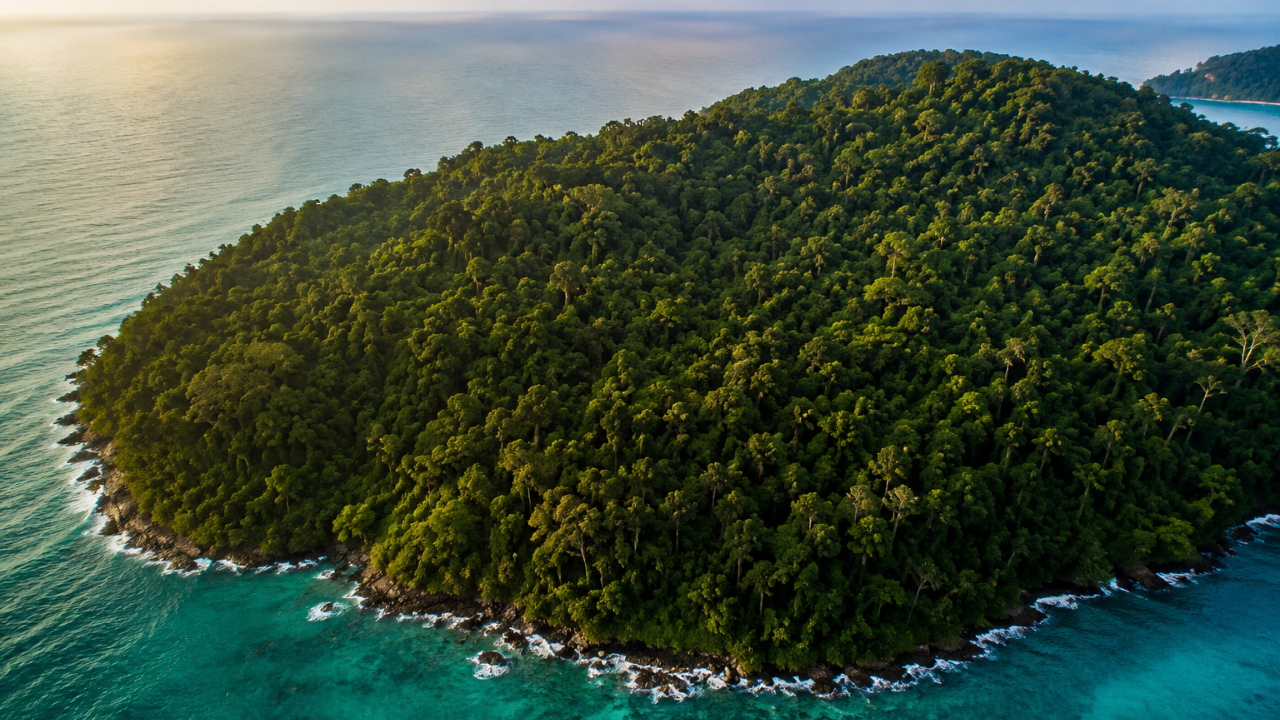
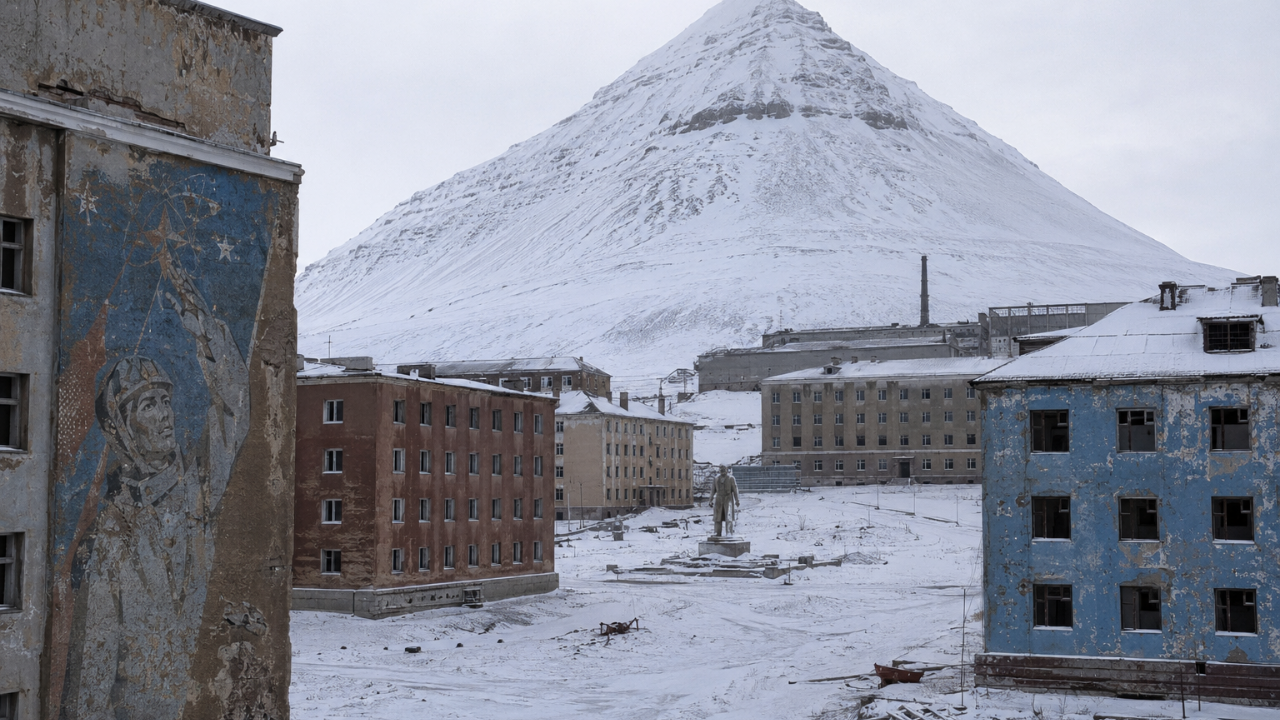
Pyramiden is a place where a piano still sits untouched in a concert hall, where library shelves are still stacked with books, and where a bust of Lenin still looks out over an empty town square – not because anyone chose to keep it that way, but because the Arctic simply never let it fall apart. Roughly 800 miles from the North Pole, this abandoned Soviet mining settlement on the Norwegian archipelago of Svalbard has spent nearly three decades sitting in a natural deep freeze, and almost nothing inside it has moved.
A Soviet Town Built Where Almost No One Should Live
Pyramiden takes its name from the pyramid-shaped mountain that looms over it. The settlement was originally founded by Sweden in 1910, before the Soviet Union purchased it in 1927 under the terms of the 1920 Svalbard Treaty, which oddly allowed foreign signatories to mine on Norwegian-controlled land. The state-owned company Arktikugol Trust took over operations a few years later and slowly built Pyramiden into something far more ambitious than a simple mining camp.
At its height, the town was home to around 1,000 residents, complete with a school, a library, a sports hall, a swimming pool, and even imported Ukrainian topsoil laid down to grow the northernmost lawn on Earth. It was, by several accounts, designed as a showcase of what an “ideal” Soviet community could look like – even in one of the most hostile environments on the planet. Researchers who’ve studied the settlement note that life there was, in some ways, genuinely comfortable compared to the Soviet mainland, which helped the town attract families willing to endure months of total polar darkness.
The Sudden Silence of 1998
Pyramiden’s decline wasn’t gradual – it happened almost overnight. The coal being mined was low quality and never turned a real profit, and once the Soviet Union collapsed in 1991, the state funding and ideological purpose that had propped up the settlement disappeared with it. A separate tragedy compounded the town’s troubles: in 1996, Vnukovo Airlines Flight 2801 crashed into a nearby mountain while carrying passengers bound for Svalbard, killing all 141 people on board, many of them miners and their families. The loss devastated an already small community and made it nearly impossible to recruit new workers.
By March 31, 1998, the last coal had been extracted, and within months the remaining residents packed up and left. What makes Pyramiden so striking isn’t just that it was abandoned – it’s how it was left. Most furniture, books, kitchen equipment, and even the grand piano in the cultural hall were simply left behind rather than shipped home, giving the town an eerie sense of having been paused rather than emptied.
Why the Arctic Never Let It Decay
Ordinary ghost towns rot. Wood warps, paint peels, paper disintegrates within a few short decades. Pyramiden has largely avoided that fate for one simple reason: sub-zero temperatures and near-constant cold act as a natural preservative, slowing decomposition to a crawl. Photographers who’ve documented the town describe desks still covered in office supplies, a movie theater with a film reel still loaded into the projector, and dried houseplants that never fully collapsed. One widely cited estimate even suggests the Arctic climate could keep Pyramiden’s buildings and belongings recognizable for another 500 years.
The result is something closer to a time capsule than a ruin. Faded murals and mosaics still decorate several public buildings, and the world’s northernmost statue of Lenin continues to stand watch over the main square, seemingly untouched by the passage of time in a way that would be impossible almost anywhere else on Earth.
Visiting a Town That’s Both Empty and Not Quite Dead
Tourism quietly returned to Pyramiden around 2007, once Arktikugol and Svalbard’s governor began marketing it as a genuine window into Soviet-era Arctic life. Today, visitors typically arrive from Longyearbyen by boat in the summer or by snowmobile across the frozen fjord in winter, and a small seasonal staff still lives on-site to maintain the hotel and welcome guests. Exploring the town alone isn’t an option, though – visitors must stay with a licensed, armed guide, both because of preservation concerns and because Svalbard has a substantial polar bear population that occasionally wanders through.
It’s worth noting that the picture has shifted in recent years. Since 2022, Svalbard’s official tourism board has stepped back from promoting tours connected to the Russian-owned settlement, reflecting broader sensitivities around anything tied to Russia’s presence in the Arctic. Pyramiden remains standing, and largely accessible, but the town’s future as a tourist destination is no longer as settled as it once seemed.
A Frozen Snapshot of a World That No Longer Exists
What makes Pyramiden genuinely unusual isn’t just its remoteness or its strange beauty – it’s the fact that an entire ideology, an entire way of organizing daily life, was essentially paused mid-sentence and left for the cold to hold onto. Walking through it today means stepping into a version of the late Soviet Union that vanished everywhere else decades ago, preserved not by any museum’s careful curation, but by ice, silence, and geography. Few places on Earth let you stand inside history quite this literally, chairs still pushed in, books still on the shelf, waiting for people who are never coming back.