
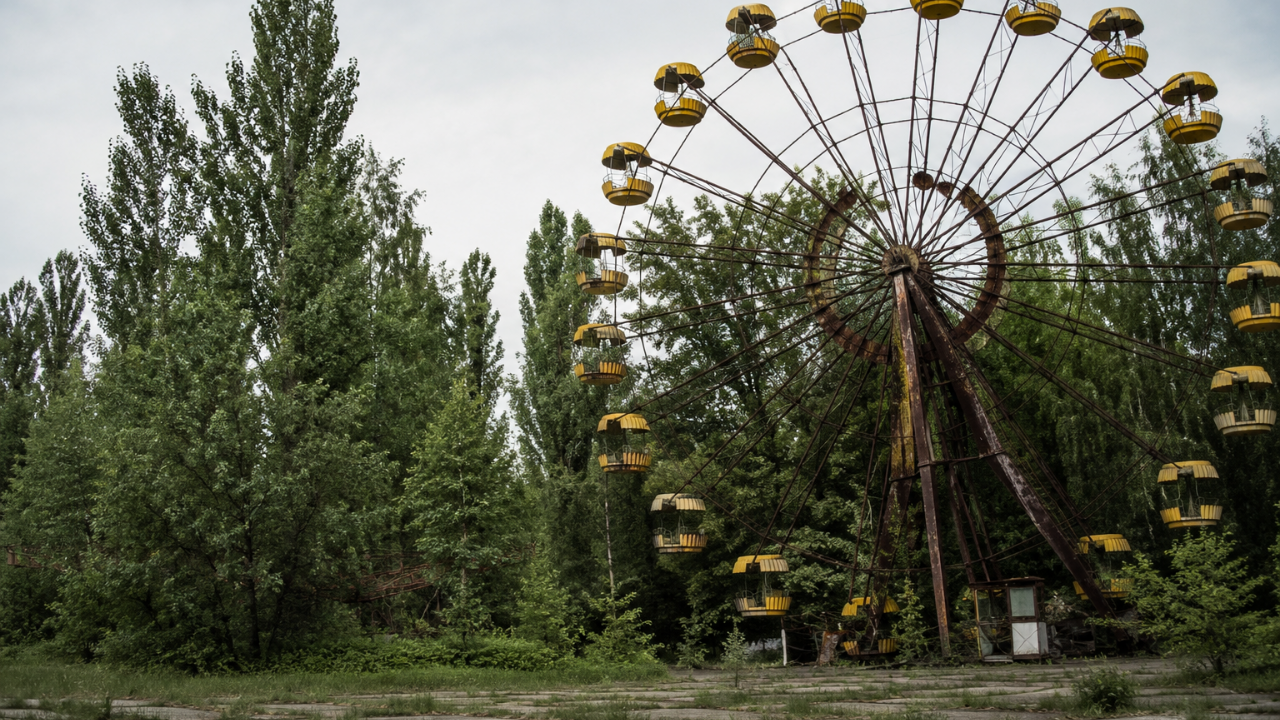
There’s a Ferris wheel standing in an amusement park in northern Ukraine that has never carried a single passenger. It was built for a grand opening scheduled for May 1, 1986, complete with bumper cars and a carousel meant to celebrate a Soviet holiday. That opening never happened. Five days before the ribbon was supposed to be cut, an entire city of nearly 50,000 people evacuated within hours and never came back. This is Pripyat, and it remains one of the most complete, untouched snapshots of a single frozen moment in modern history.
A City Built for a Nuclear Future
Pripyat wasn’t an old town slowly abandoned over generations. It was a brand-new Soviet creation, founded on February 4, 1970, specifically to house workers at the nearby Chernobyl Nuclear Power Plant. As a designated “atomgrad,” a closed city built around Soviet nuclear infrastructure, Pripyat represented something the government was genuinely proud of: modern, purpose-built urban living for the scientists, engineers, and families powering the future of Soviet energy.
By 1986, the city had grown to a population of 49,360, complete with schools, kindergartens, a hospital, a cinema, swimming pools, a river port, and a cultural palace. For a Soviet city of its size, Pripyat was considered genuinely desirable, modern, and forward-looking, a functioning symbol of what nuclear-powered progress was supposed to look like.
The Night Everything Stopped
On April 26, 1986, Reactor No. 4 at the Chernobyl plant, roughly two miles from Pripyat’s residential streets, suffered a catastrophic failure during a safety test, triggering what remains the worst nuclear disaster in history. Residents of Pripyat weren’t evacuated immediately. It took 36 hours after the explosion for authorities to order a full evacuation of the city, a delay that exposed thousands of residents to radiation before anyone fully understood the scale of what had happened.
When the evacuation order finally came, residents were told they’d be gone for roughly three days. They were instructed to bring only essential documents and enough supplies for a short trip. Apartments were left mid-routine: dishes in sinks, toys scattered across classroom floors, books open on library tables. Those three days never ended. No one has lived in Pripyat since.
A Ghost City Still Fully Furnished
What makes Pripyat so unusual among abandoned places isn’t just its size, it’s how completely intact everything remains. Unlike most ghost towns, which are slowly stripped by scavengers or deliberately demolished, Pripyat’s radioactive contamination made looting and redevelopment functionally impossible for decades. The result is a city where furniture, personal belongings, school textbooks, and even children’s dolls remain scattered almost exactly where they were left nearly four decades ago.
Photographers and researchers who’ve documented the city describe libraries with thousands of books still lying open on collapsed shelves, gymnasiums with rotting floors and peeling paint, and apartment buildings where personal photographs and mattresses remain untouched since the residents who owned them walked out the door for what they believed would be a short evacuation.
Nature’s Slow, Steady Takeover
In the decades since the evacuation, Pripyat has undergone a second transformation, this time driven entirely by nature rather than human hands. Trees now grow directly through cracked pavement and shattered windows. Roots have worked their way into building foundations. What were once wide Soviet boulevards have gradually narrowed into forest paths, swallowed by decades of unchecked vegetation growth.
The city’s roundabout, once decorated with emblems representing all fifteen Soviet republics, now sits almost entirely hidden beneath tree cover. The football stadium that once hosted local matches has been reclaimed so thoroughly by forest growth that its stands and field are barely distinguishable from the surrounding woodland. Today, Pripyat is widely recognized as the largest abandoned city in Europe, a full urban landscape being slowly, steadily dismantled not by demolition crews, but by root systems and weather.
A Radioactive Timeline Measured in Millennia
Unlike most abandoned places, Pripyat’s emptiness isn’t a matter of economic decline or shifting population. It’s a matter of physics. Experts estimate that background radiation levels in parts of Pripyat will remain too high for safe permanent habitation for thousands of years. The surrounding Chernobyl Exclusion Zone, a roughly 30-kilometer radius around the plant, was established specifically to contain radiation exposure and remains under strict access control today.
Despite this, Pripyat has become an unlikely destination for what’s often called dark tourism. Before travel disruptions in recent years, the site was drawing well over 100,000 visitors annually, guided through the ruins under strict safety protocols and radiation monitoring, with no visitor permitted to enter buildings or linger in higher-contamination areas.
A Reminder Frozen in a Single Afternoon
What makes Pripyat different from almost every other abandoned place on Earth is the speed of its ending. This wasn’t a town that faded gradually as opportunity dried up, or a city besieged over years of conflict. It was a fully functioning, modern community that ceased to exist within the span of a single afternoon, and has remained essentially paused in that exact moment ever since.
Walking through Pripyat today, at least through photographs and guided tours, means walking through a city that never got the chance to finish anything, not the amusement park opening, not the ordinary Sunday its residents expected, not even the short evacuation they were told to prepare for. Nature has spent nearly four decades quietly filling in what human absence left behind, turning a symbol of Soviet nuclear ambition into one of the most complete records of interrupted human life anywhere in the world.