
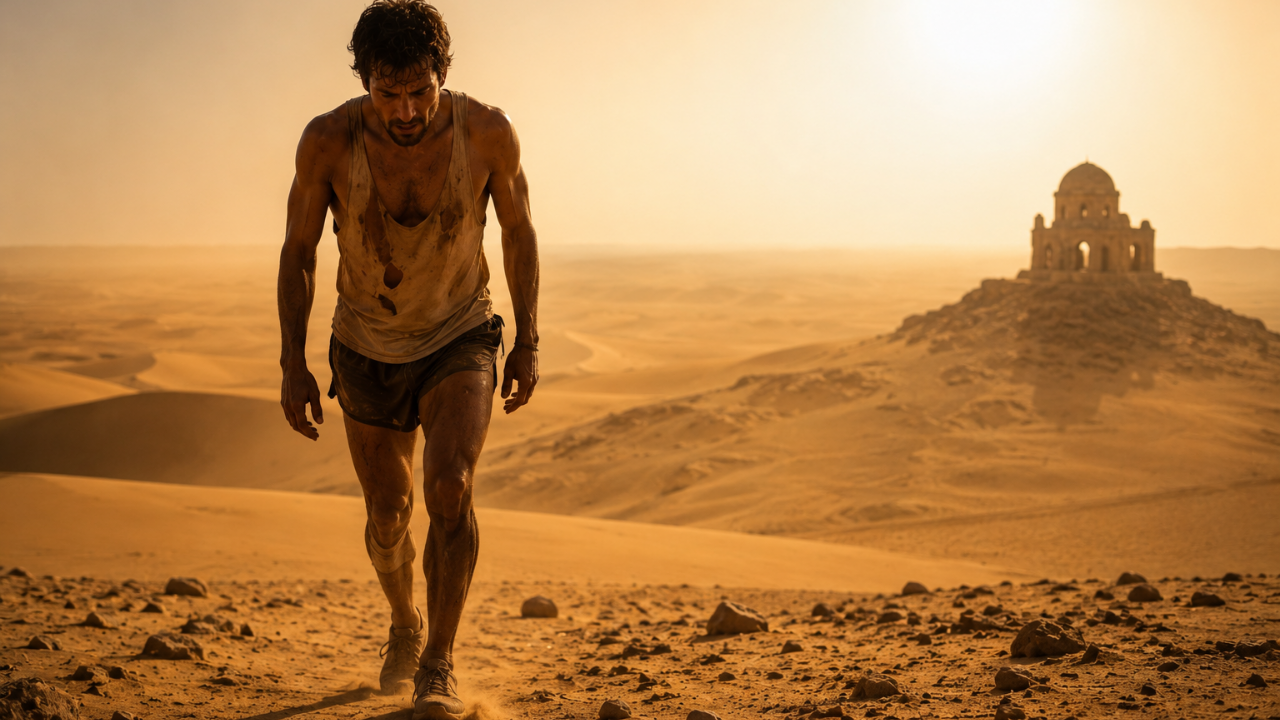
Mauro Prosperi made a decision most people would call insane: after getting hopelessly lost in the Sahara Desert with no water, he chose to keep walking rather than stay put and wait to die. What followed was nine days of hallucinations, a suicide attempt that failed only because his own blood had become too thick to flow, and a survival strategy involving raw bats – a story so extreme it sounds invented. It isn’t. Every detail is documented.
A Race Built to Push Humans to Their Absolute Limit
In 1994, the 39-year-old former Italian police officer and Olympic pentathlete entered the Marathon des Sables – a brutal, roughly 155-mile ultramarathon across the Sahara, run in stages over six punishing days. Back then the race drew only around 80 competitors, nothing like the crowded, GPS-tracked event it has become today. Getting separated from the pack wasn’t just possible; for a strong, fast runner pushing ahead of everyone else, it was almost inevitable.
Prosperi was that runner. He consistently reached each stage first among the Italians, proudly planting a small flag outside his tent each evening. On the fourth day – the race’s longest and most grueling stage – his strength became the very thing that put him in danger.
Swallowed by a Wall of Sand
Partway through that stage, high winds suddenly intensified into a violent, blinding sandstorm. Prosperi described being engulfed by what felt like a solid yellow wall of sand, losing sight of every other runner around him. Race organizers paused the event entirely because of the conditions, and by the time the storm cleared, every other competitor had made it safely to the next checkpoint.
Prosperi had vanished. When he woke the next morning, the landscape around him looked completely unfamiliar, though it took him time to fully accept what had happened: he was lost, alone, in one of the harshest environments on Earth, with no landmarks left to guide him back.
Rescue Planes That Flew Directly Overhead – and Missed Him
Following official race guidelines, Prosperi initially did the responsible thing: he sat still on a sand dune, waiting to be found. At one point, a rescue helicopter flew almost directly above his position – and failed to spot him entirely. Desperate, he later tried again, spotting a low-flying plane, lighting his backpack on fire to create a smoke signal, and carving the letters “SOS” into the sand. Cruelly, a second sandstorm swept in before the plane could notice, erasing his signal and extinguishing his fire.
With official search parties combing the race route by Land Rover and aircraft, and Moroccan military and Bedouin trackers joining the effort, no one could locate him. He had already wandered far outside the search zone.
Shelter in a Dead Man’s Tomb
Eventually, Prosperi spotted a lone structure rising from the empty landscape. Approaching it, he realized it was a marabout – an abandoned desert shrine housing the tomb of a Muslim holy man. Inside, he found no living person, only a coffin. Still, the structure offered something he desperately needed: shade from a sun pushing temperatures past 115°F (46°C).
He decided to stay, reasoning that surviving in place gave him better odds than wandering further into open desert without water. It was here, sheltering among the shrine’s rafters, that Prosperi noticed a colony of bats roosting overhead.
Drinking Blood to Survive Another Day
With his water long gone, Prosperi caught several of the bats, eating them raw and drinking their blood in a desperate attempt to replace fluids his body was rapidly losing. It wasn’t enough. He also drank his own urine – collecting it early on using a trick he’d learned from his grandfather, sipping it only while it remained relatively clear – and licked condensation and morning dew directly off rocks just to extend his survival by another few hours.
None of it was close to sufficient. Severe dehydration eventually triggered hallucinations, including vivid, comforting visions of his wife and family urging him to keep moving. Reality and delirium began blending together as the days wore on.
The Suicide Attempt His Own Body Prevented
By around the ninth day, convinced that rescue was no longer possible and facing what he believed would be a slow, agonizing death, Prosperi made a devastating decision: he attempted to end his life by cutting his wrists with a knife. Astonishingly, his own dehydration worked against him – his blood had become so thick and concentrated from fluid loss that it clotted almost immediately, and the attempt failed. He later carried a visible scar from the attempt for the rest of his life.
Forced to keep living, Prosperi resumed walking, driven partly by concern for his wife: without confirmed proof of his death, she would be unable to claim his police pension, leaving her in financial limbo indefinitely.
Found 180 Miles Off Course, in the Wrong Country Entirely
What Prosperi didn’t realize was just how far he had drifted. He had unknowingly crossed the border out of Morocco entirely, traveling roughly 180 miles off the marked race route and deep into Algeria – a journey comparable to getting lost during a race in New York and somehow ending up in Boston. Eventually, he was spotted by a young girl traveling with a nomadic caravan, who gave him goat’s milk before her group transported him by camel to the nearest village.
Given ongoing tensions between Morocco and Algeria at the time, local military police initially treated him with suspicion – until they realized who he actually was and rushed him to a hospital.
The Damage Nine Days Without Water Left Behind
The physical toll was severe. Doctors recorded that Prosperi had lost roughly 33 to 35 pounds, leaving him at approximately 99 pounds, and his liver had nearly failed completely. Hospital staff administered around 16 liters of intravenous fluids to begin reversing the damage. For months afterward, he was unable to eat solid food, surviving on soup and pureed meals, while his kidneys sustained permanent damage and he endured severe leg cramps for a full year. Complete recovery took nearly two years.
Returning to the Desert That Nearly Killed Him
Remarkably, Prosperi’s relationship with the Marathon des Sables didn’t end there. He attempted the race again in 1998, though a toe injury forced him to withdraw early. In 2012 – eighteen years after nearly dying in the same desert – he returned once more and successfully completed the race, finishing in just over 34 hours. His story also led organizers to strengthen safety protocols for future competitors, including issuing larger, more visible distress flares to anyone who found themselves off course.
What Nine Days of Nothing Reveals About Everything
Prosperi’s ordeal isn’t really a story about a race gone wrong – it’s a demonstration of exactly how far the human body and mind can be pushed before either one gives out completely. He drank blood from bats, his own urine, and dew off stone; he tried to die and survived that too, purely because his body had already been pushed past the point where death could come easily. In the end, what carried him out of the Sahara wasn’t equipment, training, or luck alone – it was a refusal to stop moving, even when every rational signal suggested there was nowhere left to go.