Abebe Bikila wasn’t even supposed to be at the 1960 Rome Olympics. He wasn’t supposed to run barefoot either. Yet somehow, through a chain of last-minute accidents, an unknown Ethiopian bodyguard ended up sprinting 26.2 miles across ancient cobblestones with nothing protecting his feet – and beat every single professional athlete on the planet to Olympic gold. It’s one of the strangest, most improbable victories in sports history, and it happened almost entirely by accident.
A Spot He Was Never Meant to Fill
Bikila’s presence in Rome traces back to pure misfortune for someone else. His countryman Wami Biratu, originally selected for Ethiopia’s marathon team, injured himself playing a casual game of football and was suddenly unable to compete. Bikila, working at the time as part of the Ethiopian Imperial Guard protecting the royal family, was added to the roster at the last possible moment.
Nothing about his path to that starting line looked conventional. Born to a family of shepherds, Bikila had shown promise during training sessions but was still a relative unknown heading into one of the biggest athletic stages in the world. Few people watching the race that day had any idea who he even was.
The Shoe Problem Nobody Could Solve
Just days before the marathon, disaster struck in the most mundane way possible: Bikila’s running shoes fell apart. Scrambling for a solution, he and his teammates searched for a replacement pair, eventually trying on a new set of shoes. They caused immediate blisters — an unacceptable risk before a 26-mile race across unforgiving city streets.
Rather than gamble on a distracting, painful pair of shoes, Bikila made the decision that would define his legacy: he would run barefoot, exactly as he had done throughout much of his training back home. It wasn’t a calculated publicity stunt or a bold statement planned in advance — it was, quite simply, the only option left that made sense to him.
Racing Through the Dark Streets of Rome
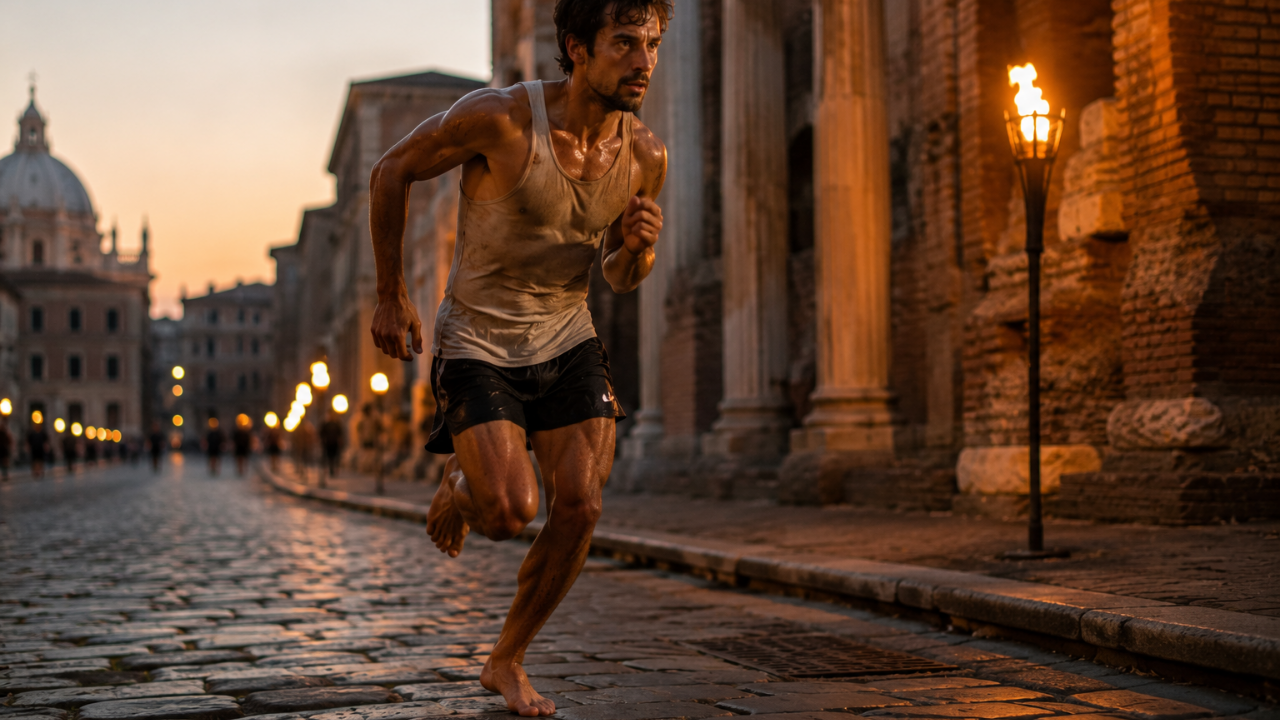
The conditions surrounding the race were unusual in their own right. To avoid the punishing heat of an Italian afternoon, organizers scheduled the marathon to begin at 5:30 PM, meaning much of the race would unfold after sunset. Rome solved this the only way it could at the time: hundreds of Italian soldiers lined the course holding torches, lighting the ancient streets for the runners passing through in darkness.
Sixty-nine athletes from 35 countries lined up at the historic Piazza del Campidoglio, facing a temperature of 23°C (73°F) as the race began. Among that entire international field, one runner stood out for a reason that had nothing to do with speed — he was the only one without shoes.
A Symbolic Sprint Past an Ancient Obelisk
As the race unfolded through Rome’s iconic streets and cobblestones, Bikila steadily worked his way toward the front of the field. In a moment loaded with historical symbolism, he made his decisive break for the lead near the Obelisk of Axum — a monument originally taken from Ethiopia itself, standing in the middle of the very city hosting the race.
Bikila crossed the finish line first, clocking a time of 2 hours, 15 minutes, and 16.2 seconds — a new world record, and roughly 25 seconds ahead of the next finisher. In doing so, he became the first Black African athlete to win an Olympic gold medal, a historic milestone that extended far beyond the sport of running itself.
Why He Chose Bare Feet Over Everything Else
When asked afterward about his decision to run without shoes, Bikila offered an answer that turned a practical shoe malfunction into something much bigger: “I wanted the world to know that my country, Ethiopia, has always won with determination and heroism.” Whatever the original, mundane cause, Bikila embraced the outcome as a statement of national pride rather than a limitation he’d been forced to overcome.
Four years later, at the 1964 Tokyo Olympics, Bikila returned and won the marathon gold medal again — proving Rome had been no fluke, and cementing his place as one of the greatest distance runners in Olympic history.
What Science Actually Says About Running Barefoot
Bikila’s victory has fueled decades of genuine scientific debate about barefoot versus shod running. Researchers studying the biomechanics of running have pointed out that barefoot runners tend to land differently than shoe-wearers, often striking the ground with the middle or front of the foot rather than the heel, which can change how impact force travels through the leg.
That said, sports scientists are careful not to oversimplify the lesson. As one physical therapist and researcher put it when discussing Bikila’s legacy, the research on whether barefoot or shod running is definitively “better” remains genuinely inconclusive — different runners’ bodies respond differently, and no single approach guarantees superior performance for everyone. What Bikila’s run does prove, unambiguously, is that elite performance doesn’t strictly require the most advanced gear available.
A Lesson That Still Challenges Modern Sports Technology
Nearly seven decades later, athletic footwear has evolved into a multi-billion-dollar industry built around cushioned soles, carbon-fiber plates, and race-day shoes engineered in laboratories to shave seconds off marathon times. Yet the fastest man on the planet on one particular September evening in 1960 wore nothing at all.
Bikila’s victory endures not because barefoot running is inherently superior, but because it stands as proof that human capability can outperform expectation, even when circumstances strip away every advantage modern athletes now take for granted. Sometimes the greatest sporting legends aren’t built by better equipment — they’re built by runners who simply refuse to let a missing pair of shoes decide the outcome of the race.