Salt Hotel stories don’t usually come with a house rule this strange: somewhere on the edge of the world’s largest salt flat sits a hotel so literal in its construction that management eventually had to tell guests, seriously, not to lick the walls. It sounds like a joke pulled from a travel blog for laughs, but it’s a genuine, actively enforced policy – and understanding why reveals something fascinating about how extreme environments force architecture, and human behavior, to adapt in ways no one could have predicted.
Built From the Only Material the Desert Had to Offer
The hotel in question, Palacio de Sal (“Salt Palace”), sits on the edge of Bolivia’s Salar de Uyuni, a blindingly white salt flat covering roughly 10,582 square kilometers, making it the largest of its kind anywhere on Earth. The surrounding region is so remote and resource-scarce that importing standard building materials like wood or concrete would have been impractical and expensive. So the builders did something remarkably logical: they built with the one material the desert had in unlimited supply.
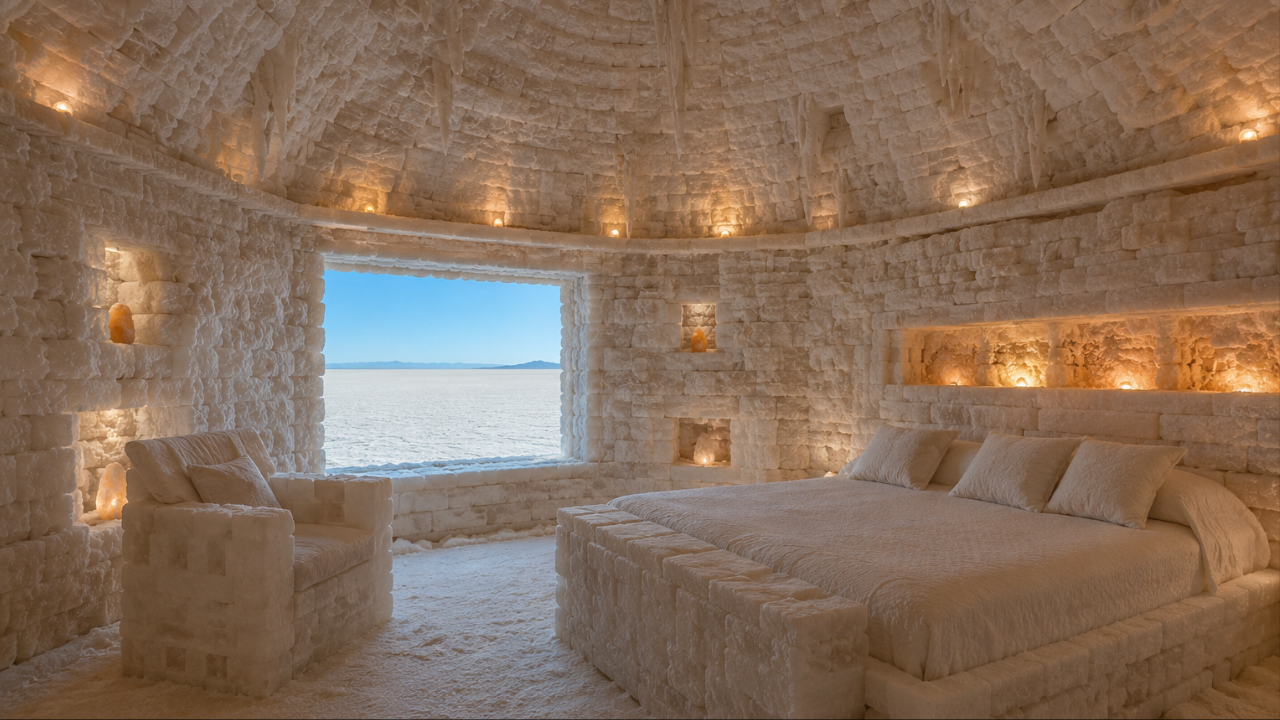
Nearly one million individual salt blocks, each roughly 35 centimeters (about 14 inches) thick, were carved directly from the flat and used to construct almost every surface of the hotel. Walls, floors, ceilings, and even furniture – beds, chairs, tables, and decorative sculptures – are all made from compressed salt. It’s less a hotel decorated with a salt theme and more a hotel that essentially is the desert around it, reassembled into rooms.
A Second Attempt After the First One Failed
Interestingly, this isn’t Bolivia’s first attempt at a salt hotel. An earlier version was constructed in the same region during the mid-1990s, but it ran into a problem that had nothing to do with the walls: managing waste and sanitation in the middle of an isolated salt desert proved genuinely difficult, and the original structure was eventually shut down.
The current Palacio de Sal was rebuilt in 2007 on an entirely new site, this time with a proper sanitary system designed to meet modern hygiene standards. It’s a useful reminder that building somewhere this extreme isn’t only an architectural challenge – it’s a logistical one, since basics like plumbing and waste management don’t come naturally to a landscape with essentially zero fresh water or vegetation nearby.
Why the Domes, Igloos, and Salt Stalactites Aren’t Just for Show
Step inside one of the hotel’s rooms and you’ll notice something unusual: many ceilings are shaped into small domes, resembling igloos, some of which have developed natural-looking salt stalactites hanging down from years of mineral buildup. This isn’t decorative flourish – it’s a direct consequence of building with a material that behaves completely differently from wood or brick under humidity and temperature shifts.
Salt is porous and reactive to moisture in ways that traditional building materials simply aren’t. Over time, tiny amounts of condensation and airborne humidity interact with the blocks, slowly forming these delicate mineral structures. It’s essentially architecture shaped by chemistry rather than intentional design, and it’s part of what gives every room in the hotel a slightly different, almost living texture.
Where the “Please Don’t Lick the Walls” Rule Actually Comes From
Here’s where curiosity becomes a genuine conservation problem. Because the entire structure is literally made of edible, dissolvable salt, guests occasionally give in to the obvious temptation – running a finger along a wall, or worse, taking an actual taste. Multiplied across the hundreds of visitors passing through every month, that kind of casual contact adds up to real, measurable erosion of the building material.
This is precisely why the hotel enforces a strict, if slightly absurd-sounding, policy: guests are firmly asked not to lick the walls, and touching furniture and structural surfaces is generally discouraged as well. It isn’t about hygiene alone – it’s about structural preservation. A wall built from compressed salt blocks can only take so much direct human contact, saliva, and oil from skin before its surface starts to visibly wear down.
A Hotel That Doubles as a Case Study in Extreme-Environment Architecture
What makes this hotel genuinely interesting, beyond the novelty, is what it demonstrates about how architecture adapts when a location offers almost nothing else to work with. Sitting at roughly 3,650 meters (about 12,000 feet) above sea level, surrounded by mountain ranges and an endless stretch of blinding white salt, the region around Palacio de Sal doesn’t support the timber, clay, or aggregate that most construction relies on.
Rather than fighting the landscape, the builders leaned entirely into it – turning an apparent limitation into the hotel’s defining feature. The result includes amenities you wouldn’t expect from a remote desert lodge: a spa with a dry sauna and steam room, saltwater pools, and even a nine-hole golf course built directly onto the hard salt surface, playable during the region’s drier months. Every part of the experience, right down to the recreation, is built around embracing the salt rather than working around it.
Human Curiosity as an Unexpected Conservation Threat
There’s something quietly revealing about a building that has to protect itself from its own guests’ curiosity rather than from weather, pests, or age. Most historic sites worry about erosion from wind, rain, or foot traffic wearing down floors. Palacio de Sal has to worry about something far more specific: the simple, human urge to taste something new, especially when that something happens to be an entire wall made of salt.
It’s a small but telling example of a broader pattern seen across unusual destinations worldwide – from ancient caves with hand-worn walls to fragile coral reefs damaged by touch-happy divers. Wherever humans encounter something novel and touchable, some percentage of them will touch it, taste it, or take a piece of it home, regardless of the potential damage. Palacio de Sal simply happens to be one of the rare places where that instinct has a documented, structural cost.
An Unlikely Lesson in Adaptation
In the end, Palacio de Sal isn’t just a quirky photo opportunity for social media – it’s a working example of architecture responding directly to what a landscape provides, restricts, and, unexpectedly, invites. A desert with no wood gave rise to a palace made of salt; a hotel made of salt gave rise to a rule nobody could have written in advance. Somewhere between practical necessity and human curiosity, this strange, glittering building keeps standing – one carefully un-licked wall at a time.