
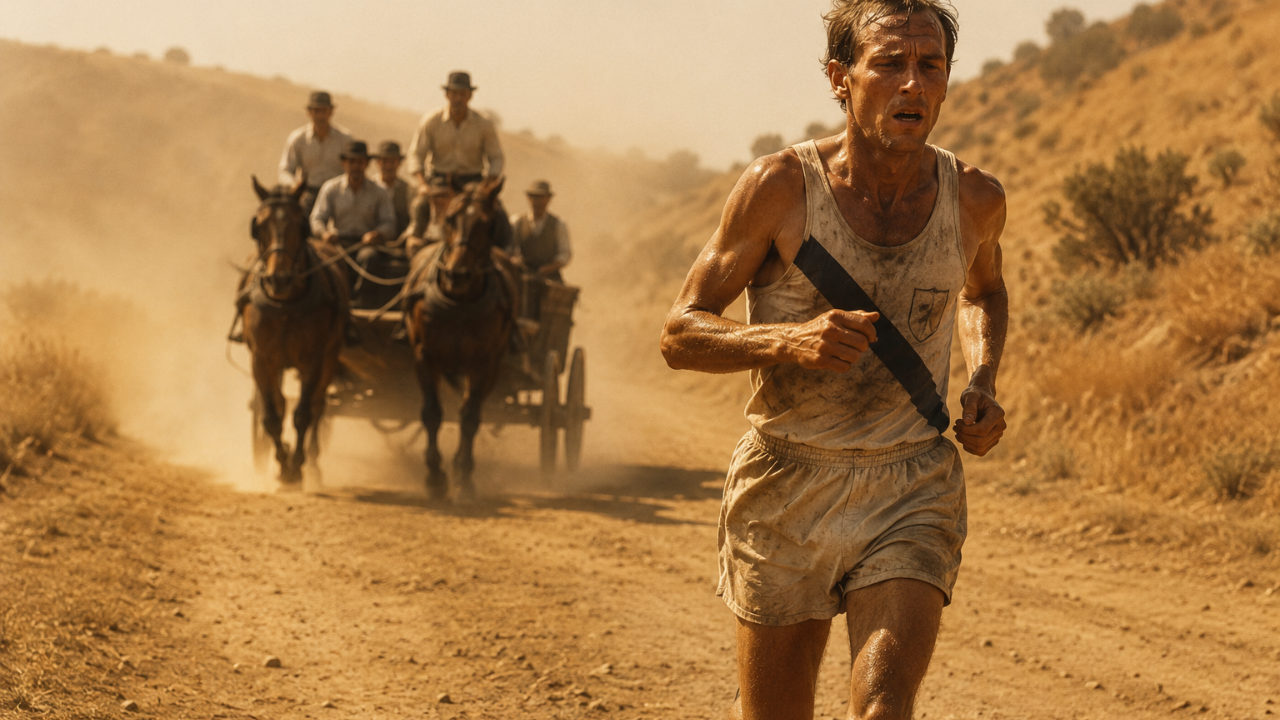
The 1904 marathon is, without exaggeration, the strangest race in Olympic history – a 24.85-mile ordeal through choking dust and 90-degree heat that somehow involved a car ride, a dose of rat poison, stolen peaches, and a runner chased off-course by wild dogs. It sounds like satire. It isn’t. Every detail is documented, and together they capture a sport still figuring out its most basic rules.
A Race Nobody Was Prepared For
Held in St. Louis, Missouri, as part of that year’s World’s Fair, the marathon set 32 competitors loose on dirt roads that hadn’t been cleared for the event. Runners had to dodge cross-town traffic, delivery wagons, railroad trains, trolley cars, and even people walking their dogs, since the course shared space with regular city life. Of those 32 starters, only 14 managed to finish, largely due to poor organization and officiating that would be unthinkable by modern standards.
The field itself was a strange mix of serious athletes and complete amateurs. Among the competitors was Frank Pierce, a member of the Seneca Nation and the first Native American athlete to compete in the Olympics, alongside two South African runners, Jan Mashiani and Len Taunyane, who had traveled to St. Louis as part of a World’s Fair exhibit rather than as trained Olympians.
The Runner Who Cheated His Way to “Gold”
Nobody embodies the chaos better than Fred Lorz, a 19-year-old New York bricklayer who trained by running at night after long shifts. At the nine-mile mark, cramps forced Lorz to stop, so he hitched a ride in one of the accompanying support cars, riding along for roughly eleven miles while waving cheerfully at spectators and fellow runners. When the car eventually broke down, Lorz calmly climbed back out and rejoined the race on foot.
He crossed the finish line first, to roaring applause, and the crowd’s cheers only turned to boos once officials pieced together what had happened. Lorz claimed the entire stunt was a joke and that he’d never actually intended to accept the medal – a defense that didn’t stop his disqualification, though it also didn’t end his career: he went on to win the legitimate 1905 Boston Marathon the following year.
Rat Poison as a Performance Enhancer
The runner who actually won, Thomas Hicks, has an even more disturbing story attached to his gold medal. Under the rules of the time, coaches were allowed to assist runners directly during the race, and Hicks received an extraordinary amount of hands-on help from his two-man support crew. At the ten-mile mark, exhausted and begging for water, Hicks was refused a drink and instead had his mouth sponged with warm distilled water by his handlers.
Seven miles from the finish, his team mixed egg whites with a small dose of strychnine – a substance more commonly known today as rat poison, which acts as a stimulant only in tiny quantities. Strychnine is capable of causing convulsions, asphyxiation, and death, yet Hicks took the dose and kept moving. When he began to fade again, his team administered another round of strychnine along with brandy, and Hicks continued forward hallucinating, barely able to walk for most of the remaining course.
By the finish line, Hicks could no longer support his own weight. His support team carried him across the line, holding him upright in the air while his legs shuffled as if he were still running – and judges accepted this as a legitimate finish, awarding him the gold medal. He had to be carried off the track on a stretcher and might have died in the stadium had four doctors not been on hand to treat him. This is now recognized as the earliest documented use of a performance-enhancing drug in modern Olympic history, and it directly led to the introduction of the Olympics’ first formal anti-doping rule at the 1908 London Games.
Stolen Fruit and an Unscheduled Nap
Not every competitor suffered quite so grimly. Félix Carvajal, a Cuban mailman who had raised money for the trip by running exhibitions across his homeland, arrived at the starting line in ordinary street clothes. A fellow competitor took pity on him and cut his trousers off at the knee just before the race began, turning them into makeshift shorts.
Carvajal ran cheerfully, chatting with spectators in broken English along the way, and at one point spotted people in a passing car eating peaches, asked for one, was refused, and simply reached in and grabbed a couple anyway, eating them as he continued running. Later in the race he detoured through an apple orchard and ate several apples that turned out to be rotten, triggering stomach cramps severe enough that he lay down in the orchard for an extended nap. Remarkably, he still recovered enough to finish fourth overall.
Chased Off-Course by Wild Dogs
The detail that sounds most invented is, in fact, real – though it happened to a different runner than most people assume. South Africa’s Len Taunyane, who had been running well and holding a strong position in the field, was chased a full mile off the marked course by a pack of wild dogs, costing him valuable time and ground he never fully recovered. He still managed to finish, ultimately placing ninth out of the fourteen runners who completed the race.
Even finishing the marathon at all was an achievement, given the conditions. One runner, William Garcia of California, inhaled so much dust kicked up by accompanying vehicles that he suffered a near-fatal internal hemorrhage and had to be hospitalized.
A Sport Still Inventing Its Own Rules
What makes the 1904 marathon so revealing isn’t just the individual absurdities – it’s what they collectively expose about early modern sport. There were no standardized regulations around outside assistance, no drug restrictions, no requirement that the course even be cleared of traffic. Athletes, officials, and spectators were all improvising a brand-new institution in real time, and the results were exactly as unpredictable as you’d expect from a system with almost no guardrails.
The fallout was significant enough that organizers explicitly banned drug use for the first time ahead of the 1908 Olympics, stating plainly that any competitor caught taking a drug during the race would be disqualified. It’s a rule so basic today that it’s easy to forget it once didn’t exist – until a man ran across a finish line hallucinating on rat poison and was handed a gold medal for it.
Why This Race Still Matters
More than a century later, the 1904 marathon endures as one of sport’s great cautionary tales – proof that even something as simple as “run this distance on foot” needed decades of trial, error, and outright disaster before it resembled the disciplined event we recognize today. Every modern safeguard, from hydration stations to anti-doping panels to cleared race routes, exists because a handful of exhausted, half-poisoned, dog-chased men in 1904 showed officials exactly what could go wrong when nobody had bothered to write the rules yet.