Crow memory research has uncovered something that sounds almost impossible: these birds can single you out in a crowd, remember a bad experience with you for years, and somehow pass that memory down to chicks who were never even born when the incident happened. This isn’t science fiction – it’s documented, peer-reviewed behavior, and it’s forcing scientists to rethink just how sophisticated a bird’s brain can be.
The Experiment That Started It All
The most compelling evidence comes from a landmark study conducted by wildlife biologist Dr. John Marzluff and his team at the University of Washington. In 2006, using a remotely triggered net, researchers captured seven crows at four sites across the Seattle campus. While handling the birds briefly to attach identifying leg bands, researchers wore a distinctive rubber caveman mask – deliberately chosen because it was unusual enough for crows to fix on it as a single, memorable face.
To make sure the crows were reacting to the face itself and not some other clue like clothing or walking style, the team introduced a second, “neutral” mask worn by different researchers who simply walked past the birds without ever trapping them. Researchers kept clothing, height, gait, and walking routes roughly consistent between both groups, leaving the mask as the only reliable difference the birds could latch onto. The results were unmistakable.
A Grudge That Doesn’t Fade
The findings, published in 2010 in the journal Animal Behaviour, confirmed that wild American crows linked a specific human face to a threatening event and continued scolding that same face for at least 2.7 years after just one encounter. That number wasn’t a rough guess – it was the figure the peer-reviewed data could firmly support.
What made the story even stranger is what happened years later. Researchers returned to the same University of Washington campus eight years after the original experiment and found the crows were still reacting fearfully to the same mask – even though most of the birds involved in the original trapping had since died. The memory had outlived the individuals who formed it, which raised an obvious question: how was this information surviving generational turnover?
Passing Down a Warning Without a Word
The answer turned out to be a form of social learning that looks remarkably deliberate for a bird. When researchers returned wearing the trapping mask, crows that had never personally been captured – including younger birds and offspring of the original subjects – immediately joined in mobbing and shrieking at the wearer, having apparently learned the association secondhand. In other words, a crow didn’t need to be caught itself to know a face meant danger; it only needed to watch another crow react, or perhaps observe a parent’s alarm calls near that individual.
Marzluff himself pointed out that this distinction – learning from direct experience versus inferring danger by observing someone else’s reaction – is one of the foundational mechanisms behind how human culture and teaching spread. Seeing it show up so clearly in a wild bird population blurred a line many scientists once assumed was uniquely human.
The Science Behind Crow Memory and Why It Evolved
It’s worth asking why crows would evolve such an elaborate system just to track individual people. Part of the answer lies in how crows actually live. These birds are highly social and often long-lived, with some species surviving 15 to 20 years in the wild, and many forming lifelong mating pairs. A species that depends this heavily on cooperation, communication, and stable social bonds gains an enormous advantage from being able to track who is trustworthy and who isn’t – whether that “who” is another crow or a human walking through their territory.
Brain imaging backs up just how seriously crows take this. In follow-up research, PET scans revealed that when crows viewed a face linked to danger, both their visual-processing regions and the areas associated with emotional and threat response activated simultaneously – strikingly similar to how a mammalian brain would respond. For a crow, recognizing a face isn’t just a matter of visual pattern-matching; it’s tied directly into an emotional memory system, much like it is for us.
The Everyday Reality of Being Watched
This research has a strange, almost unsettling implication for anyone living near crow populations: the birds outside your window may genuinely be tracking your behavior. Feed them consistently, and word can spread through a local flock that you’re a friendly presence. Chase one off a garbage can or corner one near a nest, and you may find yourself recognized – and scolded – for years afterward, by birds you’ve never directly interacted with.
The idea isn’t purely theoretical, either. Marzluff has mentioned being approached in the past by the U.S. military, curious whether crows’ long-term memory and sharp discrimination abilities could theoretically be used to help track a specific individual over time. Whether or not that particular idea went anywhere, it underlines just how seriously researchers take the birds’ capacity for long-term individual recognition.
Urban Wildlife as Silent Observers
What makes this especially relevant today is how much of this behavior plays out in cities, not remote forests. Crows have adapted extraordinarily well to urban and suburban environments, nesting near universities, parking lots, and neighborhoods. Every mail carrier, construction worker, or dog walker who passes through a crow’s territory repeatedly is, whether they realize it or not, being quietly cataloged.
This reframes urban wildlife in an interesting way. We tend to think of city birds as background noise – scavengers picking at trash, or a nuisance perched on power lines. But research like Marzluff’s suggests at least some of them are functioning as active, memory-driven observers of the humans around them, building reputations for individual people and sharing that information across generations of birds that will never meet the human in question.
This is exactly why crow memory deserves more attention than it usually gets – it’s not a quirky trivia fact, it’s evidence of a functioning, generational information system running quietly above our heads.
A Different Kind of Neighbor
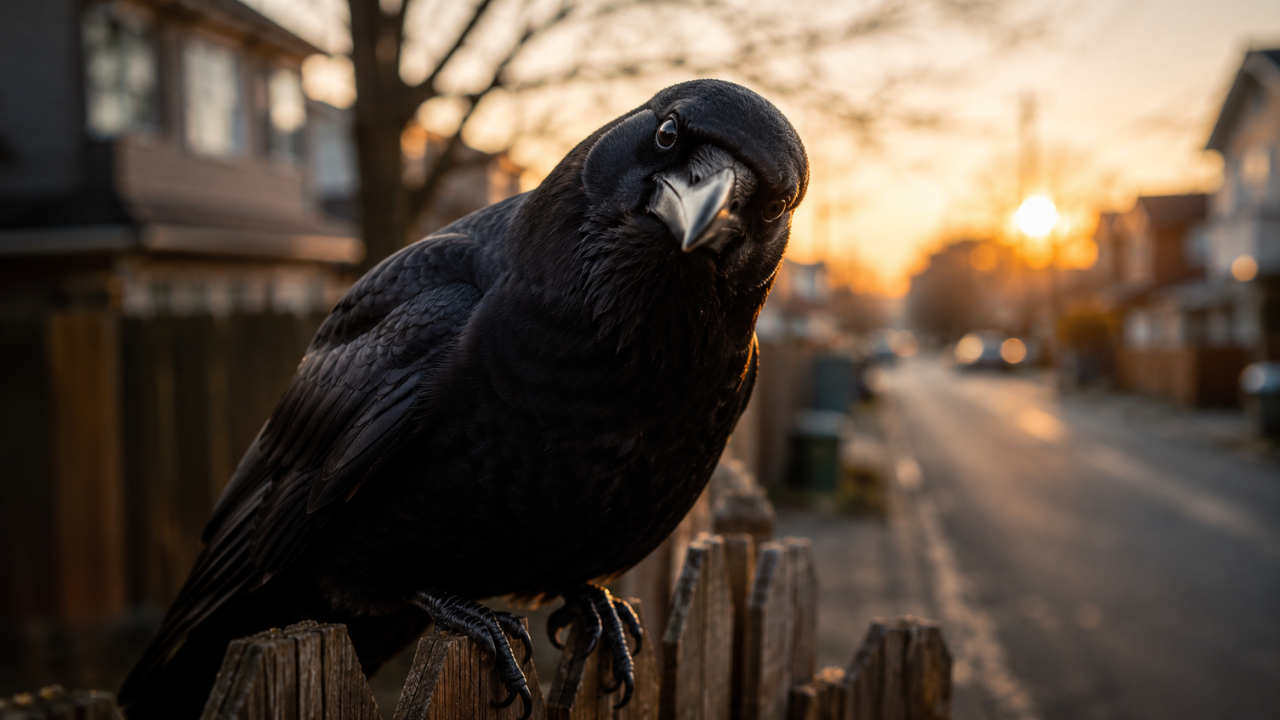
There’s something quietly remarkable about sharing our streets with a creature capable of holding a specific memory of us for over a decade, then teaching that memory to offspring who weren’t even alive to witness the original event. It suggests that intelligence in the animal kingdom doesn’t always announce itself through obvious tool use or dramatic problem-solving – sometimes it shows up in something as subtle as a bird pausing on a fence, studying your face, and quietly deciding what kind of neighbor you’re going to be.