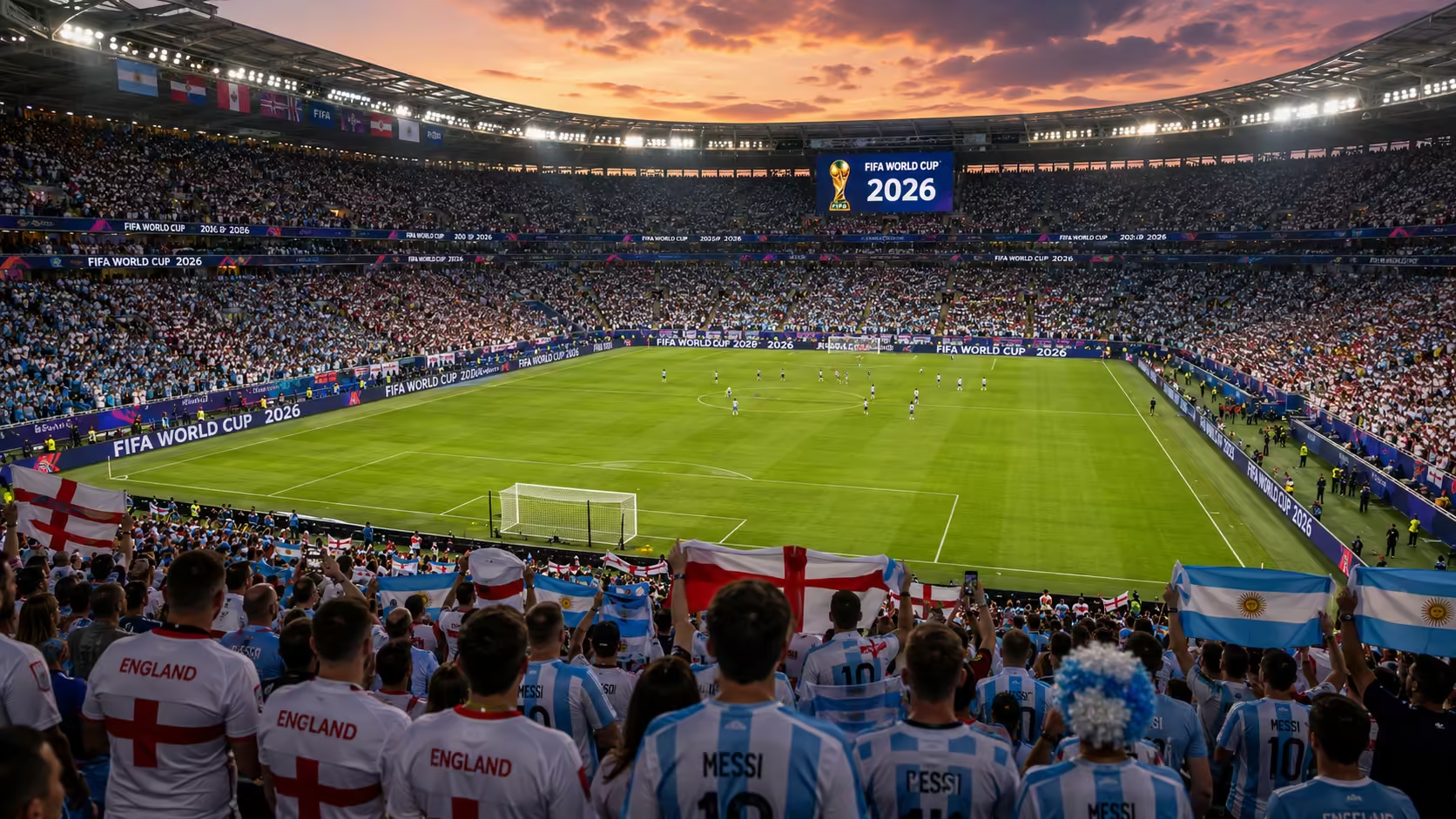
The 2026 FIFA World Cup semifinals are officially set, and the final four could not have produced a bigger storyline. England and Argentina will meet on Wednesday, July 15, in Atlanta, renewing one of soccer’s most heated rivalries for the first time at a World Cup since 2002. The matchup was confirmed after a dramatic weekend of quarterfinal action that also included a rare and controversial VAR decision that ended Switzerland’s tournament.
For millions of fans across the United States, the United Kingdom, and beyond, this World Cup 2026 semifinals lineup delivers exactly the kind of drama international soccer is known for: legendary rivals, a fading superstar chasing one last title, and a refereeing controversy that has soccer fans arguing worldwide.
Quick Facts
- England beat Norway 2-1 in extra time to reach the semifinals, its fourth in tournament history.
- Argentina defeated Switzerland 3-1 in extra time, advancing to a sixth straight World Cup semifinal.
- Switzerland’s Breel Embolo was sent off using football’s rare “mistaken identity” VAR protocol, becoming the first player in this World Cup to be dismissed that way.
- England and Argentina play Wednesday, July 15, at 3 p.m. ET at Mercedes-Benz Stadium in Atlanta.
- France and Spain face off in the other semifinal on Tuesday, July 14, in Dallas, with the winners advancing to the July 19 Final in New Jersey.
What Happened?
The quarterfinal round wrapped up over the weekend of July 9 through July 11, narrowing the 48-team tournament field down to its final four. France beat Morocco 2-0 and Spain edged Belgium 2-1 to book the first semifinal spot in Dallas. Then, on Saturday, July 11, the two remaining berths were decided in dramatic fashion.
In Miami, England needed extra time to get past Norway 2-1. Jude Bellingham, who had already emerged as one of the breakout stars of the tournament, scored to level the match before Norway’s Andreas Schjelderup had given his side an early lead, and Bellingham struck again in extra time to send England through. It marked the second straight knockout match in which the 23-year-old midfielder scored multiple goals.
Hours later in Kansas City, Argentina faced Switzerland in a match that will be remembered less for the football and more for what happened in the 72nd minute. With the score level at 1-1, Argentina’s Leandro Paredes was initially shown a yellow card for a challenge on Switzerland’s Breel Embolo.
Referee João Pinheiro sent the decision to a video review, and after consulting replays, he reversed course entirely: Paredes’s yellow card was rescinded, and Embolo was booked instead under the tournament’s expanded “mistaken identity” VAR rule, which now allows officials to penalize simulation as well as cases of wrongly identified players. Because Embolo had already picked up an earlier yellow card, the second caution meant an automatic red card and an early trip to the locker room.
Switzerland played the rest of the match a man down. The team held on through regulation, but Argentina pulled away in extra time, with Julián Alvarez scoring from long range in the 112th minute before Lautaro Martínez added a second to make it 3-1.
Switzerland’s coaching staff and players were furious. Head coach Murat Yakin told reporters the decision was “completely not understandable” and said the rule had derailed his team’s performance. Captain Granit Xhaka said the red card changed the entire complexion of the match, describing the locker room afterward as quiet and disappointed. Argentina coach Lionel Scaloni, for his part, acknowledged that the sending-off had worked in his team’s favor.
The result completed the semifinal bracket: France vs. Spain in Dallas on July 14, and England vs. Argentina in Atlanta on July 15. The two winners advance to the World Cup Final on July 19 at MetLife Stadium in East Rutherford, New Jersey. The losers meet in the third-place match on July 18 in Miami.
Why This Matters
This is the first World Cup in history in which the semifinal lineup matches the top four teams in FIFA’s world rankings entering the tournament: France, Argentina, Spain, and England, in that order. That alone makes this edition of the final four unusually stacked, with none of the traditional “surprise” underdog runs that often define the World Cup’s later stages.
The England-Argentina matchup also carries decades of history. The two nations have met in some of the sport’s most iconic World Cup moments, including Diego Maradona’s controversial handled goal in 1986. A meeting in the semifinals raises the stakes even further, since the winner will be just one match away from the country’s first World Cup title since England won on home soil in 1966.
For Argentina, the tournament may represent the final World Cup appearance for Lionel Messi, who has scored eight goals through six matches this year. A deep run would let one of the sport’s most decorated players close his international career with a shot at back-to-back titles.
The VAR controversy surrounding Embolo’s red card also puts a spotlight on how technology is reshaping officiating in soccer. The “mistaken identity” protocol, expanded by the International Football Association Board ahead of this tournament, is designed to correct clear officiating errors in real time. But its use in a pivotal knockout match has reignited debate over how much power video review should have over the outcome of a game.
Impact on American Families
For households across the United States, the World Cup semifinals mean more than just soccer on television. With games hosted in cities including Atlanta, Dallas, and New Jersey, local economies are seeing a surge in hotel bookings, restaurant traffic, and public transit use. Families attending matches in person are also facing higher prices for flights, lodging, and event tickets during the tournament’s closing stages, a pattern typical of major global sporting events hosted on U.S. soil.
For fans watching from home, coverage is available on broadcast and streaming platforms, meaning most households can follow the semifinals without extra cost beyond an existing cable or streaming subscription. Employers in host cities may also see requests for time off or flexible scheduling around weekday kickoff times, since both semifinals are being played in the afternoon on a Tuesday and Wednesday.
International Perspective
In the United Kingdom, interest in the tournament has intensified sharply now that England has reached the semifinals for the first time since 2018. A win against Argentina would send England to its first World Cup Final since 1966, a milestone that would dominate national conversation regardless of the outcome.
In Argentina, the stakes are just as high, with the country’s media closely tracking what may be Messi’s final World Cup campaign. A victory would put Argentina within reach of defending the title it won in 2022.
Beyond the two countries directly involved, the broader global soccer community is watching how the VAR controversy from the Switzerland match could influence future refereeing decisions and rule interpretations at this and future tournaments, including discussions at the international level about how the “mistaken identity” protocol should be applied going forward.
What Experts Say
Soccer analysts have been divided on the Embolo decision. According to Al Jazeera’s tournament coverage, most experts and neutral observers who reviewed the replay agreed that the officials made the correct call under the letter of the expanded VAR rule, even though the outcome was painful for Switzerland. ESPN’s reporting noted that the ruling marked only the second time in the tournament that a yellow card had been overturned through the mistaken identity protocol, underscoring how rarely officials have used the new rule.
Statistical analysis from Opta’s supercomputer, cited by Al Jazeera, currently gives France the best odds to win the tournament, with a project probability of roughly 34 percent to lift the trophy, ahead of Spain’s second-place standing in the same model. Argentina and England were not listed among the top two favorites in that projection heading into the semifinals, despite both being ranked in the world’s top four.
What Readers Should Watch Next
The France-Spain semifinal kicks off first, on Tuesday, July 14, at 3 p.m. ET at AT&T Stadium in Dallas. The England-Argentina semifinal follows on Wednesday, July 15, at the same time, at Mercedes-Benz Stadium in Atlanta.
Fans should also watch for how the “mistaken identity” VAR rule is applied, if at all, in the remaining matches. Given the scrutiny the Embolo decision has drawn, any similar review in the semifinals or final would likely generate significant discussion.
The third-place match is scheduled for Saturday, July 18, in Miami, followed by the World Cup Final on Sunday, July 19, at MetLife Stadium in New Jersey.
Practical Takeaways
Fans planning to watch in the U.S. can find both semifinals broadcast on FOX in English and Telemundo in Spanish, with streaming available through the FOX One and FOX Sports apps, and Spanish-language streaming through Peacock. Those hoping to attend matches in person should expect limited ticket availability and higher resale prices as the tournament nears its final stages. Travelers heading to host cities should also plan for increased traffic and demand for lodging around match days.
Conclusion
The 2026 World Cup has reached the stage every fan waits for, with two semifinals that pit the tournament’s top-ranked nations against each other. England’s clash with Argentina carries decades of rivalry and the promise of a first World Cup Final appearance for the Three Lions since 1966. The controversy surrounding Breel Embolo’s red card, meanwhile, has added a fresh layer of debate over how VAR technology should shape the outcome of the sport’s biggest matches. With the semifinals now locked in, the road to the July 19 Final in New Jersey is set, and the world will be watching every kickoff, every review, and every goal along the way.
FAQ
1. When are the World Cup 2026 semifinals? France plays Spain on Tuesday, July 14, at 3 p.m. ET in Dallas, and England plays Argentina on Wednesday, July 15, at 3 p.m. ET in Atlanta.
2. Why was Breel Embolo sent off? Embolo received a red card under the World Cup’s expanded “mistaken identity” VAR protocol after a review determined he had dived to draw a foul that was initially called against Argentina’s Leandro Paredes. Because Embolo already had an earlier yellow card, the second caution led to an automatic sending-off.
3. How many times has England reached a World Cup semifinal? This is England’s fourth appearance in a World Cup semifinal.
4. Is this Lionel Messi’s last World Cup? Messi has indicated this tournament will likely be his final World Cup appearance, adding extra significance to Argentina’s semifinal run.
5. Where is the World Cup 2026 Final being played? The Final is scheduled for Sunday, July 19, 2026, at MetLife Stadium in East Rutherford, New Jersey.