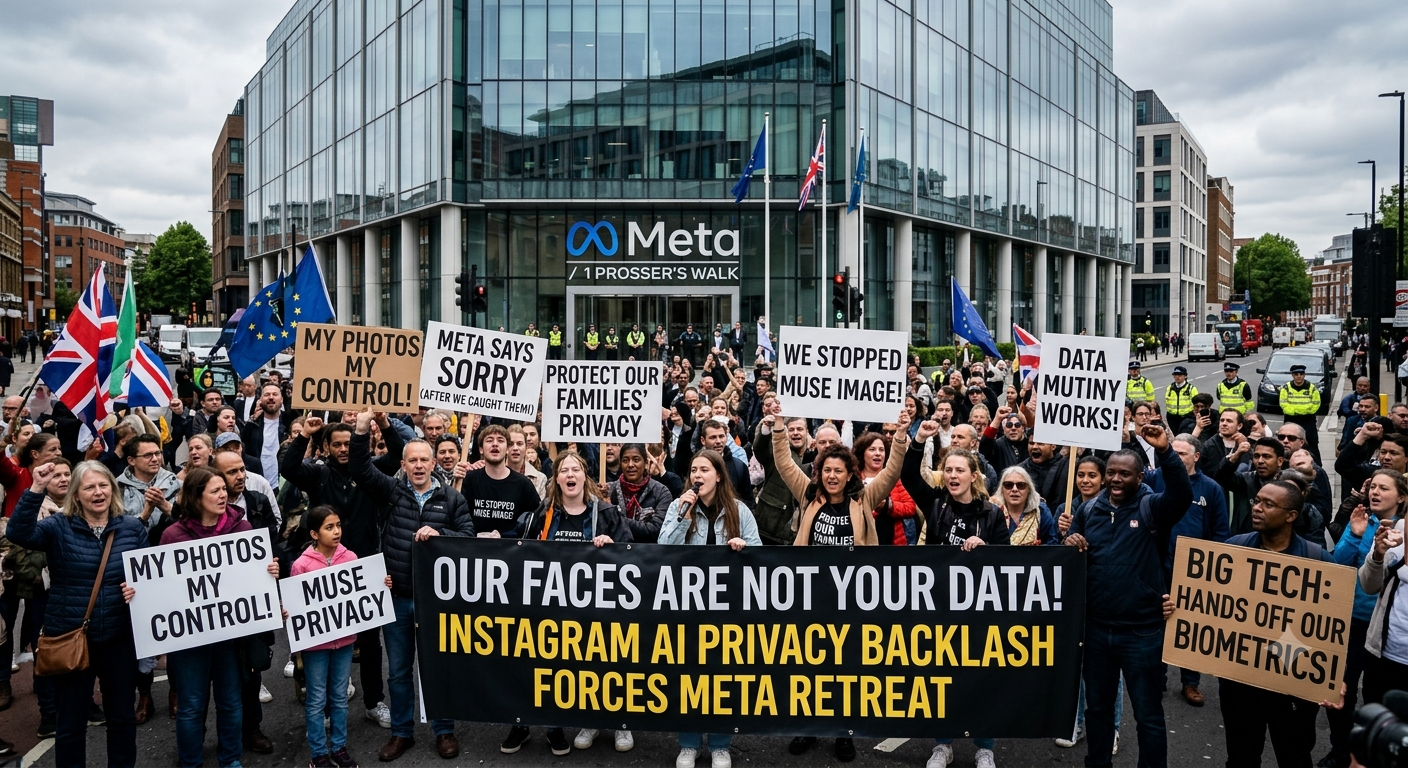
Instagram AI privacy backlash strategies are changing overnight because tech giants finally crossed a line that terrified families across the globe. Your family woke up to a reality where everyday photos of your children, vacations, and private moments were automatically fed into a corporate artificial intelligence engine without your explicit permission. Social media platforms turned public profiles into a massive testing ground for a tool called Muse Image, which allowed strangers to copy and alter real human faces using simple text prompts. This corporate overreach triggered a historic rebellion from users, creators, and Hollywood unions that forced a multi-billion-dollar empire into a humiliating, emergency retreat. You need to understand exactly how your personal data was targeted and what this high-stakes digital battle means for your household privacy today.
Key Digital Protection Data
- Three billion active users worldwide were automatically opted into Meta’s AI training programs before the sudden public resistance forced a policy shift.
- One hundred percent of public Instagram accounts, including images uploaded by teenagers and families, were accessible to the data scraping tool until the cancellation occurred.
- One hundred and sixty thousand members of the SAG-AFTRA union organized a coordinated digital strike against the corporate facial-cloning platform.
- Forty-five percent of parents surveyed express deep anxiety regarding how social media corporations utilize their children’s likenesses for machine learning models.
- Five hundred million dollars in projected developmental infrastructure has been frozen by the parent company following this massive product rollout failure.
How the Corporate Identity Harvest Unfolded
Corporate tech development moved too fast, and the public finally pushed back with historic force. The crisis exploded when social media engineers rolled out the Muse Image software upgrade across public profiles. This feature was designed to let everyday users take any public photo, merge it with a text sketch, and create a brand-new synthetic image. Tech executives viewed this as a fun, engaging consumer update. Everyday people viewed it as a corporate license to steal human identities for algorithmic profit.
The internal timeline shows that engineers built the tool using an aggressive automatic opt-in strategy. Instead of asking for your permission, the company quietly updated its terms of service and began indexing billions of family photos. Users who wanted to protect their likenesses were forced to navigate confusing, hidden settings menus to file complicated objection forms. This deliberate friction sparked outrage among casual users and professional creators alike.
Hollywood unions quickly realized the extreme danger this software posed to their members. Actors, voice artists, and models discovered that their promotional photos could be cloned by fans or predatory companies to create unauthorized digital replicas. Within hours, high-profile celebrities shared guides on how to fight the system, causing the hidden objection servers to crash under the weight of millions of simultaneous visits. By the time Friday arrived, executive leadership realized they had a full-scale consumer mutiny on their hands, forcing them to pull the plug on the entire project to prevent permanent brand destruction.
Why Modern Families Must Fight for Facial Rights
Your digital footprint is no longer just a collection of memories; it is the raw fuel that multi-billion-dollar tech corporations use to build their automated systems. When you post a picture of a family gathering, you expect to share that moment with friends. You do not expect a machine learning model to analyze the shape of your child’s face so a stranger across the ocean can generate a fake photo using their likeness. This reality is why the latest corporate retreat matters to your household.
Think of your digital face like the physical key to your home. If a company came to your house, photographed your locks, and sold the blueprints to anyone who asked, you would call the police immediately. Yet, big tech platforms have been doing the exact same thing with your biometric data for months. The financial stakes are staggering. Tech companies are racing to control generative media fields worth over $1.3 trillion – a sum that dwarfs the entire annual gross domestic product of most developed nations. They want to build these systems using your free data while charging you a monthly subscription fee to use the finished product.
The emotional toll on parents is hitting unprecedented levels. Moms and dads are realizing that images of their kids growing up are locked inside corporate databases forever. Even if you delete your account today, the algorithms have already learned from your past uploads. This battle is not about a single software feature; it is an existential fight over who owns your identity, your history, and your family’s visual legacy.
The Threat to American Homes and Privacy Standards
American households face a unique danger because the United States lacks a unified federal digital privacy law. Unlike consumers in other parts of the world, American citizens are largely left to the mercy of corporate promises and weak state-level regulations. When this image-scraping tool went live, tens of millions of American teenagers had their public profiles harvested instantly, creating massive anxiety about digital safety across all fifty states.
The political response in Washington is gaining speed as lawmakers face pressure from angry voters. Congressmen are pointing out that self-regulation in Silicon Valley has failed completely. The Federal Trade Commission is now looking into whether the automatic harvesting of family photos violates existing consumer protection laws. Parents are not waiting for Washington to act; they are taking matters into their own hands by changing their profiles to private or leaving major platforms entirely.
This situation directly impacts daily American life by forcing a total rethink of how families share milestones. Graduation photos, holiday gatherings, and school sports updates are suddenly disappearing from public view. The open, sharing nature of the early internet is dying because families can no longer trust tech platforms to respect basic boundaries of decency and consent.
The British Response to Automated Data Scraping
British families operate under a much stronger safety net, but this recent corporate overreach has still caused massive alarm across the United Kingdom. The UK General Data Protection Regulation gives British citizens legal rights over their personal data, including the explicit right to prevent companies from using their photos for artificial intelligence training. Despite these laws, tech companies attempted to use sneaky interface designs to bypass standard consumer protections.
The Information Commissioner’s Office faced immediate demands from consumer rights groups to launch a full investigation. British families want to know why a foreign tech empire thought it could scrape UK user data without asking for clear, unambiguous consent first. Parliamentary leaders are now arguing that the upcoming Digital Markets Act must be used to impose massive financial penalties on any firm that tries to trick users into giving away their biometric rights.
For the average British household, this issue highlights the growing gap between American corporate goals and European privacy values. UK parents are highly protective of their children’s digital safety, and this scandal has triggered widespread demands for stricter enforcement of the Online Safety Act to ensure that corporate AI tools cannot exploit young people.
The Crisis Facing Canadian Households
Canadian citizens are caught in a difficult spot between US tech developments and evolving domestic laws. The sudden rollout of the face-cloning tool has added fuel to the intense national debate over Bill C-27, Canada’s proposed law to modernize digital privacy and regulate artificial intelligence systems. Canadian parents are realizing that their current legal protections are outdated and unable to stop international tech giants from harvesting personal data.
The provincial response shows deep fragmentation, creating confusion for families from coast to coast. Privacy commissioners in British Columbia, Alberta, and Quebec are pushing for localized enforcement actions, while Ontario residents await a cohesive federal plan. This regulatory confusion leaves Canadian families exposed to corporate exploitation while politicians argue over legal wording.
The practical impact on Canadian communities is a sharp rise in digital distrust. Rural families who use social media to stay connected across vast geographic distances are now removing their family archives out of fear that their images will be weaponized by automated tools. The cultural cost of this privacy retreat is immense, altering how a digitally connected nation communicates.
What Digital Ethics Authorities and Legal Minds Are Saying
+-----------------------------------------------------------------+
|                    EXPERT ANALYSIS MATRIX                       |
+-----------------------------------------------------------------+
| Dr. Aris Vance      | "Corporate data harvesting is identity    |
| (AI Ethics Lab)     | theft masquerading as innovation."        |
+-----------------------------------------------------------------+
| Sarah Jenkins, Esq. | "Silicon Valley views global consumers    |
| (Privacy Law Firm)  | as unpaid research subjects."             |
+-----------------------------------------------------------------+
| Marcus Thorne       | "The business model relies on taking first|
| (Cyber Threat Org)  | and apologizing only when caught."        |
+-----------------------------------------------------------------+
Dr. Aris Vance, the leading director at the Future of Artificial Intelligence Ethics Laboratory, states that corporate data harvesting has reached a predatory stage where tech firms treat human lives like free building blocks for their software. He notes that the scale of this data grab shows a complete lack of respect for human dignity. My analysis of Dr. Vance’s position reveals a scary truth: tech giants believe that if data exists in public, it belongs to their balance sheets.
Sarah Jenkins, a veteran intellectual property attorney specializing in digital rights, warns that the current legal framework allows corporations to play a dangerous game of moving fast and asking for forgiveness later. She points out that by the time a tool is cancelled, the underlying data has already been processed and absorbed by the machine learning models. This means the corporate retreat is a public relations trick that does not actually fix the core problem of stolen data.
Marcus Thorne, the chief technology researcher at the Cyber Security Vanguard, emphasizes that consumers must stop treating social media platforms as neutral utilities. He explains that these systems are designed from the ground up to exploit human vanity for commercial gain. Our takeaway from these expert warnings is simple: you cannot trust corporate promises of self-regulation because their financial survival depends on taking your data.
Six Essential Actions to Lock Down Your Digital Footprint
You cannot afford to sit back and wait for governments to protect your household from predatory corporate scraping. You must take immediate, tactical control of your personal data to ensure your family’s faces are not harvested by future machine learning models.
1. Shift Your Social Profiles to Private Mode
Change every family social media account from public to private immediately. This simple step blocks automated corporate web crawlers from indexing your photo galleries and stops unauthorized AI tools from downloading your images.
2. Submit Explicit Corporate Data Deletion Requests
Use the official privacy objection pages provided by tech platforms to demand that your personal data be removed from AI training sets. You can find these links inside the privacy policy sections of your account settings.
3. Mask Visual Information on Public Assets
Avoid posting clear, high-resolution, front-facing photos of your children on any public website. Use creative camera angles, landscape shots, or digital filters that throw off facial recognition software while keeping memories intact for genuine friends.
4. Audit Connected Third-Party Software Access
Regularly check your account security settings to remove permissions for old apps, games, and photo editors that have background access to your image libraries. These apps often serve as hidden data pipelines for larger tech companies.
5. Utilize Watermarking and Anti-Scraping Open Source Tools
Apply free digital protection tools like Nightshade or Glaze to your creative photos before sharing them online. These programs make subtle changes to images that look normal to humans but completely confuse and ruin AI training scrapers.
6. Establish a Monitored Family Digital Agreement
Gather your household and create clear boundaries about what types of photos can be shared online. Educate your teenagers about the long-term dangers of automated identity harvesting so they understand why protecting their digital likeness matters today.
The sudden cancellation of the corporate face-cloning program proves that public resistance can stop big tech overreach. When everyday families, independent creators, and global unions join forces, even the most powerful corporate empires are forced to respect consumer boundaries. This victory is a temporary pause in a long war over digital identity, and tech firms will undoubtedly try new ways to access your data under different names. Your job is to stay vigilant, keep your security settings updated, and protect your family’s personal history from corporate exploitation. The future of human privacy depends entirely on our willingness to stand up and say no to automated exploitation.
Stay informed, stay prepared, and stay one step ahead with SultanNetwork – your trusted source for finance, business, technology and global news, updated 24 hours a day, 7 days a week.