

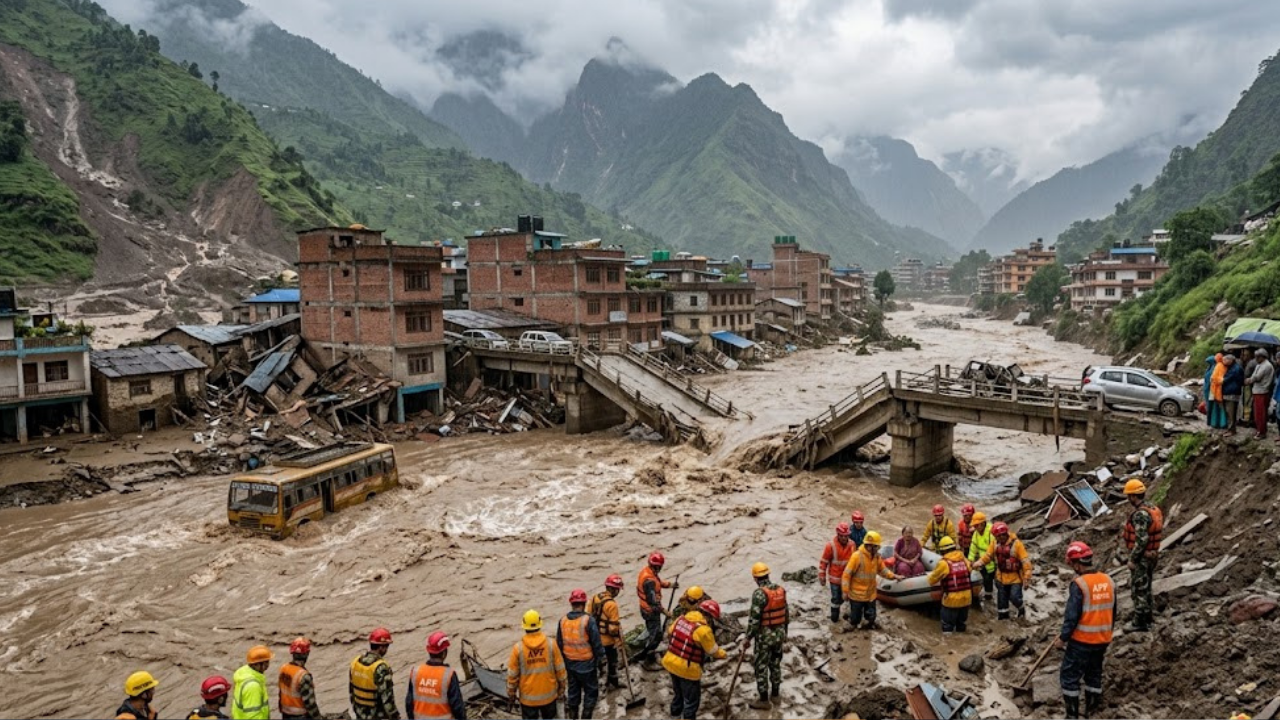
The Nepal flash flood 2026 has become one of the deadliest natural disasters to hit the Himalayas in years. A wall of mud, ice and river water tore through Rasuwa district on Wednesday morning, wiping out bridges, homes and hydropower stations along the country’s border with Tibet. By Thursday, Nepali police had recovered more than 157 bodies. Officials cautioned the toll from the Nepal flash flood 2026 would likely keep climbing as search teams reach areas still cut off by damaged roads and downed communications lines.
Across the border in China’s Gyirong county, in Tibet, state media reported three confirmed deaths. Hundreds more people remained unaccounted for after a separate but related mudslide struck a border crossing point. What sets the Nepal flash flood 2026 apart from the country’s frequent monsoon flooding is the scale of who is missing. Hundreds of the unaccounted-for are foreign tourists, trekkers and pilgrims who were passing through one of the Himalayas’ busiest travel corridors when the flood hit – including dozens of Americans.
What Triggered the Nepal Flash Flood 2026
The flooding began between roughly 8:30 and 9:15 a.m. local time on Wednesday. A surge of water suddenly overwhelmed the Bhote Koshi River in Rasuwa, quickly spreading into the neighboring Nuwakot and Dhading districts. The U.S. Geological Survey attributed the trigger behind the Nepal flash flood 2026 to a glacial collapse. A large mass of ice broke away and plunged into the valley below, picking up already waterlogged monsoon sediment as it went and turning into a fast-moving debris flow. The agency said no earthquake had occurred at the time.
Separately, a German geosciences institute detected a magnitude-4.4 seismic signal several minutes before the flood was captured on security video. It remains unclear how that detection relates to the glacial event – a point authorities have not yet reconciled. Scientists describe this type of event as a glacial lake outburst flood, or GLOF. It’s a hazard in which an unstable lake formed by melting glacier ice suddenly releases its contents downstream, sometimes triggered by an avalanche or ice collapse rather than a lake breach itself.
Nepal’s Department of Hydrology and Meteorology reached a similar conclusion after a smaller but strikingly similar flood tore through the same river corridor just over a year earlier. That June 2025 flood, also near the Rasuwagadhi border crossing, was traced to a supraglacial lake bursting roughly 36 kilometers north of the border on the Chinese side. It killed at least nine people and destroyed the same Miteri Bridge that collapsed again this week.
Why Nepal Keeps Seeing Flash Floods Like This
Nepal’s mountains sit atop one of the most glacially unstable regions on Earth. Government researchers say the country has recorded 26 glacial lake outburst floods since the 1970s, and 47 glacial lakes are currently classified as potentially dangerous.
A United Nations University assessment found that the average number of GLOF events per decade across the Himalayas is now roughly five times higher than it was before 1950. Scientists tie the trend to accelerated glacier melt driven by climate change – a key factor behind disasters like the Nepal flash flood 2026.
As glaciers retreat, they leave behind unstable lakes dammed by loose rock and ice debris. Ice avalanches, heavy monsoon rain or a chunk of collapsing glacier can breach that natural dam in seconds. The result is a wall of water, mud and boulders moving down valleys where towns, roads, farmland and border infrastructure now sit.
The Dalai Lama, in a statement offering prayers for the victims, pointed to climate change as a possible underlying factor in the disaster. That view lines up with the broader scientific consensus on why the Himalayas are seeing these floods more often. Researchers do caution that pinning any single event definitively to warming trends takes further study.
Hundreds of Travelers Caught in a Pilgrimage Season
The timing made the Nepal flash flood 2026 especially devastating for foreign visitors. Rasuwagadhi is one of the main crossing points used by pilgrims heading to Mount Kailash and Lake Manasarovar in Tibet, sites considered sacred in Hinduism, Buddhism and Jainism. This year’s Kailash Mansarovar Yatra had drawn renewed interest after a five-year pause. Nepal’s tourism authorities had projected roughly 25,000 Indian pilgrims would travel the route this season.
The Nepal Tourism Board’s preliminary count put the number of travelers who lost contact after the flood at more than 500 foreign nationals from at least 32 countries, alongside well over 100 missing Nepali citizens. Among the largest national groups reported missing were travelers from India, the United States, Ukraine, Malaysia, Australia, the United Kingdom and Canada.
U.S. officials have not yet released a confirmed, finalized count of missing Americans. Figures reported by different outlets over the past day have ranged from roughly three dozen to more than 60. That gap reflects how fluid and incomplete identification efforts remain in a region where phone and internet networks are still down.
Small tour operators have described losing contact with entire groups. One Kathmandu-based trekking company told reporters it lost touch with 20 clients, including two Americans, a Briton and 17 Malaysians, who had set out for the Kailash pilgrimage the day before the flood. Nepali guides and drivers hired for such trips are also among the missing. Nepal’s Trekking Agencies’ Association has asked the country’s Foreign Ministry and the Chinese Embassy to open alternate crossing points for stranded pilgrims. It has also urged authorities to fast-track visa processing so travelers can find another way home.
The Rescue Effort and the Wider Regional Threat
The Nepali Army has led helicopter search-and-rescue operations from a base near Trishuli, flying dozens of missions despite repeated weather delays. Officials say dozens of security personnel – from the Nepal Army, Nepal Police and Armed Police Force – are themselves among the missing.
Workers from hydropower projects and customs offices operating in the flood zone are also unaccounted for. The International Red Cross says many of the worst-affected areas remain inaccessible by road, which is slowing efforts to deliver aid and identify the dead. China has warned of the risk of a secondary disaster in Gyirong county, where more rain is forecast this week in a region already prone to landslides.
The effects of the Nepal flash flood 2026 have reached beyond the country’s borders. Authorities in India’s Bihar state, downstream along rivers that flow out of the Himalayas, issued flood alerts and began evacuating residents from low-lying districts. Officials plan to move as many as 10,000 to 12,000 people to safety as a precaution.
What Happens Next
Search and recovery operations are expected to continue for days. Officials warn the death toll from the Nepal flash flood 2026 will likely rise as crews reach isolated valleys. Identifying foreign victims and confirming the status of missing travelers is expected to take longer, given the scale of disrupted communications across the border region. Longer term, the disaster is likely to renew pressure on Nepal and China to invest in early-warning systems for glacial lakes along their shared border. Climate researchers and Nepali disaster-management officials have been pushing for this as GLOF risk rises across the region.
The Nepal flash flood 2026 may also affect this year’s Kailash Mansarovar pilgrimage season and the broader trekking economy that Rasuwa’s border towns depend on – at least until damaged roads, bridges and hydropower infrastructure can be rebuilt. For families in the U.S. and elsewhere still waiting on word about missing relatives, Nepali officials have cautioned that being “out of contact” does not necessarily mean someone is dead or injured. Communications across the disaster zone remain down in many areas, complicating even the basic task of confirming who is safe.
More from SultanNetwork: Meta’s child safety settlement – coverage of a separate, unrelated story involving child-safety accountability in the tech industry.
One thought on “Nepal Flash Flood 2026: What Caused It, Who’s Missing, and Why It Keeps Happening”