


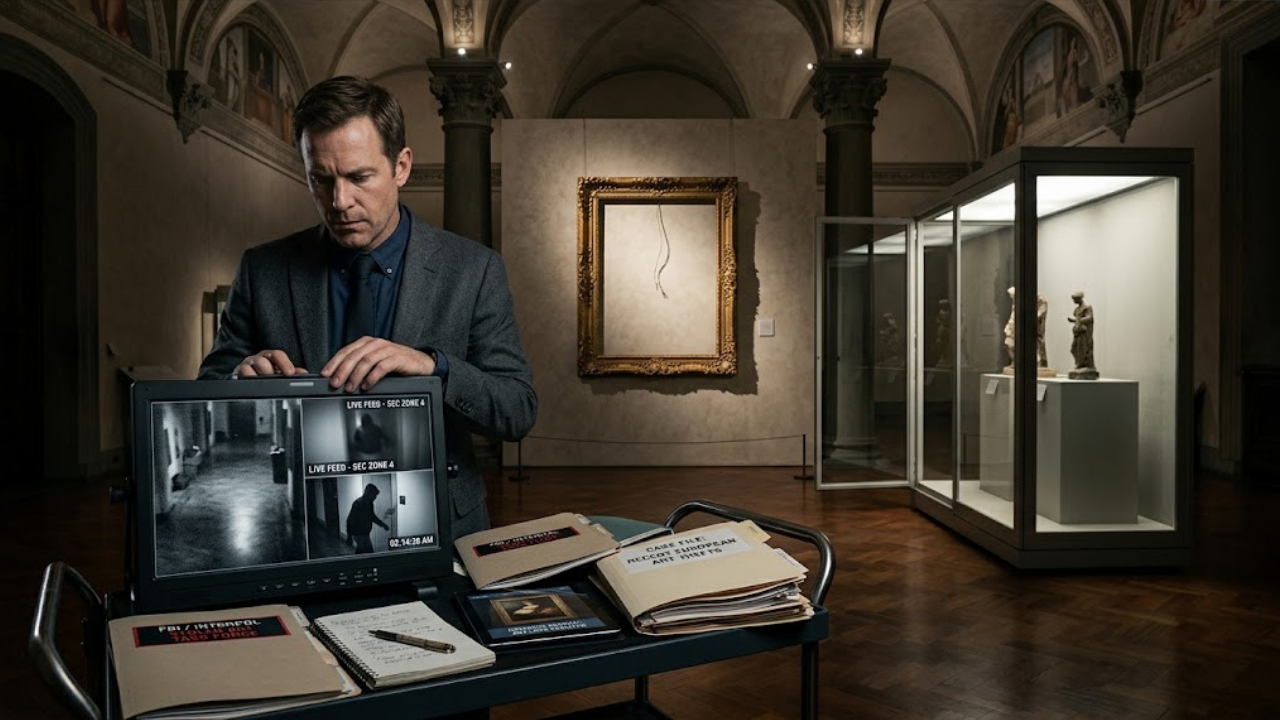
Italian police had barely finished celebrating one victory when the next crime scene opened. This latest Italy museum theft story began on Friday, August 14, when the Carabinieri announced they had recovered three paintings by Renoir, Cézanne and Matisse, stolen five months earlier from a private foundation near Parma, and arrested five suspects. Less than twenty-four hours later, while much of Sicily was in the streets for the Ferragosto holiday, thieves broke into a museum in Messina and walked out with four works by the city’s most famous son, the Renaissance painter Antonello da Messina.
Taken separately, these are two Italian crime stories with a satisfying ending and a troubling one. Taken together, with the Louvre’s crown-jewels heist from last October still unsolved, they form something else: a pattern. Three major thefts of irreplaceable, world-famous art from European institutions in under a year, each pulled off in minutes, each apparently carried out by people who understood exactly what they were doing and why. That pattern raises a question that outlasts any single headline – if these paintings and jewels are too famous to sell on the open market, why do professional criminals keep going to such lengths to steal them, and why do some of Europe’s best-known museums keep struggling to stop them?
A Renaissance Altarpiece, Broken Apart in Minutes
The Messina theft happened fast and with apparent precision. Just before 10 p.m. on August 15, while thousands of residents were following the city’s centuries-old La Vara procession through the streets, thieves entered the Museo Regionale Interdisciplinare di Messina, known as MuMe, and went straight for a specific work: the Polittico di San Gregorio, a five-panel altarpiece Antonello painted in 1473 for a local monastery destroyed in Messina’s catastrophic 1908 earthquake. It is the only painting by the city’s namesake artist that never left his hometown.
The thieves pried three of the five panels loose and also took a separate double-sided devotional painting from a supposedly secure display case, showing the Madonna and Child on one side and a Pietà scene on the other. Then, in a detail that has puzzled investigators, they abandoned two of the altarpiece panels – depicting Saint Gregory and Saint Benedict — on a low wall just outside the museum, where passersby noticed and recovered them shortly afterward.
What makes the theft unusual is that it wasn’t a case of overlooked security. MuMe’s director, Marisa Mercurio, said the alarms were functioning and guards were present when the break-in occurred. Sicily’s regional government later confirmed that both the alarm system and surveillance cameras were working properly throughout. Investigators are now examining recordings and other evidence to understand exactly how the thieves got past systems that, on paper, should have stopped them.
Local officials have floated a specific theory: that the theft was commissioned. Messina’s culture councilor, Enzo Caruso, pointed to a detail that may have quietly marked the museum as a target – earlier this year, Italy’s Culture Ministry spent close to $15 million to acquire another Antonello da Messina work, “Ecce Homo,” through Sotheby’s in New York. That purchase drew fresh international attention to the artist’s market value, and possibly to what remained in Sicily.
A local prosecutor’s assessment, reported by multiple Italian outlets, put the estimated value of the stolen San Gregorio panels and the Pietà painting at somewhere between 70 million and 80 million euros – but as with most stolen masterpieces, that number describes what the works are worth on paper, not what a thief could actually get for them.
Why Steal Something You Can Never Sell
That gap between paper value and street value is the part general coverage of these thefts tends to skip past, and it’s the real story here. Famous paintings are, in the words of art-crime researchers, almost worthless the moment they’re reported stolen. Once a work like an Antonello panel or a Renoir canvas is entered into international databases – chiefly Interpol’s Stolen Works of Art database, which now holds descriptions of more than 57,000 items – no legitimate auction house, dealer, or collector will touch it. Its face, its provenance gap, and its theft date are permanently attached to it.
That was precisely what undid the Parma thieves. Investigators told Italian media that the suspects, five Moldovan nationals living near Parma, had already started making inquiries about international buyers for the Renoir, Cézanne and Matisse works before police caught up with them. Those inquiries, an Italian art-recovery officer said, went nowhere, because the paintings had been logged with Interpol almost immediately and were effectively unsaleable through any channel a buyer would trust. Police eventually found all three works stuffed inside an empty television box in a storage closet – recovered, but never actually monetized.
So why steal art that can’t be sold? Investigators and researchers who track this world point to a different kind of value entirely. Famous stolen paintings function less like merchandise and more like a private, illegitimate currency inside organized crime. A well-documented case involved Raffaele Imperiale, a convicted Italian drug trafficker who had bought two stolen Van Gogh paintings years earlier; when Dutch and Italian authorities eventually caught up with him, he used knowledge of where the paintings were hidden as a bargaining chip to negotiate a reduced sentence on drug charges.
Lynda Albertson, chief executive of the Rome-based Association for Research into Crimes Against Art (ARCA), has described this dynamic before: stolen masterpieces circulate for years as informal collateral, insurance against prosecution, or barter between criminal networks, rather than as objects anyone expects to hang on a wall or resell at auction. That reframes the Messina theft, too – if it was commissioned, the buyer is far more likely to be someone seeking leverage or status within a closed criminal world than a private collector hoping to display it.
Why This Italy Museum Theft Wasn’t a Simple Security Failure
The recurring detail across all three recent European heists – Parma in March, the Louvre in October 2025, and now Messina — is how briefly the thieves were actually inside. The Parma theft took under three minutes. The Louvre’s crown-jewels heist took roughly six to seven minutes from entry to escape, carried out in broad daylight using a truck-mounted lift and angle grinders against display cases that had reportedly been upgraded years earlier. In each case, institutions insisted afterward that their security had functioned as designed, and in each case a museum still lost objects that can never be fully replaced.
The Louvre case did the most public damage to confidence in Europe’s museum security. France’s then-culture minister told lawmakers the security apparatus had not failed even as the country’s Louvre director resigned in the aftermath. Eight crown jewels, together valued at roughly $102 million, remain missing nearly a year later; only one piece, Empress Eugénie’s crown, was recovered after being dropped during the thieves’ escape. The Apollo Gallery reopened to the public this past July with no jewels on display at all – the surviving pieces moved to a new, windowless strongroom, an admission that the old approach to displaying priceless objects in a heavily trafficked museum no longer holds up.
Messina now raises the same question in miniature. A museum with working alarms, present guards, and functioning cameras still lost most of its target in a matter of minutes. That is arguably more unsettling than a straightforward security lapse, because it suggests professional planning capable of working around standard protections rather than simply exploiting gaps in them – the kind of operation officials describe when they use the word “commissioned.”
Why This Matters Beyond Italy
For American readers, the direct connection is narrower than the Italian headlines suggest, but it isn’t nonexistent. The United States has its own unsolved case that dwarfs anything discussed here: the 1990 theft of thirteen works, including a Vermeer and several Rembrandts, from Boston’s Isabella Stewart Gardner Museum remains the largest art theft in U.S. history, still unresolved after more than three decades, with a $10 million reward still standing and none of the works recovered. American institutions face the identical calculation Italian ones do – famous works are simultaneously the hardest to sell and the most tempting to steal, precisely because their fame is what gives them value as leverage rather than as merchandise.
There is also a U.S. link on the buying side of this market, even if it rarely involves recently stolen masterpieces directly. American collectors and major museums have repeatedly had to surrender looted or stolen antiquities once their origins came to light – the Metropolitan Museum of Art’s return of a golden mummy coffin looted during Egypt’s 2011 unrest is one widely reported example, and it prompted the Met to tighten its own acquisition vetting.
The lesson institutions and collectors on both sides of the Atlantic keep relearning is the same one driving the black-market economics described above: due diligence against stolen-art databases is no longer optional, because the paperwork gap between “recently surfaced” and “recently stolen” is exactly where criminal networks operate.
What Happens Next
This Italy museum theft case is far from closed. Two of the four stolen Messina panels are already back, found abandoned near the museum within hours of the theft. The central Madonna panel and the double-sided Pietà painting remain missing, and Italian investigators are treating the case as an active, evolving inquiry rather than a closed one – evidence from the museum’s cameras and alarm logs has been handed to prosecutors, and authorities have not ruled out an organized network behind it.
The broader pattern is harder to resolve than any single case. Interpol’s own guidance acknowledges that its widely cited 57,000-item stolen art database, while the only certified international resource of its kind, still misses a large share of thefts – items not yet reported, not yet entered by national police, or looted from sites that were never inventoried in the first place. That gap is precisely the space in which stolen masterpieces can sit for years, or decades, before either turning up in a storage closet like the Parma paintings, or vanishing the way most of the Gardner Museum’s collection and most of the Louvre’s jewels still have.
What connects Parma, the Louvre and Messina isn’t simply bad luck striking Italian and French museums in the same twelve months. It’s a mismatch between the value professional criminals see in famous art – as leverage, not as merchandise – and the security model most museums still use, built around stopping casual theft rather than fast, targeted, possibly commissioned operations. Until that mismatch narrows, expect the next Italy museum theft to make headlines with a different city and a different Renaissance master’s name attached.
