Here’s a sentence that sounds like it shouldn’t be possible: the longest chess game in recorded history lasted more than twenty hours, stretched across 269 moves, and ended in a draw that changed absolutely nothing on the scoreboard. No trophy. No prize money worth the effort. Just two grandmasters, one board, and a silence that outlasted most people’s entire workday. Why would anyone put themselves through that?
To understand this story, you have to stop thinking about chess as a game of quick, clever traps – and start thinking about it as something closer to an endurance sport that happens to be played sitting down.
Belgrade, 1989: The Setup
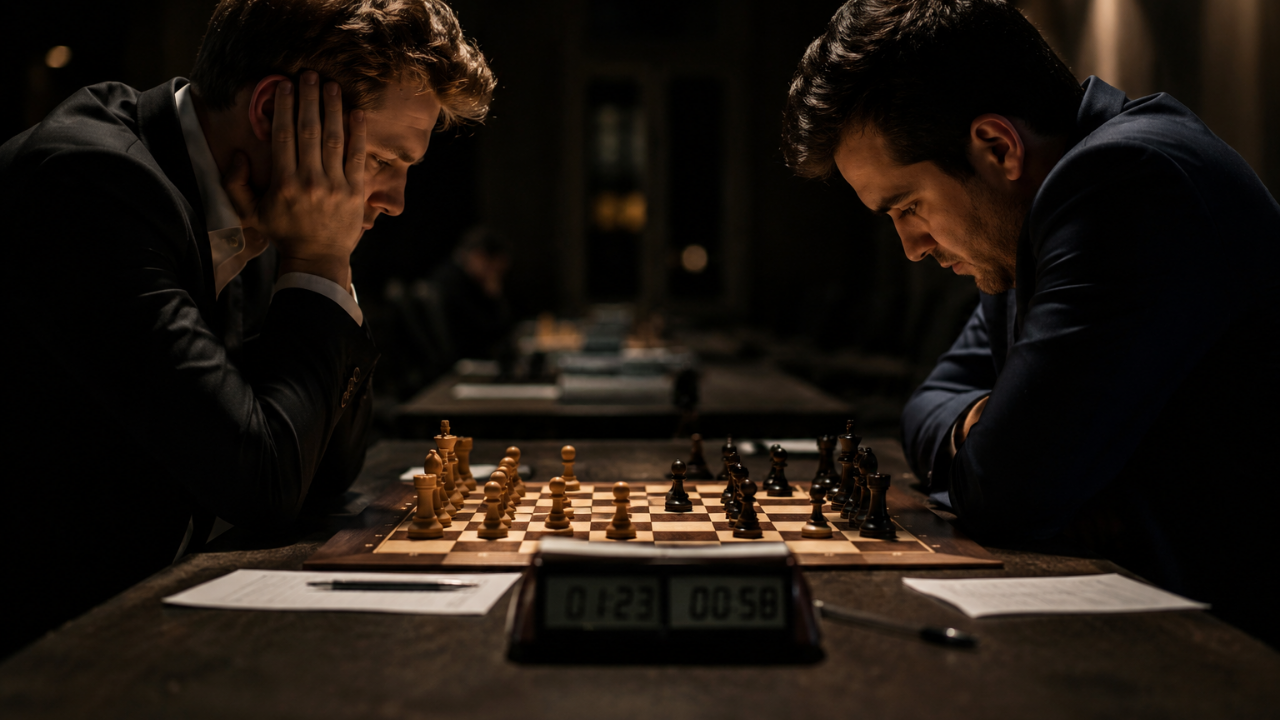
The match took place in Belgrade, in what was then Yugoslavia, between two grandmasters: Ivan Nikolić and Goran Arsović. Neither man walked into that game expecting to make chess history. They played what started as a fairly standard, well-studied opening – the kind of positional battle that thousands of serious players have studied and repeated for decades.
For the early stretch of the game, things unfolded more or less normally. Pieces were traded, positions shifted, and both players navigated the middlegame without any serious blunders. This part of the story isn’t unusual – it’s what happened afterward that turned this into a permanent chess record.
When the Board Runs Out of Ammunition
By the time the two players reached the endgame, the board had been stripped down to almost nothing – a handful of pawns, a rook, a bishop, two kings. In chess terms, this is one of the most notoriously difficult endgames to convert into a win: rook-and-bishop against a lone rook. It’s a position that has frustrated strong players for over a century, because a slight material advantage doesn’t guarantee anything close to an easy victory.
What followed wasn’t dramatic in the traditional sense. There were no sacrifices, no dramatic blunders, no crowd gasps. Instead, there was repetition – long, grinding stretches where neither player could find a way to break through, and the position simply refused to resolve itself. Under the rules in place at the time, a chess game can be declared a draw if fifty consecutive moves pass without a single pawn move or piece capture. In this game, that threshold was reached and reset not once, but twice – meaning the players spent enormous chunks of time locked in near-total stillness on the board, even as the clock kept running.
The Real Battle Wasn’t on the Board
This is the part of the story that makes it worth telling at all. On paper, “nothing was happening.” In reality, everything was happening – just not where you could see it.
Every one of those quiet, repetitive moves required full calculation. Grandmasters don’t get to skip the analysis just because a position looks familiar; each move still demands checking for hidden threats, subtle improvements, and traps buried several moves deep. Doing that for hour after hour, without a single decisive moment to break the tension, is a completely different kind of exhausting than a fast, tactical game that’s over in ninety minutes.
This is where the popular image of chess – two people calmly thinking in silence – falls apart. Anyone who has tried to concentrate hard for even two hours straight knows how much mental fatigue builds by the end. Now stretch that same intensity across ten times as long, with a draw hanging in the balance and years of training on the line.
Why the Body Pays the Price Too
It’s tempting to treat chess as purely cerebral, but professional players and researchers who’ve studied competitive chess have pointed out something counterintuitive: elite chess players burn a surprising amount of energy during long games, largely due to sustained stress, elevated heart rate, and the physical toll of remaining hyper-alert for hours without a break. A twenty-hour game doesn’t just tire the mind – it wears down the body carrying that mind around.
That’s part of why this particular match still gets brought up decades later. It’s not just a trivia answer about “the longest game ever.” It’s a rare, extreme example of what happens when two competitors refuse to blink first, each one betting that the other will crack before they do.
A Draw That Still Meant Something
In the end, neither Nikolić nor Arsović managed to force a win. The game was recorded as a draw – technically, a result where nobody loses, but also a result where twenty-plus hours of effort produced no winner at all. It would be easy to call that anticlimactic. It’s more accurate to call it honest: some positions in chess, like some situations in life, simply don’t have a clean resolution no matter how long you stare at them.
What the match left behind wasn’t a trophy – it was a new understanding of just how far competitive endurance in chess could stretch. It reset what “long game” even meant in professional play, and it’s still referenced whenever chess commentators want to explain that this sport asks more of the human mind and body than most people assume.
The Real Lesson Behind the Record
Strip away the impressive number – 269 moves, over twenty hours – and what’s left is a much simpler idea: sometimes the hardest kind of competition isn’t the one with the most dramatic swings. It’s the one where nothing moves for a long, long time, and the only thing separating the two people at the table is who can keep thinking clearly the longest.
That’s the real story behind the longest chess game ever played. Not a single explosive moment. Just two minds, refusing to give the other one an inch, for far longer than most of us could sit still at all.