
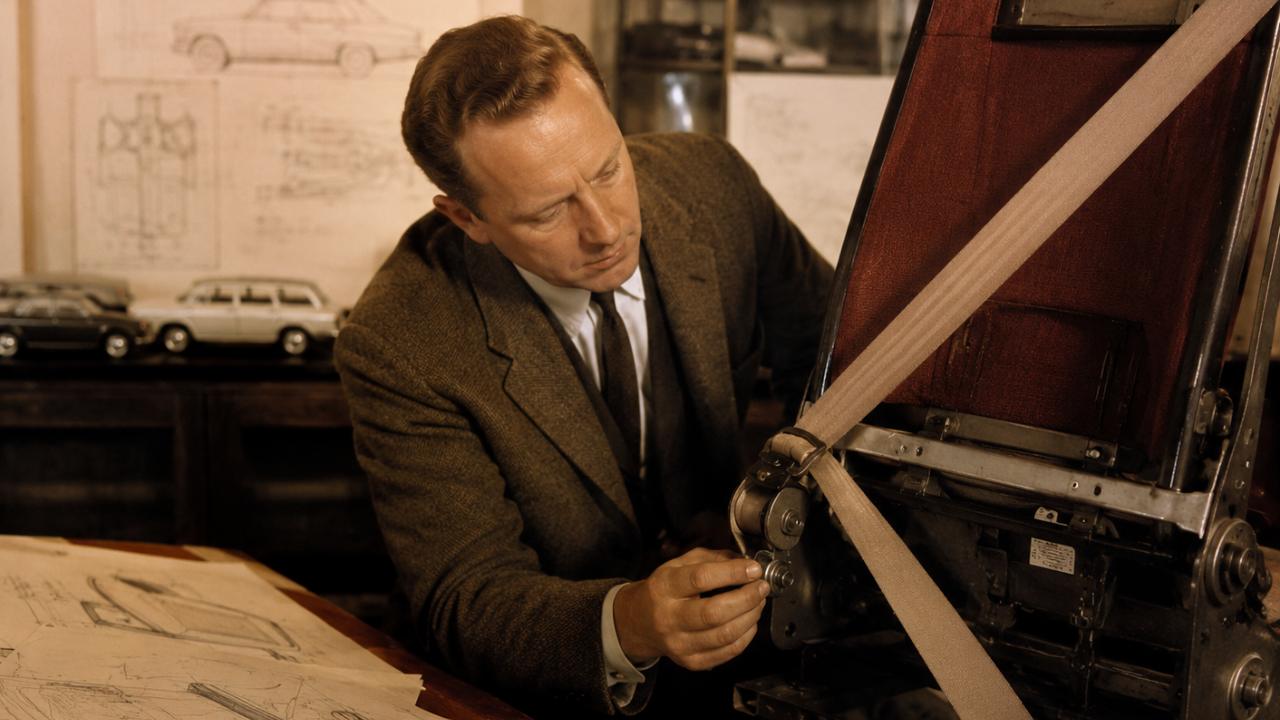
Most inventors spend their careers trying to protect what they create. Nils Bohlin did the opposite. In 1959, this Swedish engineer designed one of the most important safety inventions in automotive history, and instead of locking it behind a patent wall to make his employer rich, he watched as that same employer handed the design away to every competitor on the planet, for free, forever.
That invention was the modern three-point seatbelt, the simple diagonal strap across your chest and lap that you probably buckled without thinking the last time you got into a car. It’s estimated to have saved more than a million lives worldwide. And it almost didn’t exist in the form we know today.
A Problem Rooted in Aviation, Not Automobiles
Before joining Volvo, Bohlin spent years at Saab, the Swedish aircraft manufacturer, where he worked on ejection seat systems designed to save fighter pilots’ lives during high-speed emergencies. That background in life-or-death engineering shaped how he approached his next job entirely.
In 1958, Volvo hired Bohlin as the company’s first chief safety engineer. At the time, most cars that had seatbelts at all used a simple two-point lap belt, a single strap buckled across the stomach. It sounds safer than nothing, but in a real high-speed collision, that design frequently caused severe internal injuries, as the body’s upper half whipped forward with nothing to restrain it, while the lap belt itself could crush internal organs on impact.
Bohlin saw the flaw immediately, likely informed by everything he’d learned designing restraint systems for pilots facing far more violent forces than most drivers would ever encounter.
A Design Solved in Under a Year
Working at Volvo, Bohlin spent less than a year developing what became the three-point safety belt: two straps joined near the hip and anchored at a single point, distributing crash force across the chest, pelvis, and shoulders rather than concentrating it on the abdomen alone. It was, in engineering terms, an almost elegant solution to a problem that had injured and killed drivers for decades.
Volvo installed Bohlin’s design as standard equipment on the front seats of the Volvo PV544 in 1959. Three years later, on July 10, 1962, the U.S. Patent Office formally granted him Patent No. 3,043,625 for the invention.
The Decision That Changed Everything
This is where the story stops being a simple engineering success and becomes something far more unusual. Volvo held a patent on what was, by any reasonable measure, one of the most valuable safety inventions in automotive history. Every car manufacturer on Earth would eventually need something like it. Volvo could have charged licensing fees to every competitor for decades, generating what would likely have amounted to billions of dollars in patent royalties over time.
Instead, Volvo made the patent open. Any manufacturer, anywhere in the world, was free to use Bohlin’s three-point design at no cost and without needing Volvo’s permission. There was no fine print, no expiration date attached to the generosity, no attempt to extract value before eventually loosening restrictions. The decision was made almost immediately, and it was permanent.
Volvo’s reasoning, according to the company’s own account of the decision, was straightforward: the value of preventing death and injury outweighed any financial gain the company could extract from controlling the technology. Safety, in this case, was treated as something too important to monetize exclusively.
What Giving It Away Actually Meant
It’s worth sitting with what this decision actually cost. Patents exist specifically so inventors and companies can profit from their innovations before competitors can copy them. Bohlin and Volvo voluntarily walked away from that entire system for what may be the single most universally adopted safety feature ever installed in a consumer product.
Within years, three-point seatbelts modeled directly on Bohlin’s design began appearing in vehicles from manufacturers who had no financial relationship with Volvo whatsoever. Governments eventually made the design a legal requirement in most of the industrialized world. Today, in some form or another, Bohlin’s exact concept sits in the vast majority of cars built anywhere on the planet, whether that car rolled off a Volvo assembly line or one belonging to a direct competitor.
The Numbers Behind the Decision
The scale of what this choice accomplished is difficult to overstate. Research attributes more than a million lives saved globally to the three-point seatbelt design, with U.S. federal safety data alone crediting the invention with saving hundreds of thousands of lives domestically since the mid-1970s. Studies have found the design reduces fatal injury risk by roughly 45 percent in passenger cars.
Germany’s patent office later recognized Bohlin’s three-point belt as one of only eight patents in the past century and a half considered to have had the greatest positive impact on humanity, placing a seatbelt design in the same conversation as some of the most transformative inventions in modern history.
A Different Kind of Legacy
Bohlin never became a household name the way some inventors do. There’s no seatbelt-branded product line, no royalty fortune tied to his name, nothing that turned his invention into personal wealth on the scale it easily could have generated. What he left behind instead is something harder to quantify: a design so thoroughly integrated into daily life that most people who use it every single day have no idea who created it, or that its creator’s employer chose, quite deliberately, not to profit from controlling it.
In an era where companies frequently guard incremental innovations behind aggressive patent litigation, Bohlin and Volvo’s decision reads almost like an artifact from a different value system entirely, one where an invention capable of saving lives was treated as too important to keep for themselves.