
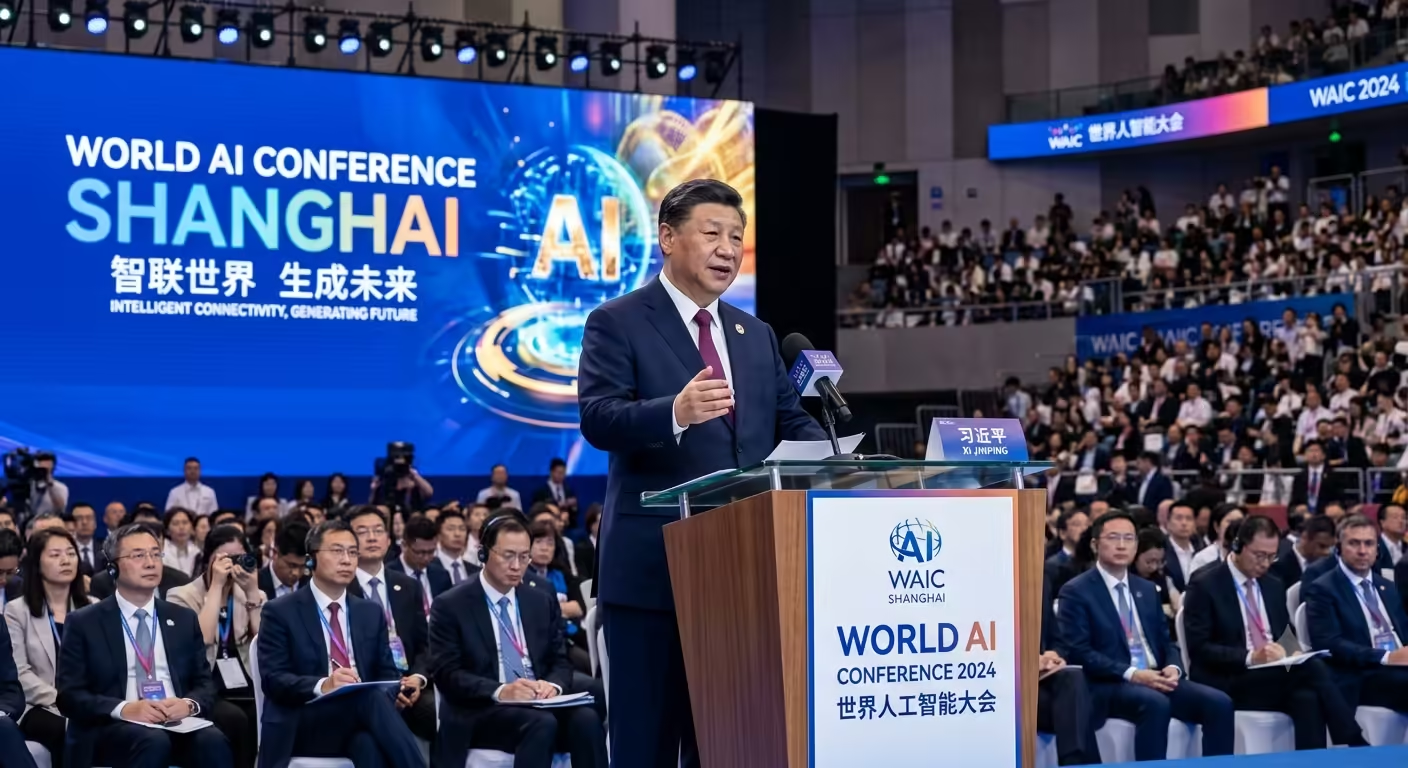
The Xi Jinping World AI Conference 2026 speech has become one of the most closely watched moments in the global technology calendar this year. Speaking Friday at the opening of the World Artificial Intelligence Conference in Shanghai, China’s president made his first-ever appearance at the country’s flagship AI event, using the moment to push back against Washington’s export controls and to position Beijing as a partner for countries left out of the West’s AI buildout.
It was a significant shift in tone. In previous years, Xi sent only a congratulatory letter to the conference, leaving the opening remarks to Premier Li Qiang. His decision to headline the event himself, alongside the leaders of Kazakhstan, Cambodia and Thailand and UN Secretary-General António Guterres, signaled how central AI has become to China’s economic and diplomatic strategy.
Quick Facts
- Xi Jinping delivered his first-ever keynote at the World AI Conference, held in Shanghai from July 17 to 20.
- He renewed China’s objection to what he called the “overstretching” of national security concerns in AI policy, a clear reference to US export restrictions.
- China will provide 5,000 AI training opportunities to developing countries over the next five years.
- A day before the speech, 29 countries – including Pakistan, Russia, Indonesia, and Kazakhstan – signed an agreement establishing the World Artificial Intelligence Cooperation Organization (WAICO), headquartered in Shanghai.
- The four-day conference drew more than 1,400 guests, 1,100 exhibiting companies, and over 300 product debuts.
What Happened?
Xi’s address came at a moment when Chinese AI firms are closing the gap with their American rivals while facing continued limits on access to advanced chips. In his speech, Xi argued that AI development should not be “a solo performance by any single country” but instead “a symphony of global cooperation.” He called for the world to reject security-driven barriers that, in his framing, let one country place its own interests above everyone else’s.
That message was reinforced a day earlier when representatives from 29 nations signed the founding agreement for WAICO in Shanghai. According to China’s state Xinhua news agency, signatories included countries with close ties to Beijing, among them Russia, Indonesia, and Kazakhstan. Chinese officials describe the new body as an intergovernmental organization meant to set shared standards for AI governance and to give participating countries – many from the Global South – a seat at the table on rules that have so far been shaped mostly by the United States and its allies.
To back that pitch with concrete offers, Xi announced that China will provide 5,000 AI training and research opportunities to developing nations over the next five years. He also pledged to expand AI cooperation through existing blocs, including ASEAN, the League of Arab States, the African Union, the Community of Latin American and Caribbean States, the Shanghai Cooperation Organization, and BRICS. As part of the package, Beijing will give 30 countries access to a Chinese-built AI meteorological system designed to provide early flood and storm warnings – a detail with obvious resonance for regions vulnerable to extreme weather.
Xi also struck a more cautious domestic note, calling for stronger legislation, oversight, and early-warning systems to keep AI “safe and controllable” as adoption accelerates inside China itself.
Why This Matters
The speech crystallizes a divide that has been building for several years: a US-led model built around export controls, proprietary systems, and close allied partnerships, against a China-led push for open cooperation, shared standards, and expanded access for countries that have largely been shut out of frontier AI development. Analysts have already compared WAICO to Washington’s own outreach efforts in the region, suggesting the two initiatives may now compete directly for the loyalty of the same set of developing economies.
For the tech industry, the stakes are practical as much as ideological. Continued restrictions on advanced semiconductors have pushed Chinese firms to accelerate domestic chip and model development, narrowing a gap that US policy was designed to widen. Every new AI cooperation pact China signs with a Global South nation is also a data point in the broader argument over whether export controls are containing China’s AI ambitions or simply speeding up its self-sufficiency.
Impact on American Families
For most US households, the immediate effects are indirect but real. Continued tension over semiconductor export policy can influence chip prices and supply chains that feed everyday electronics, from laptops to cars. Renewed Chinese diplomatic outreach on AI could also affect which technology standards eventually dominate emerging markets that US companies compete in, shaping long-term job growth in the American tech sector. None of this changes daily costs overnight, but it adds to the uncertainty already facing chipmakers and the broader tech supply chain that many American jobs depend on.
International Perspective
For the United Kingdom, the announcement forces policymakers to weigh how closely to align with Washington’s restrictive approach versus engaging with China’s more open, access-driven model, particularly as British universities and firms look for AI research partners. Canada faces a similar calculation, since its tech research ties are shaped by continental defense and trade agreements with the US that limit how freely Canadian institutions can cooperate with Chinese AI initiatives. More broadly, the emergence of WAICO gives dozens of Global South nations a structured alternative to Western-led AI governance bodies for the first time, a development likely to reshape how international AI standards are negotiated in the years ahead.
What Experts Say
Trade analysts who track the US-China relationship note that WAICO functions as a direct counterpart to the United States’ own regional technology partnerships, giving Beijing a comparable diplomatic tool. Some observers caution that Xi’s remarks, while significant symbolically, were relatively general on specifics, meaning the new organization’s real influence will depend on how it operationalizes shared standards rather than on the launch speech alone.
What Readers Should Watch Next
Key developments to track include how many additional countries join WAICO in the coming months, whether Washington responds with new restrictions or countermeasures, and how the 5,000 training slots are distributed and to which nations. Also worth watching: any statements from major US chipmakers or the Silicon Valley tech lobby responding to the widening divide, and whether allied governments in Europe or Asia begin explicitly choosing between the two competing governance frameworks.
Practical Takeaways
For businesses operating across US and Chinese supply chains, this is a moment to reassess exposure to further semiconductor restrictions and to watch for shifts in which AI standards gain traction in emerging markets. For policymakers in allied nations, the conference underscores the need to clarify where they stand as two competing AI governance blocs continue to solidify.
Conclusion
Xi Jinping’s keynote at the 2026 World AI Conference did more than criticize US policy – it offered a concrete, funded alternative aimed squarely at the countries caught in the middle of the US-China tech rivalry. With WAICO now formally established and thousands of training slots on offer, the coming months will show whether this marks a genuine shift in global AI governance or simply a well-funded diplomatic gesture.
FAQ
1. What did Xi Jinping announce at the 2026 World AI Conference? He announced that China will provide 5,000 AI training and research opportunities to developing nations over the next five years and confirmed the creation of the World Artificial Intelligence Cooperation Organization, headquartered in Shanghai.
2. What is the World Artificial Intelligence Cooperation Organization (WAICO)? WAICO is a new intergovernmental body, established a day before Xi’s speech when 29 countries – including Russia, Pakistan, Indonesia, and Kazakhstan – signed a founding agreement in Shanghai to promote shared AI governance standards.
3. Did Xi Jinping directly criticize the United States? He did not name the US outright but objected to what he called the “overstretching” of national security concerns in AI policy, a widely understood reference to US semiconductor export controls.
4. Why does this matter for countries outside the US and China? The announcement gives developing nations a structured alternative to Western-led AI governance frameworks, potentially reshaping which technology standards and partnerships they adopt going forward.
5. How does this affect the US semiconductor export debate? It adds pressure to the argument that export restrictions may be accelerating China’s push for self-sufficiency in AI and chips rather than containing its progress.